When Does an Elderly Parent Need Help at Home? - 10 Warning Signs
Is your elderly parent still safe living independently? Learn 10 warning signs that they may need more help at home, from falls and missed medicines to memory, mobility and personal-care difficulties.
Written by Dr Sanjay Kumar K A · Medically reviewed by Dr Sanjay Kumar K A, M D Anaesthesiology (Sat, 3 Oct 2026)
Published Sat, 3 Oct 2026 · Updated Thu, 8 Oct 2026 · 7 min read
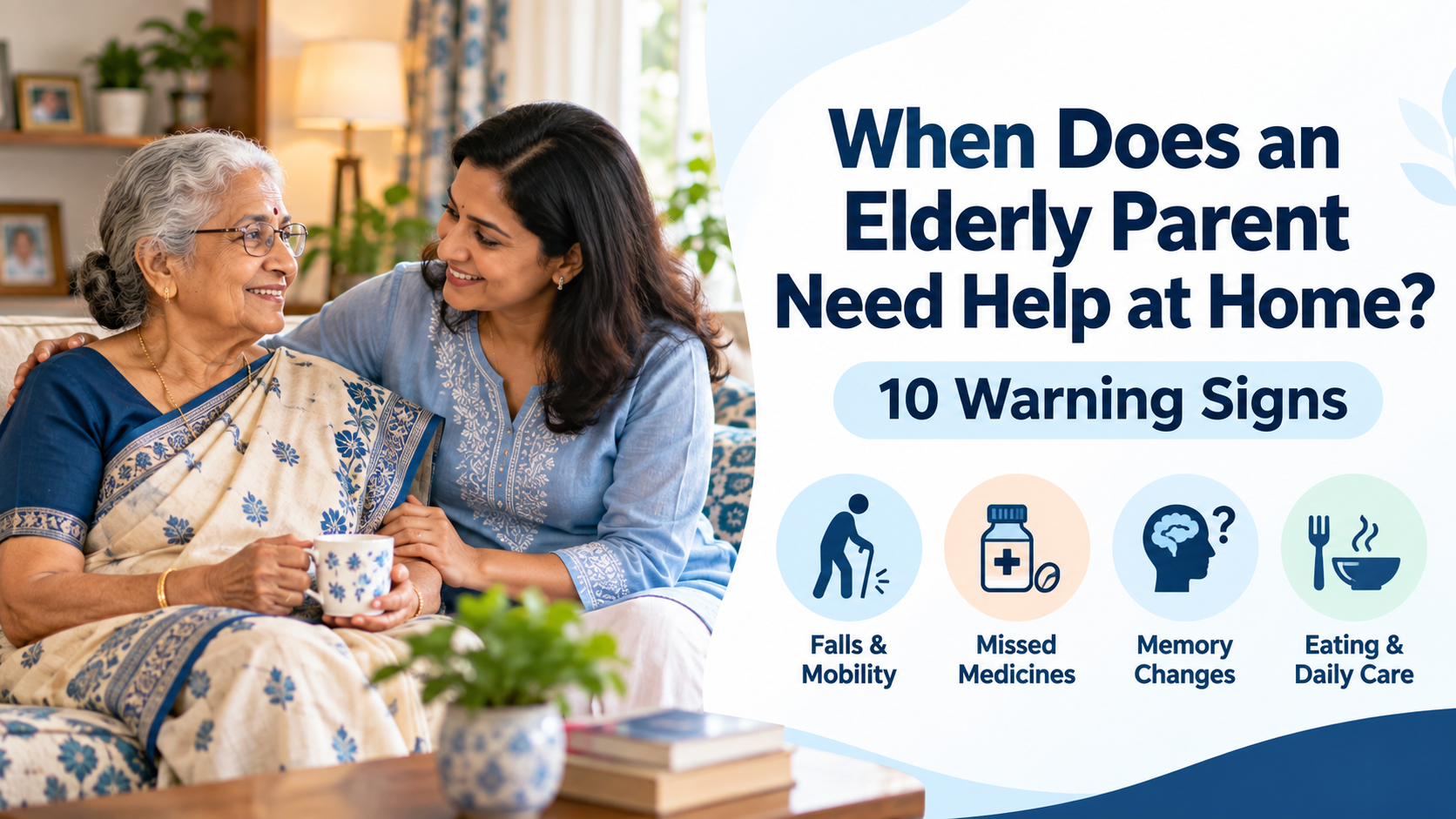
It is not always obvious when an ageing parent begins to need help at home. Changes often happen gradually: meals become simpler, medicines are occasionally forgotten, bathing becomes difficult or your parent starts avoiding stairs they previously used without trouble. The most useful question is not simply “Can my parent live alone?” It is “Can my parent safely manage the important parts of everyday life without regular assistance?”
1. Everyday activities are becoming difficult
Doctors often assess an older person's independence using Activities of Daily Living (ADLs) and Instrumental Activities of Daily Living (IADLs). Indian research shows that functional dependency becomes increasingly important with advancing age. A 2026 study published in the Indian Journal of Community Medicine found ADL dependency in 30.6% of elderly patients attending a tertiary-care outpatient clinic, with higher age associated with greater dependency.
| Daily activity | Warning signs | ||
| Bathing | Avoiding baths, difficulty entering the bathroom, needing physical support | ||
| Dressing | Difficulty putting on clothes or managing buttons/zips | ||
| Toileting | Trouble reaching or using the toilet safely | ||
| Eating | Difficulty feeding themselves or regularly skipping meals | ||
| Transfers | Struggling to get out of bed or rise from a chair | ||
| Walking | Holding furniture, becoming unsteady or requiring increasing support | ||
| Medicines | Forgotten doses, repeated doses or confusion about tablets | ||
| Cooking | Burnt food, forgotten gas/stove, inability to prepare meals safely | ||
| Shopping/finances | Difficulty buying essentials, paying bills or managing money |
2. They are falling or becoming increasingly unsteady
A fall should not automatically be dismissed as part of getting older. A community study of 511 adults aged 60 years or older in rural Kolar, Karnataka, published in the Journal of Family Medicine and Primary Care, found that 46.8% reported a fall during the previous year. Increasing age, chronic disease and use of walking aids were among the factors associated with falls. This was one regional study rather than a national estimate, but it highlights how important falls are in Indian elderly care. Repeated falls, near-falls, holding onto walls or furniture, fear of walking alone, or suddenly avoiding stairs should prompt assessment.
3. Medicines are being missed, doubled or mixed up
Many older Indians take medicines for several chronic conditions. Problems may start with something as simple as forgetting whether the morning tablet was taken. Indian literature has linked polypharmacy in older people with problems including poor adherence, adverse drug reactions and falls. Watch for unused strips accumulating, medicines running out unexpectedly, duplicate tablets from different doctors, or your parent being unable to explain which medicine is taken when.
4. They are losing weight or regularly skipping meals
Unintentional weight loss should not simply be accepted as normal ageing. In a Kerala community study published in the Journal of Family Medicine and Primary Care, 14.3% of the older adults studied were malnourished and another 44.1% were considered at risk of malnutrition. Difficulty chewing or swallowing, depression and greater dependency in daily activities were associated with malnutrition. Look for loose-fitting clothes, an increasingly empty refrigerator, unfinished meals, reduced appetite, difficulty chewing or swallowing, or increasing weakness.
5. Memory or judgement is interfering with daily life
Occasional forgetfulness is common. More concerning changes interfere with safe everyday functioning. Examples include repeatedly forgetting medicines, getting lost in familiar surroundings, leaving the gas stove on, becoming unable to manage money, repeatedly asking the same question or showing a noticeable decline in judgement. A change like this deserves medical assessment rather than automatically being labelled “old age.”
6. Personal hygiene or the home is noticeably deteriorating
- Wearing the same clothes repeatedly
- Strong body or urine odour
- Difficulty bathing
- Poor oral hygiene
- Unwashed clothes or bedding
- Increasing household clutter
- Spoiled food remaining in the refrigerator
- Toileting accidents that are not being managed
- Pressure injuries or skin problems in someone with limited mobility
7. They are becoming much less mobile
A parent who previously walked to the neighbourhood shop but now rarely leaves a chair deserves attention. Difficulty rising from a chair, slower walking, needing support to reach the bathroom, avoiding stairs or becoming largely bed-bound can result from pain, weakness, neurological disease, recent illness or deconditioning. Loss of mobility can quickly affect toileting, bathing, nutrition and independence, so early assessment can be valuable.
8. They are becoming isolated, withdrawn or unusually low
A parent may remain physically capable of living alone but gradually stop interacting with others. Watch for withdrawal from neighbours or family, loss of interest in usual activities, persistent low mood, major sleep changes or regularly going days without meaningful social interaction. These changes can coexist with physical illness, cognitive impairment or depression and should not automatically be considered an inevitable part of ageing.
9. Recovering from illness or hospitalisation has become difficult
Older adults may need temporary or longer-term support after conditions such as pneumonia, fractures, surgery, stroke or prolonged hospital admission. Someone who could previously bathe, walk and use the toilet independently may return home needing help with transfers, medication, feeding, mobility or personal care. The need for home support should therefore be reassessed after major illnesses and hospitalisations, even if your parent managed independently before.
10. The family can no longer provide the required care safely
Sometimes the warning sign is not a sudden deterioration in the parent—it is that the amount of care required has become greater than the family can safely provide. A parent may require assistance every time they use the bathroom, help several times through the night, supervision because of confusion, regular mobility support or trained assistance with nursing needs. Trying to provide complex care while simultaneously managing work, children and other responsibilities can make care inconsistent even in a very involved family. Needing additional support does not mean the family is stepping away from care. It can mean making the home-care arrangement safer and more sustainable.
How much help does your parent actually need?
| Situation | Type of support to consider | ||
| Independent but needs occasional help | Family support, home modifications and regular monitoring | ||
| Needs help with bathing, dressing, feeding or mobility | Regular trained caregiving support | ||
| Cannot safely remain alone for long periods | Extended daytime or 24-hour caregiving | ||
| Has tubes, injections or other nursing requirements | Appropriate trained nursing support | ||
| Suddenly becomes more confused or dependent | Medical assessment first | ||
| Recently discharged from hospital | Reassess mobility, medicines, nutrition and care needs |
When professional home care may be the better option
Professional home support becomes worth considering when your parent needs regular assistance rather than occasional help—particularly with bathing, toileting, feeding, mobility, medication routines, supervision or nursing care. It can also be useful when family members live elsewhere, work long hours, cannot safely lift or transfer the parent, or cannot reliably provide continuous supervision. The goal should be to provide the minimum level of assistance required to keep the person safe while preserving as much independence as possible.
How MITRA can help families in Bengaluru
MITRA provides home caregiving in Bengaluru for families who have reached the point where an elderly parent needs consistent, trained support at home. Depending on the person's needs, MITRA can provide 12-hour or 24-hour support, ranging from assistance with daily activities such as bathing, hygiene, feeding, mobility, companionship and medication reminders to higher levels of care delivered by appropriately trained nursing professionals. The aim is not to replace the family. It is to give the family a dependable care system while helping the older person remain in familiar surroundings at home.
When should a sudden change be treated as an emergency?
- Seek urgent medical attention for an older adult who develops:
- Sudden weakness of the face, arm or leg
- New difficulty speaking
- Sudden severe breathlessness
- Chest pressure or pain
- Loss of consciousness
- New seizure
- Sudden severe confusion
- Serious injury after a fall
- Severe bleeding
- Inability to wake normally
Read our practical guide to caring for an elderly parent at home
Know the warning signs of a heart attack
See how to choose a home care agency in Bengaluru
References
- Activities of Daily Living Dependency among Elderly Patients — Indian Journal of Community Medicine (2026) · source
- Ageing and Functional Disability: An Unbreakable Bond — Indian Journal of Community Medicine (2023) · source
- Prevalence of Fall and Associated Risk Factors among the Elderly Living in Rural Kolar — ournal of Family Medicine and Primary Care (2022) · source
- Malnutrition among Community-Dwelling Older Adults in South India — Journal of Family Medicine and Primary Care (2020) · source
- Issues and Challenges of Polypharmacy in the Elderly: A Review of Contemporary Indian Literature — Journal of Family Medicine and Primary Care (2021) · source
This article is for general health education and does not replace advice from your doctor. Please consult a qualified professional about your specific situation.
Need care at home in Bengaluru? See MITRA services.
Related articles
Elderly Care · 6 min read
How to Care for an Elderly Parent at Home: A Practical Family Guide
Caring for an elderly parent at home? Use this practical India-focused guide for medicines, nutrition, mobility, fall prevention, hygiene, health checks and knowing when extra help is needed.
Sat, 3 Oct 2026