Heart Attack Symptoms: Warning Signs and When to Get Emergency Help
Heart attack symptoms can include chest pressure or pain, shortness of breath, sweating, nausea, dizziness, and discomfort in the arms, back, neck or jaw. Learn the warning signs and when to seek emergency help.
Written by Dr Sanjay Kumar K A · Medically reviewed by Dr Sanjay Kumar K A, M D Anaesthesiology (Sat, 3 Oct 2026)
Published Sat, 3 Oct 2026 · Updated Sat, 3 Oct 2026 · 8 min read
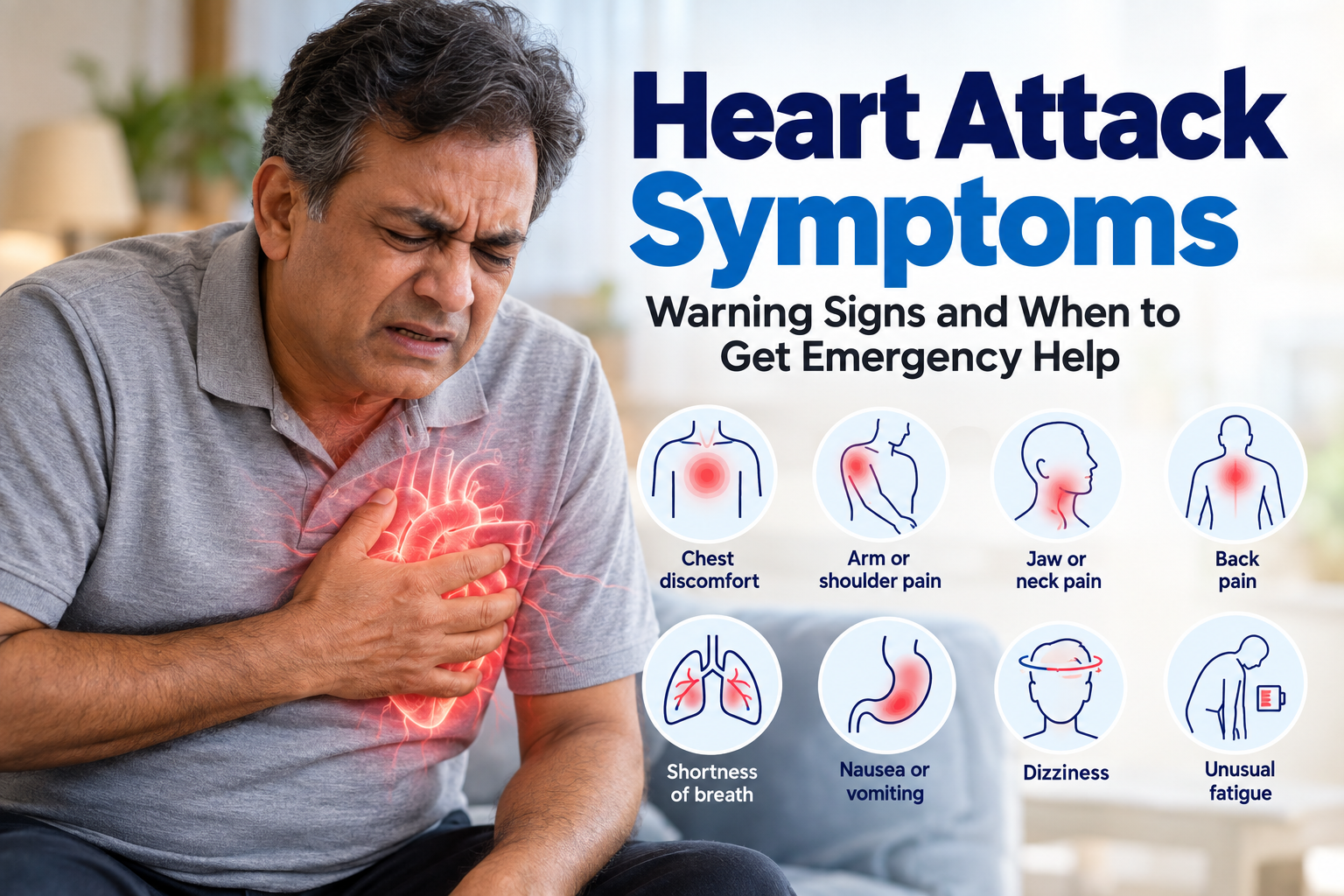
A heart attack, also called a myocardial infarction, happens when blood flow to part of the heart muscle is severely reduced or blocked. The symptoms are not always dramatic. Some heart attacks cause severe chest pain, while others begin gradually with mild pressure, breathlessness, nausea, unusual tiredness or discomfort elsewhere in the upper body. Recognising the warning signs and getting emergency medical care quickly can reduce heart damage and save lives.
What are the symptoms of a heart attack?
Heart attack symptoms vary from person to person. Chest discomfort is the most common symptom, but a heart attack can also cause symptoms elsewhere in the body. Symptoms may start suddenly or gradually, may be mild or severe, and may sometimes come and go.
| Symptom | What it may feel like | ||
| Chest discomfort | Pressure, squeezing, heaviness, tightness, fullness, burning or pain | ||
| Arm or shoulder discomfort | Pain or discomfort in one or both arms or shoulders | ||
| Jaw, neck or back discomfort | Aching, pressure or pain that may occur with or without chest pain | ||
| Shortness of breath | Difficulty breathing, with or without chest discomfort | ||
| Sweating | Sudden unexplained sweating or a cold sweat | ||
| Nausea or vomiting | Feeling sick, indigestion-like discomfort or vomiting | ||
| Lightheadedness | Dizziness, weakness or feeling faint | ||
| Unusual fatigue | New or unexplained tiredness or weakness | ||
| Upper abdominal discomfort | Pressure, burning or discomfort that may resemble indigestion |
What does heart attack chest pain feel like?
Heart attack discomfort is often felt in the centre or left side of the chest. People may describe it as pressure, squeezing, heaviness, tightness, fullness or pain rather than a sharp pain. It may persist for several minutes or disappear and return. However, the intensity of pain does not reliably tell you how serious the problem is: some heart attacks cause relatively mild discomfort.
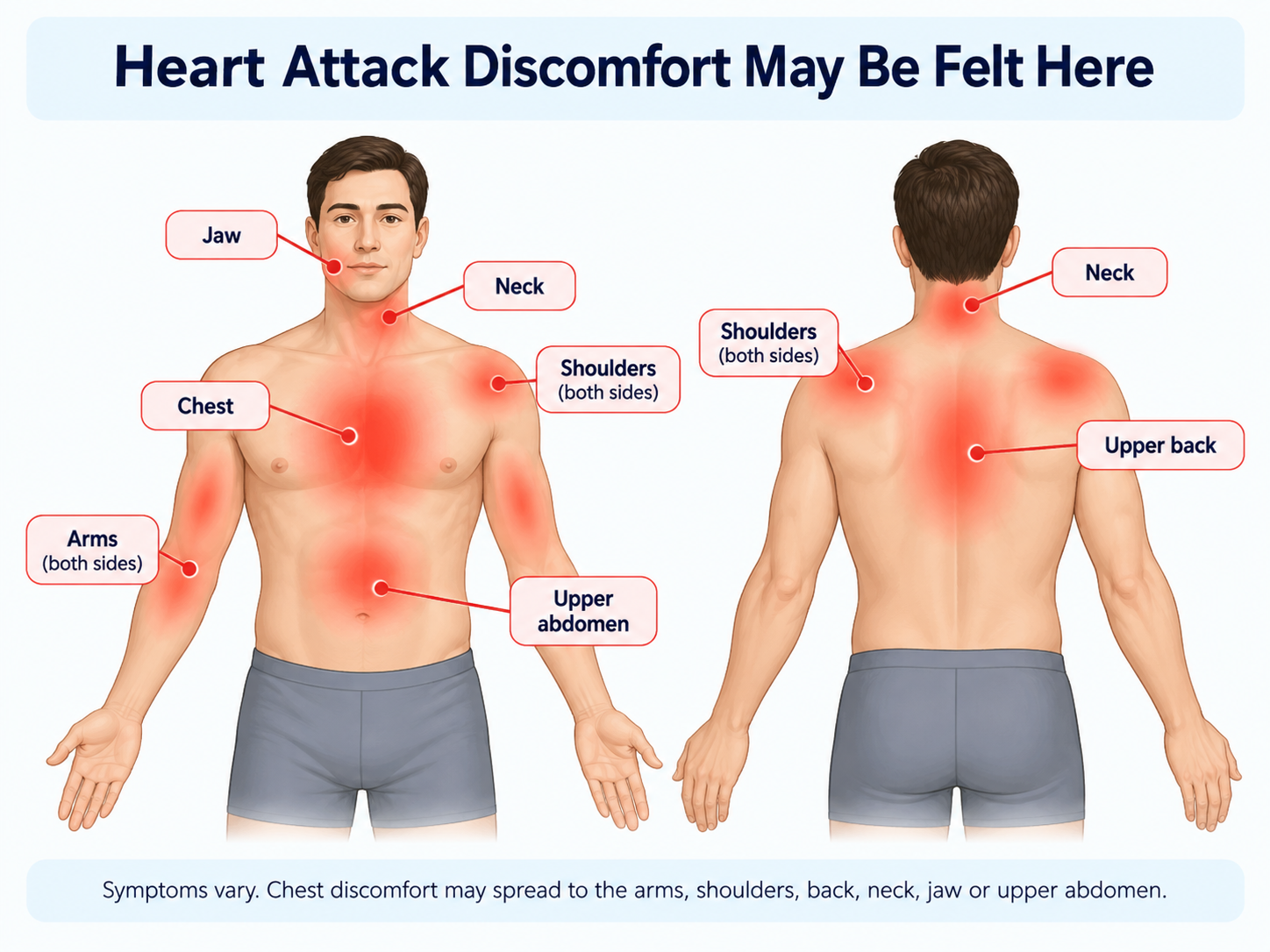
Where can heart attack pain spread?
- One arm or both arms
- Either shoulder
- The upper or lower chest
- The back
- The neck
- The jaw
- The upper abdomen or stomach area
- The symptoms do not have to occur on the left side of the body.
Can you have a heart attack without chest pain?
Yes. Although chest pain or discomfort is common, some people experience a heart attack with little or no chest pain. They may instead have shortness of breath, unusual tiredness, sweating, nausea, dizziness, back or jaw discomfort, or only vague symptoms. Some heart attacks cause very mild symptoms or no recognised symptoms at all; these are sometimes called silent heart attacks.
Heart attack symptoms in women
Women can experience the same classic symptoms as men, and chest pain or chest discomfort remains a common heart attack symptom in women. However, women may also experience symptoms that are easier to mistake for other illnesses, including unusual fatigue, shortness of breath, nausea or vomiting, upper-back pressure, shoulder or jaw discomfort and indigestion-like symptoms.Symptoms women should not ignore include:
- Chest pressure, squeezing, fullness or pain
- Shortness of breath
- Unusual or extreme tiredness
- Nausea or vomiting
- Back or shoulder discomfort
- Neck or jaw discomfort
- Lightheadedness
- Unexplained sweating
- Upper abdominal or indigestion-like discomfort
- Importantly, having symptoms that seem “atypical” does not make a heart attack less serious.
Heart attack symptoms in older adults and people with diabetes
Heart attacks with very mild or unnoticed symptoms are more common in older adults and in people with diabetes or high blood sugar. Breathlessness, fatigue, weakness, nausea or dizziness may sometimes be more noticeable than chest pain. This is one reason unexplained new symptoms should not be dismissed simply because severe chest pain is absent.
What should you do if you think someone is having a heart attack?
- Treat the symptoms as an emergency. Do not wait to see whether they become more severe.
- Call emergency medical services. In India, dial 112 for emergency assistance.
- Keep the person resting while help is being arranged.
- Use an ambulance when available rather than driving the person yourself. Emergency medical personnel can assess the patient and begin care during transport.
- If the person suddenly becomes unresponsive and is not breathing normally, treat it as cardiac arrest. Call for emergency help, begin CPR and use an AED if one is available.
- Emergency medical care is particularly important because the longer heart muscle remains without adequate blood flow, the greater the potential damage.
Heart attack vs cardiac arrest: what is the difference?
| Heart attack | Cardiac arrest | |||
| What happens? | Blood flow to part of the heart is severely reduced or blocked | The heart suddenly stops pumping effectively | ||
| Main problem | Circulation | Electrical/pumping failure | ||
| Person usually conscious? | Often yes | Usually no | ||
| Typical signs | Chest discomfort, breathlessness, sweating, nausea, arm/jaw/back discomfort | Sudden collapse, unresponsiveness, no normal breathing or only gasping | ||
| What to do | Call emergency medical services immediately | Call emergency services, start CPR and use an AED if available |
How do doctors know if it is a heart attack?
Symptoms alone cannot reliably confirm or exclude a heart attack. In hospital, doctors assess the symptoms, medical history and vital signs and perform investigations to determine whether the heart muscle is being damaged. Tests commonly used when a heart attack or acute coronary syndrome is suspected include:
- Electrocardiogram (ECG): records the electrical activity of the heart and may show changes caused by reduced blood flow.
- Cardiac troponin blood tests: detect proteins released when heart muscle is injured.
- Echocardiography: may assess heart function and areas of abnormal movement.
- Coronary angiography: may be used to identify blocked or severely narrowed coronary arteries.
- Other imaging such as cardiac CT or MRI may be appropriate in selected patients.
- Current ACS guidance uses ECG findings, cardiac biomarkers and other investigations together rather than relying on symptoms alone.
Can indigestion or acidity feel like a heart attack?
Yes. Heart attack discomfort can sometimes resemble acidity, indigestion, burning or upper-abdominal discomfort. The reverse is also true: many non-cardiac conditions can cause chest discomfort. Because it may be impossible to distinguish these safely based on symptoms alone, new, unexplained or concerning chest discomfort should not automatically be assumed to be “gas” or acidity, particularly when it occurs with breathlessness, sweating, nausea, dizziness or pain elsewhere in the upper body.
Frequently asked questions about heart attack symptoms
Does heart attack pain always occur on the left side?
No. Heart attack discomfort may occur in the centre or left side of the chest and may spread to either arm, both arms, the shoulders, back, neck, jaw or upper abdomen. Left-arm pain is only one possible presentation.
Can heart attack symptoms come and go?
Yes. Symptoms can sometimes disappear and return. A temporary improvement does not safely exclude a heart attack, so recurrent or suspicious symptoms still require urgent assessment.
Can a heart attack cause shortness of breath without chest pain?
Yes. Shortness of breath can occur with chest discomfort or independently of it. This is particularly important when the breathlessness is sudden, unexplained or accompanied by other symptoms such as sweating, nausea, dizziness or unusual weakness.
What is a silent heart attack?
A silent heart attack is one that causes no obvious symptoms or symptoms mild enough that the person does not recognise them as a heart attack. Symptoms may resemble fatigue, indigestion or mild back or jaw discomfort. Silent heart attacks can still damage the heart and should be taken seriously
Can young people have heart attacks?
Yes. Heart attacks are more common as cardiovascular risk increases with age, but younger adults can also experience acute coronary syndromes. Age alone should therefore not be used to dismiss convincing symptoms of a possible heart attack. Recent American Heart Association guidance specifically highlights that acute coronary syndromes in younger, premenopausal women can be under-recognised.
References
- 2025 ACC/AHA/ACEP/NAEMSP/SCAI Guideline for the Management of Patients With Acute Coronary Syndromes — American Heart Association / American College of Cardiology (2025) · source
- Key Patient Messages: 2025 Acute Coronary Syndromes Guideline — American Heart Association (2025) · source
- Heart Attack Symptoms — National Heart, Lung, and Blood Institute, NIH (2022) · source
- Heart Attack Symptoms in Women — American Heart Association (2024) · source
This article is for general health education and does not replace advice from your doctor. Please consult a qualified professional about your specific situation.
Need care at home in Bengaluru? See MITRA services.
Related articles
Heart Health · 5 min read
Blood Pressure Chart: Normal, High and Low BP Readings
Use this blood pressure chart to understand normal, elevated, high and low BP readings, what systolic and diastolic mean, and when to seek care.
Sat, 3 Oct 2026