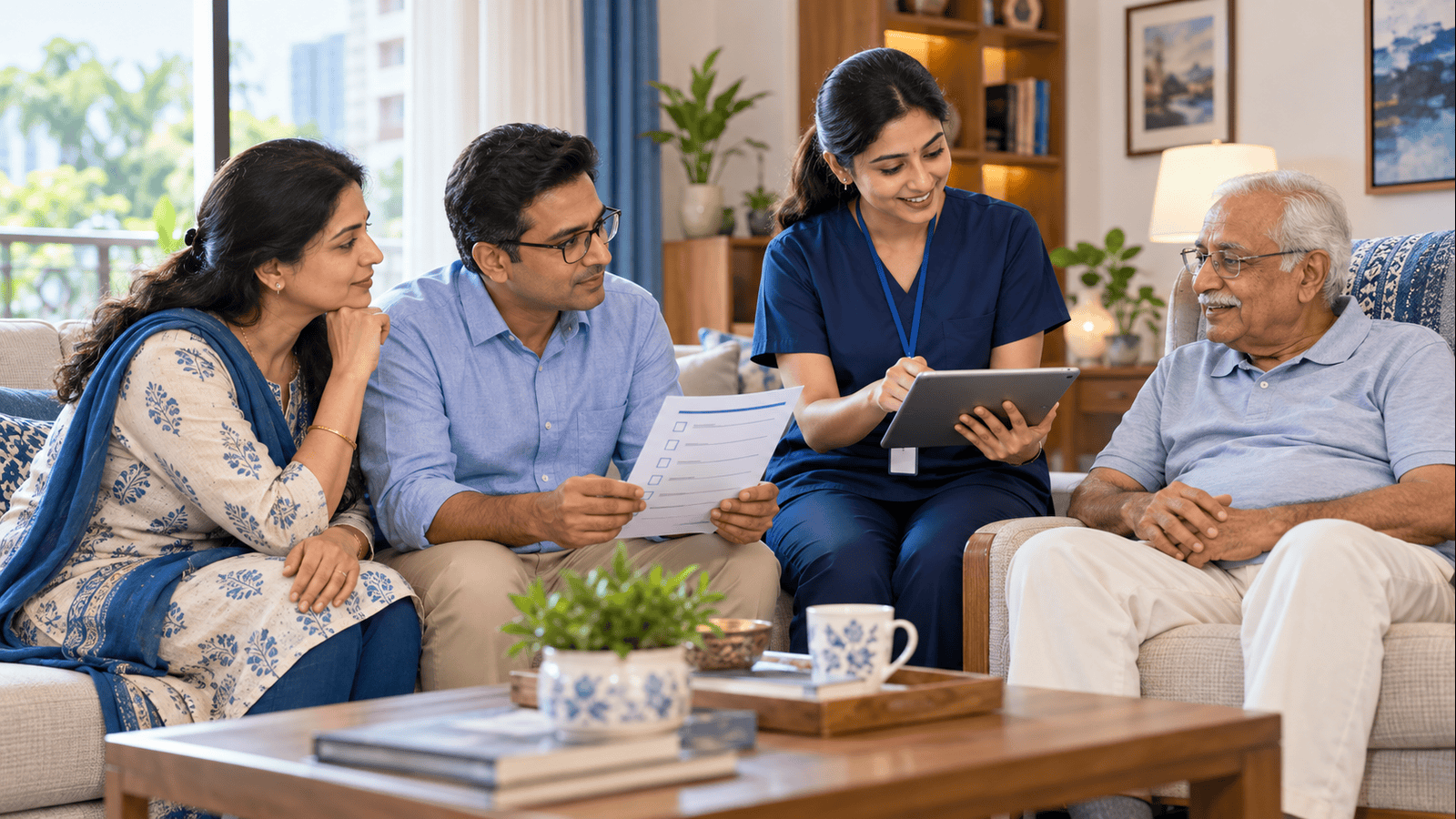
How MITRA Screens, Trains and Matches Home Care Providers
See how MITRA screens, trains and verifies home care providers, matches families with four suitable options, and continues supporting care after the caregiver joins.
Written by Dr. Sanjay Kumar K A
Published Sat, 10 Oct 2026 · 9 min read
Finding a caregiver is only the beginning of home care. Families also need to know whether the person has been screened, trained and verified, whether their skills match the patient's actual needs, and what happens if the placement does not work after care begins. MITRA was designed around this entire journey. Instead of simply connecting a family with an available caregiver, MITRA operates as a managed caregiving service — from provider screening and training to patient assessment, matching, ongoing monitoring, family support and replacements.
Step 1: Providers first undergo initial screening
Before someone can become part of the MITRA provider pool, the first step is a baseline screening process. MITRA reviews information relevant to whether the person is suitable to move into caregiver training, including their background, experience, qualifications and ability to work in home-care environments. Initial screening can consider:
- Identity and basic personal information
- Previous caregiving or nursing experience
- Educational background
- Languages spoken
- Previous patient-care experience
- Preferred work arrangement
- Availability
- Role suitability
- Nursing qualification or registration where applicable
Step 2: Providers undergo MITRA caregiving training
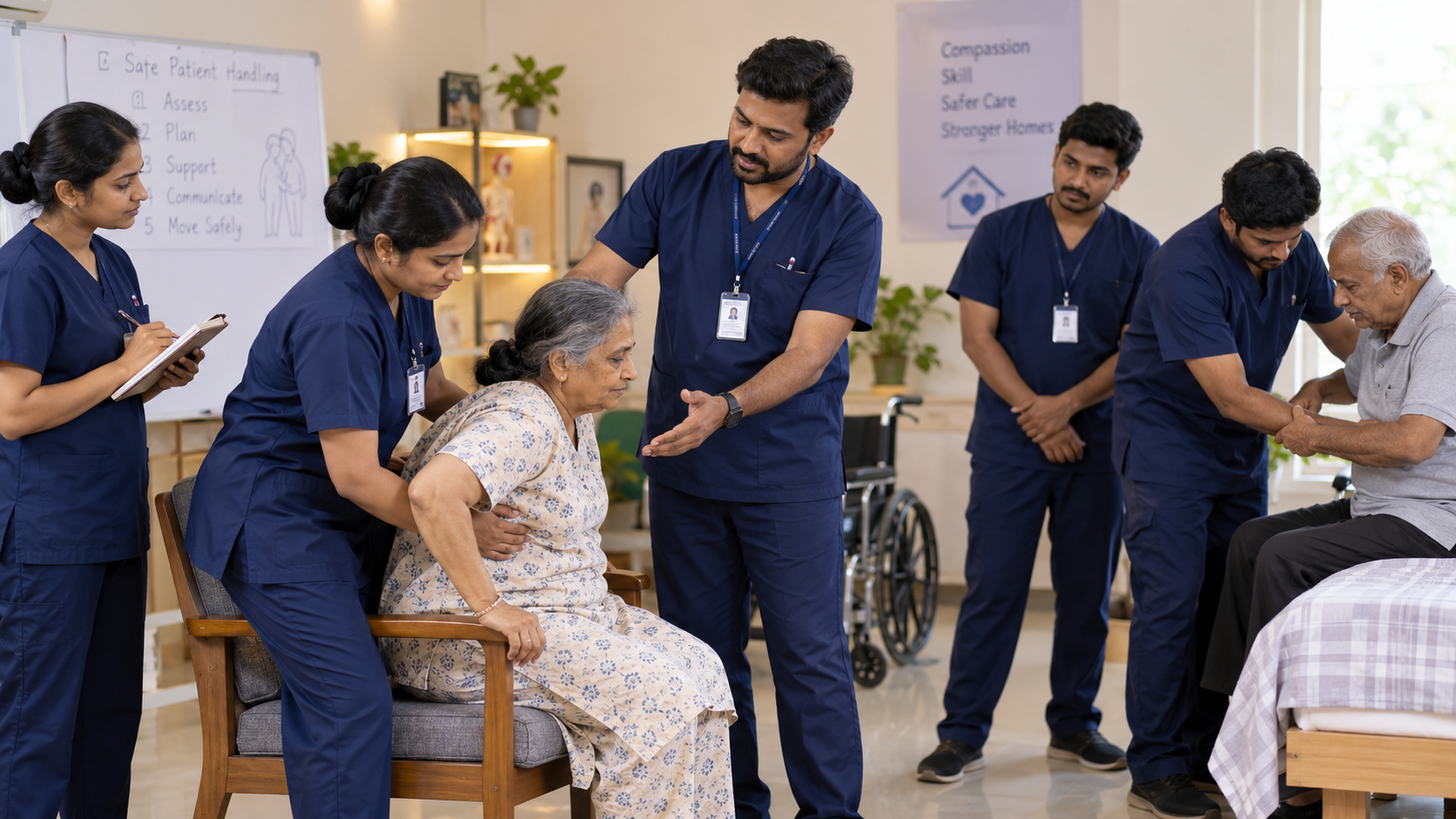
Providers who clear the initial screening move into MITRA's training programme. The objective is to create a consistent baseline for how care should be delivered in the home, rather than assuming that previous experience automatically means everyone has been taught the same methods. Training covers the practical situations caregivers are likely to encounter with elderly, dependent and recovering patients. Training includes:
- Personal hygiene and dignity
- Bathing and grooming
- Toileting and continence care
- Safe mobility and transfers
- Fall prevention
- Feeding and hydration support
- Basic observations and vital signs
- Skin and pressure-area care
- Dementia and behavioural support
- Stroke-related caregiving
- Medication reminders and medication boundaries
- Recognising warning signs
- Escalation when a patient's condition changes
- Care documentation
- Using MITRA's care-monitoring systems
- Understanding what a caregiver should not perform without the appropriate training or qualification
Step 3: Background verification happens before activation
After completing the required training, providers undergo formal background verification before becoming active members of the MITRA provider pool. MITRA uses an external verification agency for this process.Depending on the provider and role, verification can include:
- Identity verification
- Police/background verification
- Document verification
- Educational qualification verification
- Previous-employment verification where applicable
- Nursing credentials or registration where relevant
- Other checks applicable to the provider's role
Step 4: The provider enters MITRA's active pool
At this stage, MITRA has information about the provider that can be used for matching future patients. This can include: - Caregiving or nursing level- Relevant experience- Competencies- Primary language- English fluency- Gender- Age- Qualifications- Nursing registration where applicable- Availability- Previous care experience This allows MITRA to evaluate providers against the needs and preferences of an individual family when a new care requirement arrives.
Step 5: MITRA assesses the patient before matching anyone
When a family contacts MITRA, the first question is not simply: “Which caregiver is available?”MITRA first tries to understand what the patient actually requires.The assessment can consider:
- Bathing and personal-care requirements
- Toileting and continence
- Feeding and hydration
- Walking and mobility
- Transfers
- Fall risk
- Bed-bound care requirements
- Memory and behavioural concerns
- Medication support
- Monitoring requirements
- Nighttime needs
- Clinical or nursing requirements
- What assistance the family can provide
Step 6: The family's preferences are part of the match
Clinical and caregiving requirements are only part of a successful placement. The person may spend many hours every day with the caregiver, so practical compatibility matters too. MITRA therefore also asks about family preferences such as:
- Preferred caregiver gender
- Preferred language
- Age preference where relevant
- Required shift
- Particular patient-care experience
- Other practical requirements relevant to the home
Step 7: The family receives four matching provider options
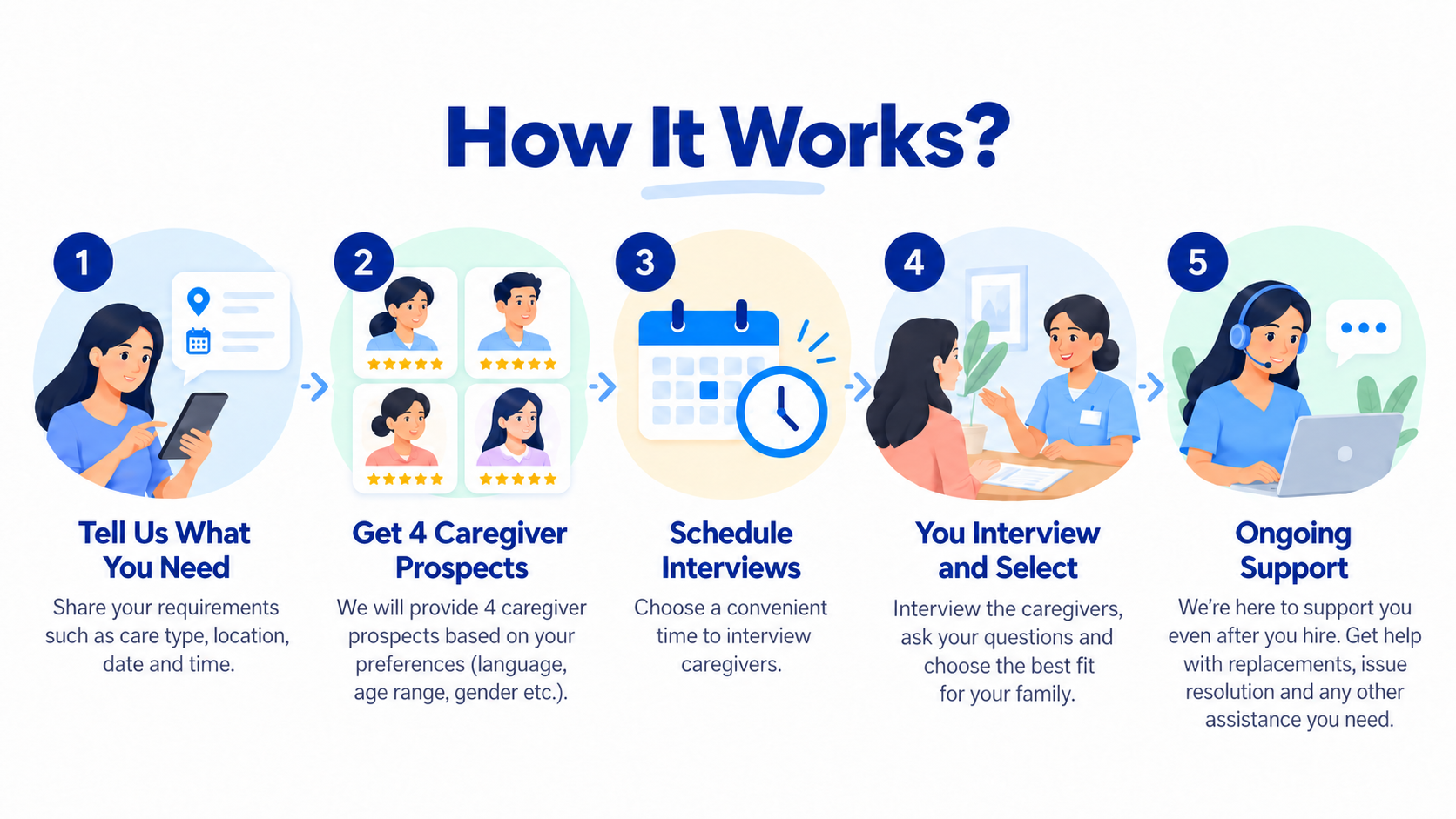
MITRA typically shares four suitable provider options with the family. These are not simply four available people. They are selected because their profile is considered suitable for the patient's care requirement and the family's stated preferences. The family then decides which provider they would like to explore further.
Step 8: The family can speak with and interview the caregivers
The final provider is not imposed on the family. Families can speak directly with the shortlisted caregivers, discuss the patient's routine and expectations, ask questions and determine which person they feel most comfortable proceeding with. The caregiver also gets an opportunity to understand the placement and confirm that they are comfortable with the requirements. The match proceeds when both the family and provider are comfortable with the arrangement.
Use these questions when evaluating a caregiver for your parent
Step 9: MITRA coordinates the placement and joining
Once the family chooses a provider and both sides agree to proceed, MITRA coordinates the placement and commencement of care. The caregiver starts with a clearer understanding of:- The patient's needs- Expected duties- Daily routine- Important care-plan instructions- Relevant medication routines- Monitoring requirements- Escalation instructions- Family expectations This reduces the need for the family to rebuild the entire care arrangement from scratch on the caregiver's first day.
The most important part: MITRA stays involved after joining
The caregiver joining the home is not the end of MITRA's role. MITRA is designed as a managed caregiving service, which means ongoing support continues throughout the care period. The family and caregiver continue to have a care system behind the placement rather than being left to manage everything independently.
| After the caregiver joins | MITRA's ongoing role | ||
| Daily care | CareTrack oversight | ||
| Clinical concerns | Escalation and medical guidance through the defined care pathway | ||
| Patient health | Ongoing clinical oversight appropriate to the care plan | ||
| Doctor follow-up | Scheduled doctor check-ins | ||
| Lab information | LabTrack oversight where applicable | ||
| Caregiver questions | Communication and support | ||
| Family concerns | Regular family communication | ||
| Change in condition | Reassessment of care requirement | ||
| Poor caregiver fit | Replacement coordination | ||
| Provider abandonment | Replacement support |
CareTrack helps MITRA follow what is happening at home
Home care becomes difficult to manage when important information exists only in verbal conversations. MITRA's CareTrack system is intended to create a structured record of relevant day-to-day care information. Depending on the patient's plan, this can include areas such as: - Food and fluid intake- Medication routine- Sleep- Bowel and bladder patterns- Mood and behaviour- Mobility- Basic observations- Care delivered- Relevant changes noticed by the provider This helps provide continuity between the caregiver, family and MITRA care team.
Doctor check-ins and clinical oversight continue during care
MITRA's managed-care model also includes ongoing clinical oversight appropriate to the patient's care plan, including scheduled doctor check-ins. When a caregiver notices a medical concern or is unsure about a change in the patient's condition, there is a defined pathway for communication and escalation rather than expecting the caregiver to independently make medical decisions. MITRA also remains in communication with the family so that important changes can be identified and acted upon.
The caregiver's role still has clear boundaries
Ongoing support does not mean asking a caregiver to perform every task that arises. If the patient's condition changes and new clinical procedures become necessary, MITRA reassesses whether the existing provider remains appropriate. A person who initially required assistance only with bathing, feeding and mobility may later develop a wound, catheter, feeding-tube requirement or another clinical need requiring a higher level of provider.
Understand when caregiving is enough and when nursing support is needed
What happens if the family is unhappy with the caregiver?
Even with careful screening and matching, not every caregiver-family relationship will be the right fit. There may be differences in communication, personality, routines or expectations. If a family is genuinely dissatisfied with the caregiver, MITRA allows up to two free dissatisfaction replacements under the current replacement policy. MITRA shares suitable alternative provider options, and the family can again speak with the shortlisted caregivers before selecting a replacement.
What if a caregiver suddenly abandons the placement?
Unexpected abandonment or “ghosting” can be particularly disruptive when an elderly or dependent person cannot safely remain without support. MITRA treats abandonment differently from an ordinary dissatisfaction replacement. If a provider abandons the placement, MITRA provides unlimited replacement support for abandonment situations under the current policy. The aim is to restore the care arrangement as quickly as reasonably possible without treating the provider's abandonment as the family's choice to change caregivers.
Why MITRA calls this managed caregiving
A traditional placement model can end once the family receives a caregiver's contact information. MITRA's model is intended to continue beyond that point. The managed service covers the broader care journey:
- Screen potential providers.
- Train eligible providers.
- Complete background verification.
- Maintain an active verified provider pool.
- Assess the patient's care requirements.
- Understand family preferences.
- Shortlist four matching providers.
- Allow the family to interview and choose.
- Coordinate joining and care planning.
- Continue CareTrack and applicable LabTrack oversight.
- Provide scheduled doctor check-ins and clinical escalation pathways.
- Stay in communication with the caregiver and family.
- Reassess care when requirements change.
- Coordinate replacements when required.
What families should expect from MITRA
See what families should compare when choosing a home-care provider
Looking for managed home caregiving in Bengaluru?
Need care at home in Bengaluru? See MITRA services.
Related articles
Home Care Guides · 8 min read
Night Care for Elderly Parents: When Overnight Support Is Needed
Does your elderly parent need help at night? Learn the warning signs, including falls, frequent toileting, dementia, confusion and mobility problems, and when overnight caregiving may help.
Sat, 10 Oct 2026
Home Care Guides · 8 min read
24-Hour Elderly Care at Home in Bengaluru: What Families Should Know
Considering 24-hour elderly care in Bengaluru? Learn who may need round-the-clock support, what a live-in caregiver does, night-care limits, costs and when nursing care is needed.
Fri, 9 Oct 2026
Home Care Guides · 9 min read
15 Questions to Ask Before Hiring a Caregiver in Bengaluru
Hiring a caregiver for an elderly parent? Ask these 15 questions about experience, mobility, dementia, daily care, medicines, night duties, leave and safety before care begins.
Fri, 9 Oct 2026