Caregiver vs Nurse at Home: Which Does Your Parent Need?
Caregiver or nurse at home? Compare what each can do, who needs which level of care, and how to choose the right home support for an elderly or recovering parent.
Written by Mr. Rahul B S
Published Tue, 6 Oct 2026 · Updated Thu, 8 Oct 2026 · 8 min read
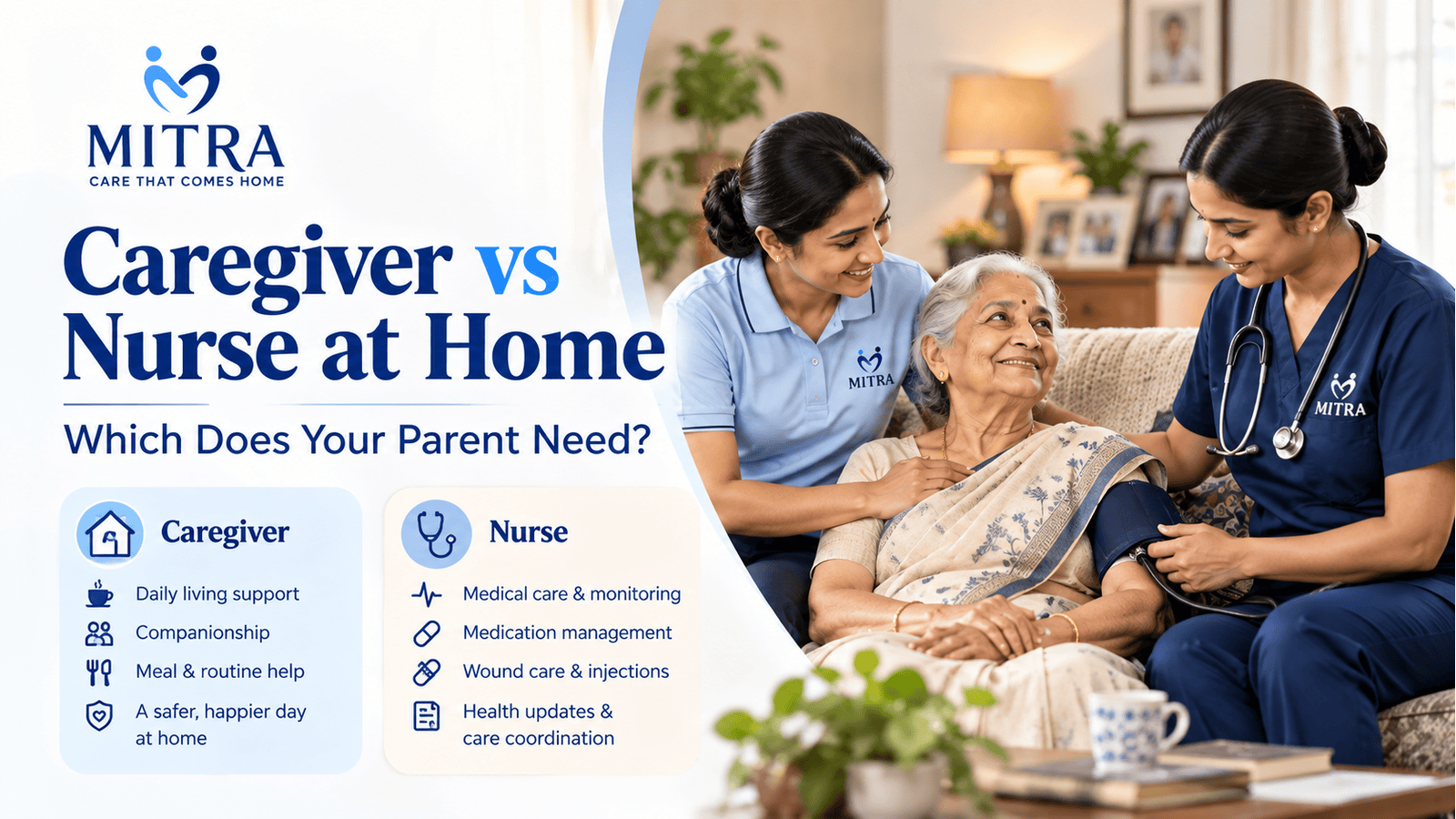
If your parent needs help at home, one of the most important decisions is whether they need a caregiver or a nurse. The difference is not simply qualification or price. A caregiver mainly supports everyday living, safety and independence, while a nurse is needed when care involves clinical procedures or nursing skills. Choosing the correct level matters. Hiring a nurse for someone who only needs help bathing and walking may be unnecessary, while expecting a basic caregiver to manage injections, tubes or complex wounds may be unsafe.
Caregiver vs nurse: the difference at a glance
| Need | Caregiver | Nurse | ||
| Bathing and hygiene | ✓ | ✓ | ||
| Toileting/incontinence assistance | ✓ | ✓ | ||
| Feeding assistance | ✓ | ✓ | ||
| Walking and transfers | ✓ | ✓ | ||
| Companionship | ✓ | ✓ | ||
| Medication reminders | ✓ | ✓ | ||
| Routine observation | ✓ | ✓ | ||
| Basic monitoring when part of the care plan | ✓ | ✓ | ||
| Injections | ✓ | |||
| Catheter insertion/change | ✓ | |||
| Feeding-tube procedures | ✓ | |||
| Complex wound dressing | ✓ | |||
| Suctioning | ✓ | |||
| Tracheostomy care | ✓ | |||
| Other skilled nursing procedures | ✓ when appropriate |
What does a home caregiver do?
A home caregiver helps a person manage the activities that have become difficult because of age, weakness, disability, dementia, illness or recovery after hospitalisation. The focus is primarily on daily living and maintaining function, rather than performing medical procedures. WHO's approach to integrated care for older people similarly focuses on maintaining functional ability and identifying support needs across mobility, cognition, nutrition and everyday life.
- Bathing and personal hygiene
- Dressing and grooming
- Toileting and incontinence care
- Feeding and encouraging fluids
- Getting in and out of bed
- Walking and wheelchair support
- Repositioning a person who has limited mobility
- Medication reminders
- Following the person's daily routine
- Companionship and conversation
- Basic observations and monitoring included in the care plan
- Noticing changes and escalating concerns to the family or clinical team
Who usually benefits from a caregiver?
- A caregiver may be the appropriate choice for someone who:
- Is elderly and needs help with everyday activities
- Has difficulty bathing or dressing independently
- Needs assistance reaching or using the toilet
- Has become weak after hospitalisation
- Needs support while walking
- Is at increased risk of falls
- Needs regular supervision because of memory problems
- Requires help eating or drinking
- Cannot safely remain alone for long periods
- Needs companionship and a structured daily routine
What does a nurse at home do?
A nurse becomes more important when the person's needs move beyond routine assistance into clinical care. Depending on the nurse's qualifications, competency, prescription and care plan, this can include procedures such as injections, catheter care, feeding-tube care, wound management, suctioning or tracheostomy care. Home nursing does not mean turning the house into a hospital. It means bringing appropriately skilled nursing care into the home when the patient's condition can safely be managed there. India's National Programme for Health Care of the Elderly recognises home-based care as part of the wider continuum of geriatric healthcare.
Signs that your parent may need a nurse rather than a caregiver
- Prescribed injections
- Insulin administration when the patient cannot manage it independently
- Foley catheter insertion, replacement or skilled catheter management
- Ryle's/NG feeding-tube procedures
- PEG-related nursing care
- Complex wound dressings
- Suctioning
- Tracheostomy care
- New clinical procedures following hospital discharge
- Nursing assessment or closer clinical observation
Does a bedridden parent need a nurse?
Not necessarily. Being bedridden often creates a high caregiving workload: bathing in bed, changing diapers, feeding, repositioning, skin care and assistance with transfers. Those needs alone do not automatically require a registered nurse. A nurse becomes necessary when the person's care also involves clinical procedures or nursing needs such as complex wounds, tubes, injections, suctioning or other skilled interventions.
What about a parent with dementia?
Dementia alone does not automatically require nursing care. Many people with dementia mainly need supervision, routine, assistance with meals and hygiene, mobility support, medication reminders and companionship — all of which may be appropriately provided through caregiving. The level of support should increase if dementia begins affecting safety, such as wandering, falls, inability to toilet independently or repeated attempts to leave the home. If a person with dementia also has clinical nursing requirements, both needs must be addressed. WHO recommends assessing cognition alongside mobility, nutrition, functional ability and social-support needs rather than planning care around a diagnosis alone.
What about stroke recovery at home?
Stroke recovery is a good example of why the distinction matters. A recovering patient may need a caregiver for: - Bathing - Toileting - Feeding - Transfers - Walking support - Positioning - Following physiotherapy exercises prescribed by the rehabilitation team But if the same patient has a feeding tube, catheter, complex wound, tracheostomy or another clinical requirement, nursing support may also be needed. One person can therefore need caregiving, nursing and physiotherapy at the same time.
What about after hospital discharge?
Care requirements should be reassessed whenever an older adult returns home after a major illness, surgery, fracture, stroke or prolonged hospitalisation. Ask two separate questions: 1. What everyday activities can they no longer perform safely? This determines the caregiving requirement. 2. What medical or nursing procedures now need to be performed at home? This determines the nursing requirement. A personalised care plan is preferable to choosing a provider purely from the diagnosis written on the discharge summary. WHO's current ICOPE guidance similarly recommends assessment followed by an individualised care plan based on the older person's actual functional and support needs.
Caregiver vs nurse: common examples
| Situation | More likely to need | ||
| Needs help bathing and dressing | Caregiver | ||
| Needs someone present while family is at work | Caregiver | ||
| Needs help walking to the toilet | Caregiver | ||
| Needs feeding assistance | Caregiver | ||
| Dementia with supervision needs | Caregiver | ||
| Bedridden but medically stable | Caregiver, depending on care plan | ||
| Needs prescribed injections | Nurse | ||
| New Foley catheter insertion/change | Nurse | ||
| Complex wound dressing | Nurse | ||
| Feeding-tube procedure/care | Nurse | ||
| Tracheostomy care or suctioning | Nurse | ||
| Stroke with ADL dependency plus feeding tube | Caregiver + nursing support may both be required |
Can a caregiver replace a nurse if they have experience?
Experience is valuable, but it should not be used as a substitute for appropriate training and competency. Someone may have cared for many elderly patients and still not be the correct person to perform a clinical procedure. At MITRA, the care plan is matched to the level of care required and the provider's demonstrated competency, rather than assuming that every caregiver or every nurse can perform every task.
Can a nurse also provide basic caregiving?
Yes. A nurse can generally assist with everyday care as part of a broader nursing plan. The more important question is whether paying for nursing-level care is necessary when the person's actual needs consist entirely of bathing, mobility, feeding, toileting and companionship. The objective should be to provide the appropriate level of skill, not simply the highest qualification available.
Hours and skill level are two different decisions
| Question | What you are deciding | ||
| 12 hours or 24 hours? | How long support needs to be present | ||
| Caregiver or nurse? | What skills the provider needs | ||
| Basic or advanced support? | How complex the person's daily and clinical needs are |
For example, someone may need: 12-hour caregiver — daytime assistance only. 24-hour caregiver — continuous presence because they cannot safely remain alone. 12-hour nurse — skilled clinical care during one shift. 24-hour nursing support — when appropriately indicated for more complex needs. The correct combination depends on the person's condition rather than choosing one package for every family.
Not sure how many hours of care you need? Compare 12-hour and 24-hour caregiving.
How MITRA decides what level of home care you need
At MITRA, the decision is based on the person's actual care requirements, not simply their age or diagnosis. The care team looks at areas such as: - Personal hygiene and toileting - Mobility and transfers - Feeding and hydration - Cognitive and behavioural concerns - Medication support - Basic monitoring - Tubes, catheters or wounds - Injections or other procedures - Overnight requirements - What family members can realistically manage The person can then be matched to an appropriate level of trained caregiving or nursing support. If their condition or needs change after care begins, the level of support should be reassessed.
When home care may not be enough
Some patients are too medically unstable for routine home caregiving or nursing to be the safest setting. Severe breathing difficulty, shock, suspected heart attack or stroke, loss of consciousness, rapidly worsening illness or other emergencies require urgent medical assessment, not simply a higher level of home care. In an emergency in India, call 112.
How to choose a home care agency in Bengaluru
Need care at home in Bengaluru? See MITRA services.
Related articles
Home Care Guides · 9 min read
How MITRA Screens, Trains and Matches Home Care Providers
See how MITRA screens, trains and verifies home care providers, matches families with four suitable options, and continues supporting care after the caregiver joins.
Sat, 10 Oct 2026
Home Care Guides · 8 min read
Night Care for Elderly Parents: When Overnight Support Is Needed
Does your elderly parent need help at night? Learn the warning signs, including falls, frequent toileting, dementia, confusion and mobility problems, and when overnight caregiving may help.
Sat, 10 Oct 2026
Home Care Guides · 8 min read
24-Hour Elderly Care at Home in Bengaluru: What Families Should Know
Considering 24-hour elderly care in Bengaluru? Learn who may need round-the-clock support, what a live-in caregiver does, night-care limits, costs and when nursing care is needed.
Fri, 9 Oct 2026