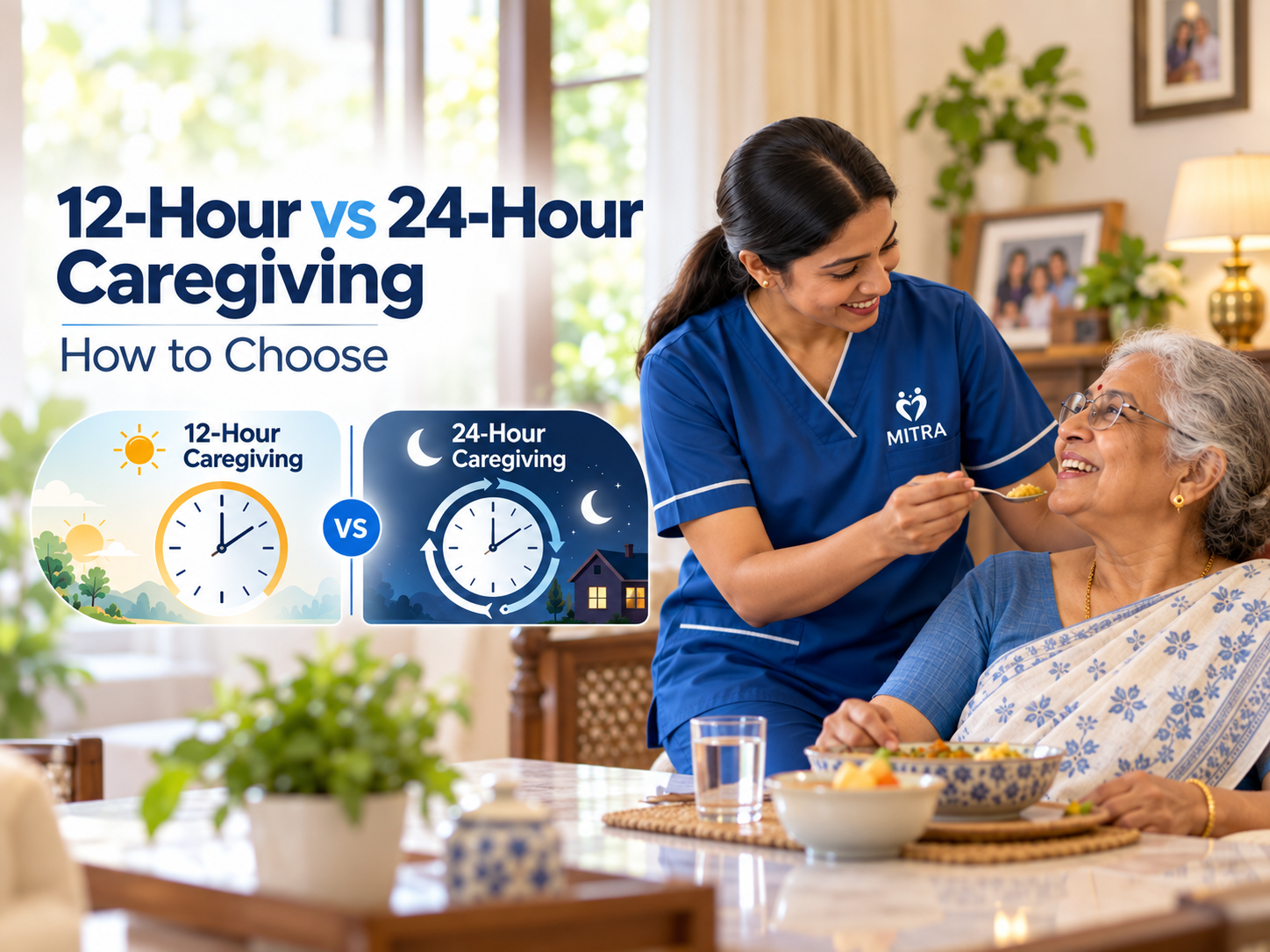
12-Hour vs 24-Hour Caregiving: How to Choose
Should you choose 12-hour or 24-hour caregiving at home? Compare both options, understand who each is suited for, and learn how to choose the right level of support for your family.
Written by Mr. Rahul B S
Published Mon, 5 Oct 2026 · 8 min read
When an ageing parent or recovering family member begins needing regular help at home, one of the first decisions is how many hours of caregiving they actually need. For some people, a caregiver during the active part of the day is enough. Others need someone available throughout the day and night because they cannot safely remain alone. Choosing between 12-hour and 24-hour caregiving should therefore be based on the person's daily activities, mobility, safety, cognition, medical needs and what support the family can reliably provide when the caregiver is not present.
12-hour vs 24-hour caregiving at a glance
| 12-hour caregiving | 24-hour caregiving | |||
| Best suited for | Regular daytime or nighttime support | People who should not be left alone | ||
| Caregiver presence | One defined 12-hour shift | Caregiver stays in the home | ||
| Personal care | Yes | Yes | ||
| Feeding assistance | Yes | Yes | ||
| Mobility support | Yes | Yes | ||
| Medication reminders | Yes | Yes | ||
| Companionship | During the shift | Throughout the day | ||
| Night availability | Only if the chosen shift covers night | Available in the home, with required sleep/rest | ||
| Family involvement | Usually needed outside the shift | Less continuous family supervision required | ||
| Good for frequent overnight care? | Two alternating shifts may be more appropriate | A single live-in caregiver may not be appropriate if repeatedly awakened |
What does 12-hour caregiving mean?
A 12-hour caregiver supports the person for one continuous shift. At MITRA, the current daytime 12-hour option runs from 8 AM to 8 PM. During this period, support can include personal hygiene, toileting, meals and fluids, mobility, medication reminders, basic monitoring, companionship and the activities defined in the person's care plan. The key question is what happens during the other 12 hours. If a family member is available and the person usually sleeps safely through the night, daytime support may be sufficient.
Who is 12-hour caregiving best for?
- Needs help with bathing, dressing or toileting during the day
- Requires assistance with meals and hydration
- Needs help walking or transferring
- Benefits from companionship and supervision during waking hours
- Needs medication reminders
- Cannot safely stay alone during the day
- Has family available during the remaining hours
- Generally sleeps through the night without frequent assistance
- Is recovering from illness or hospitalisation but does not require round-the-clock support
When might 12 hours not be enough?
Twelve hours may be insufficient when the person remains dependent after the caregiver leaves. For example, an elderly parent may need excellent daytime care but still require help getting to the toilet at midnight, repositioning in bed, managing confusion, or safely getting out of bed during the night. In that situation, the decision should be based on the full 24-hour routine, not just how demanding the daytime appears.
What does 24-hour caregiving mean?
With 24-hour caregiving, the caregiver stays in the home so support is available across the person's day and night routine. This can be useful for people who require assistance throughout the day, cannot safely remain alone, or whose family cannot reliably provide the remaining hours of care. However, 24-hour presence does not mean one caregiver can work continuously for 24 hours without sleeping. A live-in caregiver requires adequate rest to remain alert and provide safe care. MITRA specifically advises that if the person needs attention repeatedly throughout the night, two caregivers working separate 12-hour shifts may be safer than repeatedly waking one 24-hour caregiver.
If your loved one needs frequent toileting, suctioning, repositioning, behavioural supervision or repeated assistance throughout the night, tell the care team during assessment so the staffing arrangement can be planned safely.
Who should consider 24-hour caregiving?
- Cannot safely remain alone
- Needs substantial assistance with most daily activities
- Has significant mobility limitations
- Requires help transferring between bed, chair and toilet
- Has dementia or confusion that creates safety concerns
- Is at high risk of falls when unsupervised
- Needs regular continence or toileting assistance
- Is largely bed-bound
- Has recently returned home after a major illness or hospital stay
- Has family members who cannot provide reliable overnight or daytime coverage
Five questions that usually make the decision clearer
1. Can they safely be alone?
If the answer is no, a 12-hour plan leaves an important gap unless family can reliably cover the remaining hours.
2. Do they need help during the night?
Occasional help is different from needing assistance repeatedly every night.
Can they use the toilet independently?
Nighttime toileting is a common reason families discover that daytime-only care is not enough.
Can they get out of bed or a chair safely?
Someone who requires physical assistance for transfers may need another responsible person present whenever the caregiver is off duty.
Who provides care during the other hours?
Do not choose 12-hour care assuming that “someone in the family will manage” unless that arrangement is realistic every day.
The level of care matters as much as the number of hours
A person can need 24-hour assistance without needing a nurse, while another person may need a trained nursing professional for a shorter period because their care involves clinical procedures. The number of hours answers: “How long does someone need to be present?” The level of care answers: “What does that person need to be trained to do?” These are different decisions.
| Need | General caregiving may be suitable | Nursing assessment/support may be required | ||
| Bathing and grooming | ✓ | |||
| Feeding assistance | ✓ | |||
| Toileting/incontinence care | ✓ | |||
| Walking and transfers | ✓ | |||
| Companionship | ✓ | |||
| Medication reminders | ✓ | |||
| Injections | ✓ | |||
| New catheter or feeding-tube needs | ✓ | |||
| Complex wound dressing | ✓ | |||
| Tracheostomy care | ✓ | |||
| Suctioning | ✓ |
Do not choose longer hours when what you actually need is higher-skilled care
If your family member develops new clinical needs, simply increasing a basic caregiver from 12 hours to 24 hours may not solve the problem. For example, injections, catheter-related needs, complex wounds, feeding tubes or tracheostomy care may require an appropriately trained nursing professional. The care plan should therefore be reassessed whenever the person's condition changes.
What about dementia?
Dementia does not automatically mean someone requires 24-hour caregiving. The more useful question is whether cognitive impairment affects safety and daily functioning. A person with mild memory problems who remains independent may need relatively little assistance. Someone who wanders, repeatedly attempts unsafe transfers, forgets to eat or take medicines, leaves appliances on, or becomes confused at night may require substantially more supervision. WHO's current Integrated Care for Older People approach recommends assessing cognition, mobility, nutrition and social-support needs together when developing an individualised care plan for an older person.
What about someone who is bedridden?
A bed-bound person commonly needs assistance with several activities including hygiene, feeding, continence care, skin care, positioning and transfers. Whether this requires 12-hour or 24-hour support depends on what happens outside the caregiver's shift. If the person cannot reposition, toilet or call for help safely at night and no trained family member is available, a longer care arrangement may be necessary. Functional dependency is common among older adults needing healthcare. A 2026 Indian study of elderly patients attending a tertiary-care outpatient clinic found some degree of dependency in activities of daily living in 30.6% of participants, with dependency increasing with age. This was a hospital-based study rather than a national prevalence estimate.
12-hour or 24-hour care after hospital discharge?
Care needs can change substantially after surgery, stroke, fracture, severe infection or a prolonged hospital stay. A person who was independent before admission may initially require help with walking, toileting, bathing, meals and medication after returning home. This does not necessarily mean they will need the same level of care permanently. The initial plan can be reassessed as strength and independence improve.
How MITRA helps you choose
Families do not always know in advance whether they need 12-hour care, 24-hour care or a higher level of nursing support — and they should not have to make that decision based only on a service catalogue. MITRA assesses the person's day-to-day requirements and develops a care plan around factors such as mobility, personal care, feeding, continence, cognition, medication support, monitoring and nursing needs. The aim is to match the person to the right amount and level of support, rather than automatically recommending the largest package. MITRA currently provides both 12-hour and 24-hour home caregiving options in Bengaluru, with different levels of support depending on the person's needs.
A simple way to decide
Read our guide to caring for an elderly parent at home
Still unsure whether your family needs 12-hour or 24-hour care?
Need care at home in Bengaluru? See MITRA services.
Related articles
Home Care Guides · 19 min read
Personalised Home Care Plans: How MITRA Decides What Care a Patient Actually Needs
A home care plan should be based on what a person actually needs help with — not simply their age or diagnosis. See how MITRA assesses daily activities, mobility, nursing requirements, night needs, family support and preferences before structuring personalised home care.
Fri, 6 Nov 2026
Home Care Guides · 15 min read
Doctor-Guided Home Care at MITRA: What Doctor Check-Ins Actually Include
MITRA caregiving plans include doctor check-ins as part of ongoing home care. See what the doctor reviews, how CareTrack and LabTrack support the review, when the care plan may change, and what doctor oversight does not replace.
Thu, 5 Nov 2026
Home Care Guides · 12 min read
MITRA CareTrack Explained: How Families Receive Daily Care Updates
CareTrack is MITRA's structured daily care record for home caregiving. See what caregivers document, how families can follow day-to-day care, how vitals and concerns are tracked, and how CareTrack supports doctor reviews, escalation and continuity when caregivers change.
Wed, 4 Nov 2026