Personalised Home Care Plans: How MITRA Decides What Care a Patient Actually Needs
A home care plan should be based on what a person actually needs help with — not simply their age or diagnosis. See how MITRA assesses daily activities, mobility, nursing requirements, night needs, family support and preferences before structuring personalised home care.
Written by Mr. Rahul B S
Published Fri, 6 Nov 2026 · 19 min read

Two people can have the same diagnosis and need completely different care at home. One person recovering from a stroke may walk with assistance, eat normally and mainly need help bathing and dressing. Another person with the same diagnosis may be largely bed-bound, require tube feeding, catheter care and regular nursing procedures. That is why MITRA does not determine home care simply from a patient's age or diagnosis. The first question is: “What does this person actually need help with at home?”
What is a personalised home care plan?
A personalised home care plan is a structured description of the support a particular person requires at home. It can define areas such as:- Personal hygiene assistance- Toileting- Feeding and hydration- Mobility and transfers- Positioning- Medication-related support within the provider's scope- Monitoring requirements- Nighttime requirements- Nursing procedures- Safety considerations- Relevant routines- What changes should be reported- What the family will continue to manageThe purpose is to give the caregiver or nurse a clearer understanding of what care is actually expected for that individual. MITRA's current caregiving services state that the patient's condition, routine and support requirements are understood before care begins and that an individualised care plan is then structured around those needs.
Why isn't the diagnosis enough?
A diagnosis tells you what medical condition someone has. It does not automatically tell you how dependent that person is at home. Consider three people with Parkinson's disease. Person A may walk independently, eat without assistance and only need supervision during bathing. Person B may need assistance with transfers, toileting, meals and medication reminders. Person C may have advanced mobility limitations, swallowing problems and clinical requirements that need nursing involvement. The diagnosis is the same. The home-care requirement is not.
What does MITRA assess before deciding the care plan?
MITRA's assessment can consider several parts of the patient's everyday life and current care requirements, including:- Bathing and grooming- Dressing- Toileting and continence- Eating and drinking- Walking- Transfers- Bed mobility- Fall risk- Repositioning- Memory and behaviour- Medication support- Vital-sign monitoring- Nighttime assistance- Existing tubes, catheters or devices- Wound-care requirements- Other nursing procedures- What assistance the family can provideMITRA's current provider-matching process uses these types of requirements before selecting suitable caregiver profiles.
Step 1: What can the person do independently?
A good care plan should not focus only on limitations. It should also identify what the person can continue doing independently. For example, someone may be able to:- Eat independently- Walk short distances using a walker- Use the toilet with minimal assistance- Brush their teeth- Choose their clothes- Take part in conversations- Manage some parts of their daily routineThe caregiver should support areas where help is needed without unnecessarily taking over activities the person can still perform. This approach is consistent with person-centred home-care guidance, which emphasises maintaining independence rather than defining care only by what someone cannot do.
Step 2: How much help is needed with personal care?
Personal-care requirements can vary widely. MITRA may need to understand whether the person requires assistance with:- Bathing- Grooming- Dressing- Oral hygiene- Toileting- Continence care- Changing clothes- General personal hygieneThe level of help matters. There is a difference between someone who needs a caregiver nearby for safety and someone who requires substantial physical assistance throughout the activity.
Step 3: How mobile is the patient?
Mobility is one of the most important parts of a home-care assessment. Questions can include:- Can the person walk independently?- Do they use a walker or walking stick?- Do they require one-person assistance?- Do they require substantial assistance?- Can they get out of bed?- Can they transfer between the bed and chair?- Can they safely use the bathroom?- Are they largely bed-bound?- Have they had recent falls?The answer affects both the daily care plan and the type of caregiver who may be suitable.
Why transfers deserve separate attention
A patient saying they can “walk a little” does not necessarily mean they can safely:- Stand from bed- Move to a wheelchair- Sit on the toilet- Get into the shower- Return to bedTransfers are often where significant physical assistance is required. Understanding these movements before the caregiver joins can help MITRA match the patient with someone whose experience fits the actual requirement.
Step 4: What help is needed with food and fluids?
The assessment should distinguish between different types of feeding support. For example, a person may need:- Meals placed in front of them- Food cut into smaller portions- Encouragement to eat- Direct feeding assistance- Fluid reminders- Monitoring of food or fluid intakeThese are different from clinical feeding requirements, such as feeding through a Ryle's tube or PEG tube. Those procedures require the appropriate nursing-care level.
Step 5: What are the toileting and continence needs?
Toileting needs can strongly influence how much assistance someone requires throughout the day and night. The care assessment may need to understand whether the person:- Uses the toilet independently- Needs help walking to the toilet- Requires assistance transferring onto a commode- Uses adult diapers- Has urinary or bowel incontinence- Requires frequent nighttime toileting- Has an existing urinary catheterAn existing catheter may require observation or routine catheter care depending on the care level. Insertion or replacement is a different clinical requirement and requires appropriately qualified nursing care.
Step 6: Does the patient require closer observation?
Some people do not require regular nursing procedures but need more structured observation than basic daily assistance alone. Examples may include:- Regular vital-sign monitoring- Intake and output tracking- Pressure-area observation- Closer observation of mobility changes- Monitoring existing devices- More structured reporting of changesMITRA's Enhanced Daily Care is designed for patients who need everyday assistance together with closer observation and basic health monitoring, without requiring regular nursing procedures.
Step 7: Are any nursing procedures required?
This is one of the most important dividing lines in the care assessment. A trained caregiver can provide extensive assistance with everyday living. But some tasks require a qualified nurse. Depending on the prescribed care plan, nursing requirements may include areas such as:- Injectable medicines- IV medication through appropriate existing access- Tube feeding- Catheter care- Wound dressings- Suctioning- Tracheostomy care- Other prescribed nursing proceduresWhen these requirements exist, assigning a basic caregiver simply because they cost less would not be an appropriate match. MITRA's current service structure separates daily caregiving from nursing-care levels for this reason.
See the difference between everyday caregiving and nursing care at home
Step 8: Are there existing medical devices?
The presence of a medical device does not automatically determine the care level. What matters is what needs to be done with it. A patient may already have:- Urinary catheter- Feeding tube- PEG tube- Tracheostomy- IV access- Other prescribed equipmentObservation of an existing device is different from performing a clinical procedure involving that device. MITRA therefore needs to understand exactly what assistance is required rather than recording only that a device exists.
Step 9: Does the person need pressure-area and positioning support?
Patients with limited mobility may spend long periods in bed or in a chair. The care plan may therefore need to consider:- Repositioning- Comfort measures- Pressure-area awareness- Assistance moving in bed- Mobility encouragement where appropriate- Changes in skin condition that should be reportedThe exact requirement depends on the person's mobility, medical condition and prescribed care.
Step 10: Are there memory or behavioural concerns?
Physical ability is only one part of independence. Someone may be able to walk normally but still require supervision because of:- Dementia- Memory impairment- Disorientation- Wandering- Unsafe judgement- Changes in behaviour- Difficulty following routinesFor these patients, the care plan may place greater emphasis on supervision, familiar routines, communication and safety.
Step 11: What happens at night?
Families often describe a patient's daytime routine accurately but overlook what happens after bedtime. MITRA may need to understand:- Does the patient sleep through most nights?- Do they wake frequently?- Do they require toileting assistance?- Are they confused at night?- Do they attempt to walk without assistance?- Is there a fall risk?- Do they require repositioning?- Does the family reliably provide overnight support?Nighttime requirements can influence whether 12-hour or 24-hour support is more appropriate.
See how daytime, nighttime and family support affect the choice between 12-hour and 24-hour care
Step 12: What can the family realistically manage?
The same patient may require a different professional-care arrangement depending on the support available at home. For example, a patient may need assistance throughout the day. In one family, relatives can reliably provide care overnight. In another family, the patient lives alone and there is nobody available after the daytime caregiver leaves. The patient's condition has not changed. The care environment has. That is why the family's availability needs to be part of the assessment.
Step 13: What is the patient's normal daily routine?
A care plan should not turn the patient's home into a hospital ward. Every person has an existing routine. Relevant details may include:- Usual wake-up time- Bathing routine- Meal timings- Walking or exercise- Prayer or religious routine- Rest periods- Television or reading- Social interaction- Sleep pattern- Preferred way of doing everyday activitiesKnowing these preferences can help the caregiver support the person's normal life rather than unnecessarily replacing it with a generic schedule.
Step 14: What medicines does the patient take?
The care assessment should identify the patient's current medicines and what type of assistance is expected. There is an important difference between:- Reminding someone that a prescribed medicine is due- Helping organise an existing medication routine within the care plan- Administering prescribed medicines as a qualified nurse- Giving injections or IV medicines- Independently changing treatmentThe final activity — changing prescribed treatment — is not a caregiver decision. Medication responsibilities should therefore be clearly defined in the care plan.
Step 15: What monitoring is actually necessary?
More measurements do not automatically mean better care. Monitoring should have a reason. Depending on the patient and care plan, relevant observations might include:- Blood pressure- Pulse- Temperature- Oxygen saturation- Blood glucose- Food and fluid intake- Urine output- Mobility changes- Other clinically relevant observationsThe care plan should specify what needs to be followed rather than expecting caregivers to record every possible measurement.
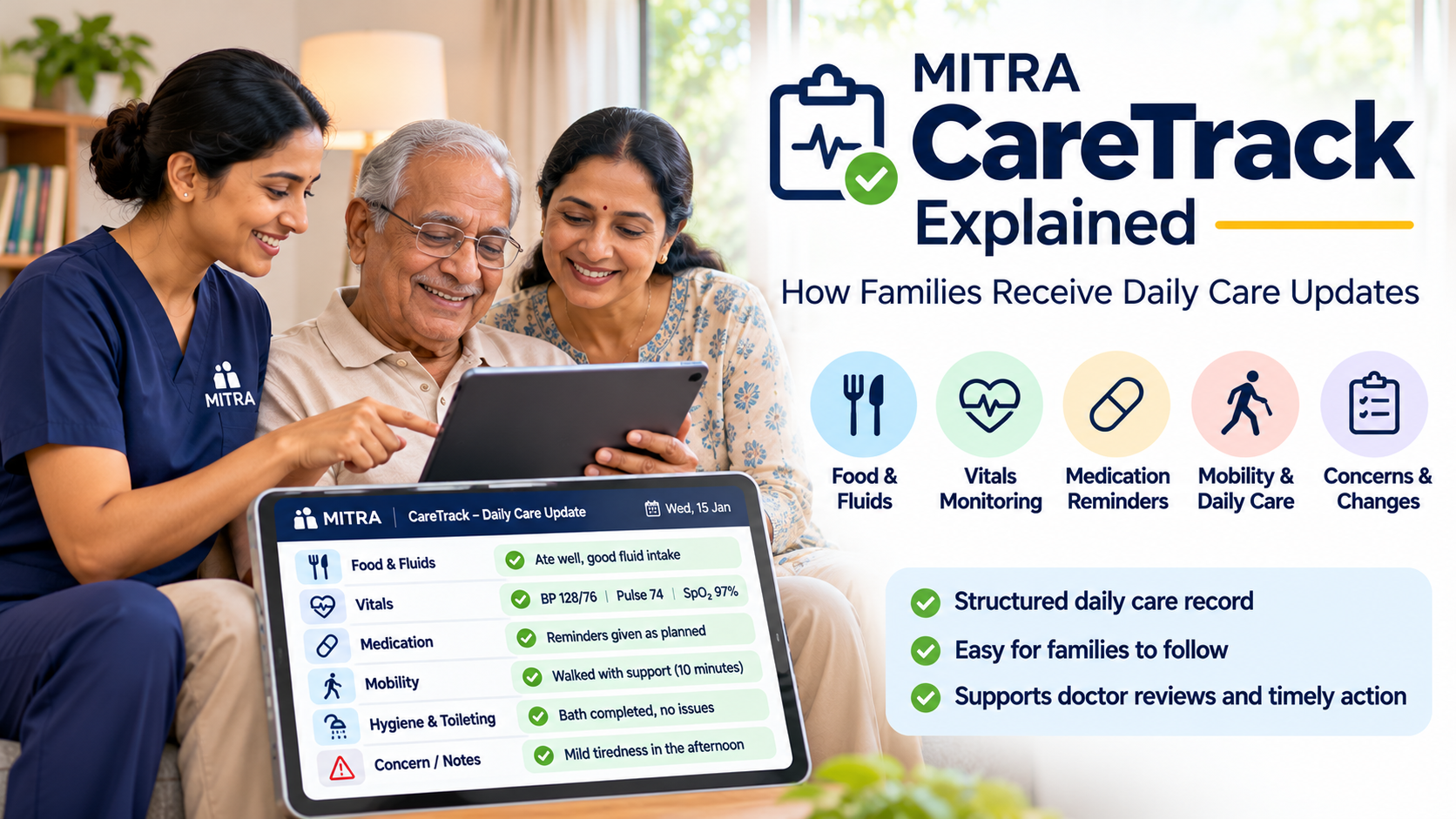
How CareTrack connects the written plan with everyday care
A care plan explains what should happen. MITRA's CareTrack helps record what actually happened. Depending on the agreed plan, CareTrack can document relevant areas such as:- Food and fluids- Vitals- Medication-related tasks- Mobility- Hygiene and toileting- Relevant concerns- Other care observationsThat daily record can then support family communication, handovers and subsequent care reviews.
See how CareTrack turns the care plan into a structured day-to-day care record
How does MITRA decide the appropriate care level?
| Care requirement | MITRA care level that may fit | ||
| Everyday assistance with bathing, feeding, toileting, mobility and companionship | Essential Daily Care | ||
| Everyday assistance plus closer observation, basic vitals and structured tracking | Enhanced Daily Care | ||
| Regular prescribed nursing procedures | Comprehensive Nursing Care | ||
| Higher-dependency or more complex nursing requirements | Advanced Nursing Care |
Essential Daily Care
Essential Daily Care is intended for people who primarily need assistance with everyday living and do not require regular nursing procedures. This can include help with:- Bathing- Grooming- Dressing- Toileting- Feeding- Walking and transfers- Positioning- Medication reminders- Basic monitoring- Companionship- Daily routinesThe service is delivered by a trained caretaker rather than a nurse.
Enhanced Daily Care
Enhanced Daily Care is intended for someone who still does not require regular nursing procedures but needs more structured observation. This can include:- Everyday caregiving- Closer observation- Basic vital-sign monitoring- Intake/output tracking when required- Pressure-area support- Observation of existing devices- Structured reporting of changesMITRA describes this as a higher level of everyday support rather than nursing care.
Comprehensive Nursing Care
Comprehensive Nursing Care is intended for patients whose care plan includes regular nursing requirements. Depending on the prescribed care plan, these may include areas such as:- Medication administration- Injectable medication- IV medication through existing access- Tube feeding- Existing catheter care- Wound dressings- Suctioning- Tracheostomy careThis requires an appropriately qualified nursing provider rather than a basic caretaker.
Advanced Nursing Care
Some patients need a higher level of nursing competency. MITRA's Advanced Nursing Care is designed for higher-dependency situations requiring senior nursing skills and may include more complex procedures where appropriate and prescribed. The important distinction is that the care level increases because the patient's actual clinical requirements increase, not simply because the patient has a serious-sounding diagnosis.
Why choosing the highest-qualified provider is not always better
If someone mainly needs:- Bathing assistance- Help walking- Meals- Toileting- Companionshipa trained caregiver may be entirely appropriate. Hiring a nurse does not automatically make everyday caregiving better. Similarly, if a patient's care plan includes injections, tube feeding or complex nursing procedures, assigning a basic caregiver is not appropriate simply because they are available. Matching competency to requirement matters more than choosing the highest qualification.
Compare caregiver and nurse responsibilities before choosing a home-care level
Patient preferences also matter
The clinical and functional requirements determine what skills the provider needs. But a successful home-care placement also needs practical compatibility. MITRA's matching process can consider preferences such as:- Gender- Language- Experience- Shift- Location- Relevant previous patient-care experience- Other practical requirementsThe family can then consider shortlisted providers rather than simply receiving whichever person happens to be available.
The care plan also helps MITRA choose the caregiver
The assessment is not only used to choose a service package. It also helps determine which individual provider profiles are suitable. For example, MITRA may match according to: Patient needs-Caregiver or nurse competency-Experience-Language and gender preferences-Shift availability This makes the care plan part of the provider-selection process rather than a document created after someone has already been assigned.
See how MITRA turns the patient's care requirements into a shortlist of suitable caregivers
Can the family interview the caregiver before starting?
Yes. MITRA's current model allows families to review shortlisted caregiver profiles and speak with potential providers before making their selection. This gives both sides an opportunity to understand:- Patient routine- Care requirements- Expected duties- Language compatibility- Shift arrangement- Household expectations- Whether the placement feels appropriateMITRA states that it typically shares suitable provider options rather than simply assigning the first available person
What if the patient's needs change after care starts?
A personalised care plan should not be treated as permanently fixed. For example, a person may initially need only:- Bathing assistance- Walking support- Meals- Medication remindersLater, they may develop:- Greater mobility dependence- Increased nighttime needs- A wound requiring prescribed nursing care- A feeding tube- A catheter-related requirement- Another new clinical needMITRA's current services state that care plans can be reviewed when needs change and that a higher level of care may be recommended if the patient's clinical requirements increase.
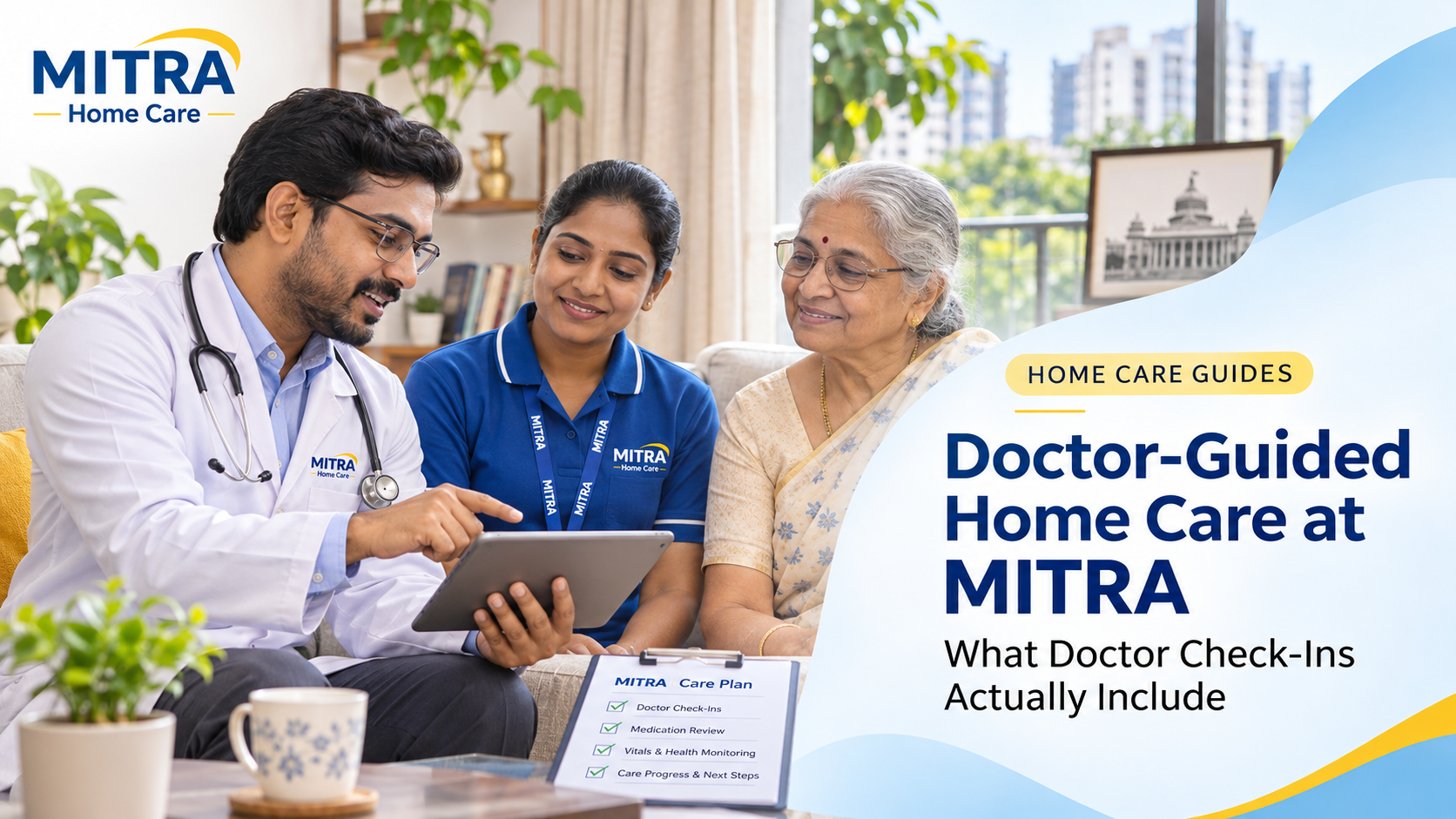
How doctor check-ins can support care-plan review
MITRA's managed-care model also includes scheduled doctor review. Relevant information from the home-care record, family and caregiver can help identify whether:- The current care level remains appropriate- Assistance requirements are increasing- New concerns need formal medical evaluation- Monitoring requirements need review- A nursing-level requirement has appearedThe doctor check-in does not replace the patient's treating specialist or emergency medical care.
Example 1: An elderly person who mainly needs daily assistance
Consider an older adult who:- Walks with a walker- Needs help bathing- Needs assistance getting dressed- Requires help with some meals- Uses the toilet with assistance- Takes prescribed medicines independently when reminded- Has no regular nursing proceduresThe primary need is everyday support. A trained caregiver may therefore be more appropriate than a nurse.
Example 2: Everyday care plus closer monitoring
Now consider someone who:- Needs bathing and toileting assistance- Has reduced mobility- Requires regular vitals monitoring- Needs food and fluid intake followed more closely- Has pressure-area concerns- Has an existing device that needs observation- Does not require injections, tube feeds or other regular nursing proceduresThis person may need a higher caregiving level without necessarily requiring full nursing care.
Example 3: regular nursing requirements
Consider a patient who needs: - Assistance with everyday activities- Prescribed injectable medication- Tube feeding- Existing catheter care- Regular wound dressingsHere, the issue is no longer only assistance with daily living. The care plan contains nursing procedures, so the provider needs appropriate nursing qualifications and competencies.
Example 4: same diagnosis, different plan
| Patient | Same diagnosis | Actual requirement | Likely care direction | ||
| A | Stroke | Bathing + walking assistance | Daily caregiving | ||
| B | Stroke | High dependency + closer monitoring | Enhanced caregiving may be considered | ||
| C | Stroke | Tube feeding + catheter care + dressings | Nursing care |
What information should families have ready for the assessment?
- Patient's age.
- Main medical conditions.
- Recent hospitalisation or surgery.
- Current walking ability.
- Whether the person is bed-bound.
- Bathing and toileting assistance required.
- Feeding requirements.
- Memory or behavioural concerns.
- Nighttime assistance required.
- Current medicines.
- Existing tubes, catheters or medical devices.
- Wound-care or other nursing requirements.
- Whether 12-hour or 24-hour support is being considered.
- What assistance the family can provide.
- Preferred caregiver gender or language where relevant.
Why families should mention clinical requirements early
An important requirement discovered late can completely change the provider match. For example, if the original request says: “My father needs help after discharge.” MITRA may initially look for a caregiver. If it later becomes clear that the patient needs regular prescribed wound care and injectable medication, the provider requirement changes. Explaining those needs during the initial assessment helps the correct provider category get considered from the beginning.
A care plan is not the same as a medical prescription
The home care plan organises how agreed support will be delivered at home. It does not independently replace:- Hospital discharge instructions- A doctor's prescription- Specialist follow-up- Physiotherapy instructions- Emergency medical evaluationWhere clinical treatment is required, the appropriate treating clinician remains important.
What makes a good home care plan?
A useful plan should be: Individualised — based on the person rather than a generic diagnosis. Specific — clear about what assistance is required. Realistic — based on the actual home environment and family availability. Within scope — tasks should match the provider's qualification and competency. Understandable — the caregiver, family and relevant care team should know what is expected. Reviewable — it should be capable of changing when the person's needs change. NICE recommends that home-care plans reflect a person's needs, priorities, independence, safety, specialist requirements and the role of family or other carers.
Why personalised care planning matters in elderly care
Older adults often have several interacting needs rather than one isolated condition. A person may simultaneously have:- Diabetes- Arthritis- Reduced vision- Mild memory impairment- Difficulty walking- Urinary incontinence- Several medicines- Limited family supportA useful home-care plan therefore needs to consider the person as a whole, rather than creating separate caregiving decisions around each diagnosis. WHO's current ICOPE framework similarly describes person-centred assessment followed by development, implementation and monitoring of an individualised care plan.
Frequently asked questions
Does every MITRA patient get the same care plan?
No. The plan is structured around the individual's current support requirements, routine and relevant clinical needs. Two people of the same age or with the same diagnosis may therefore receive very different care recommendations.
Who decides whether my parent needs a caregiver or nurse?
The decision should be based primarily on the tasks and level of care required. Everyday assistance can often be provided by a trained caregiver. When the care plan includes nursing procedures or a higher clinical level of care, an appropriately qualified nurse is required.
Can I request a nurse even if my parent only needs a caregiver?
Families can discuss their preferences with MITRA, but the objective of assessment is to match the patient's needs with an appropriate provider level. A higher qualification does not automatically make a provider more appropriate for routine daily caregiving.
Can a caregiver start doing nursing procedures if the patient's needs change?
No. A change in the patient's needs does not expand the caregiver's permitted scope. If nursing procedures become necessary, the care requirement should be reassessed and an appropriately qualified provider considered.
Can the care plan change after the caregiver starts?
Yes. MITRA's current service pages state that the personalised care plan can be reviewed as the patient's needs change.
Does the family have a say in the care plan?
Yes. Family members often provide important information about the patient's normal routine, previous independence, preferences, nighttime needs and what support relatives can realistically provide. The patient's own preferences should also be considered wherever possible. Person-centred home-care guidance recommends involving the individual and appropriate carers in care planning rather than imposing a standard package.
Does a personalised care plan mean everything is medically supervised?
No. A care plan organises the agreed home-care arrangement. It does not turn routine caregiving into continuous medical monitoring and does not replace emergency services, hospital care or the patient's treating doctors.
The simplest way to think about personalised home care
MITRA's process can be reduced to a straightforward sequence: Understand the person ↓ Identify what they can and cannot do independently ↓ Identify any nursing or clinical requirements ↓ Understand family and nighttime support ↓ Select the appropriate care level ↓ Match suitable providers ↓ Create the individual care plan ↓ Record relevant day-to-day care ↓ Review the plan when needs change That is the practical purpose of personalised home care.
Need care at home in Bengaluru? See MITRA services.
Related articles
Home Care Guides · 15 min read
Doctor-Guided Home Care at MITRA: What Doctor Check-Ins Actually Include
MITRA caregiving plans include doctor check-ins as part of ongoing home care. See what the doctor reviews, how CareTrack and LabTrack support the review, when the care plan may change, and what doctor oversight does not replace.
Thu, 5 Nov 2026
Home Care Guides · 12 min read
MITRA CareTrack Explained: How Families Receive Daily Care Updates
CareTrack is MITRA's structured daily care record for home caregiving. See what caregivers document, how families can follow day-to-day care, how vitals and concerns are tracked, and how CareTrack supports doctor reviews, escalation and continuity when caregivers change.
Wed, 4 Nov 2026
Home Care Guides · 11 min read
MITRA LabTrack Explained: How Home Test Results Stay Organised
LabTrack is MITRA's structured record for laboratory results during home care. See how reports, individual test values, reference ranges and dates are organised, how trends can be followed over time, and how LabTrack works alongside CareTrack and doctor check-ins.
Wed, 4 Nov 2026