MITRA LabTrack Explained: How Home Test Results Stay Organised
LabTrack is MITRA's structured record for laboratory results during home care. See how reports, individual test values, reference ranges and dates are organised, how trends can be followed over time, and how LabTrack works alongside CareTrack and doctor check-ins.
Written by Mr. Rahul B S
Published Wed, 4 Nov 2026 · 11 min read

When an older parent or recovering patient has repeated blood and urine tests, reports can quickly become scattered across WhatsApp messages, PDFs, email, paper files and different laboratories. MITRA's LabTrack is designed to keep relevant laboratory information organised as part of the patient's broader home-care record. When testing is done through MITRA, a copy of the laboratory report is stored and individual values are entered so results can be followed over time.
What is MITRA LabTrack?
LabTrack is the laboratory-results component of MITRA's MiTrack care record. MITRA currently describes MiTrack as the broader patient record in which:- CareTrack records daily care and relevant observations- LabTrack stores laboratory reports and structured test resultsThis allows day-to-day caregiving information and laboratory data to remain connected rather than existing in separate systems.
CareTrack vs LabTrack: what is the difference?
| CareTrack | LabTrack | |||
| Main purpose | Follow everyday care | Follow laboratory results | ||
| Information | Food, fluids, vitals, mobility, hygiene, concerns | Laboratory reports and individual test values | ||
| Frequency | Ongoing during care | Whenever relevant tests are performed | ||
| Useful for | Daily changes | Laboratory trends | ||
| Part of | MiTrack | MiTrack |
What information does LabTrack store?
For laboratory tests performed through MITRA, the current LabTrack workflow records the report and enters individual values including:- Test name- Result- Unit- Laboratory reference range- DateMITRA states that this is done for the family rather than requiring them to manually enter each laboratory value themselves.
Why store the individual values if the PDF report already exists?
A PDF tells you what happened on one particular test date. Structured data makes it easier to answer another question: “How has this value changed across multiple reports?” For example, a family may want to see whether:- Haemoglobin is falling- Creatinine is rising- HbA1c is improving- TSH is changing- Cholesterol has fallen after treatmentLabTrack is designed to make this longitudinal view easier to follow.
What does a LabTrack entry look like conceptually?
| Date | Test | Result | Unit | Lab reference range | ||
| 15 Jan | HbA1c | 7.8 | % | Lab-defined | ||
| 15 Apr | HbA1c | 7.2 | % | Lab-defined | ||
| 15 Jul | HbA1c | 6.9 | % | Lab-defined |
Which laboratory tests can appear in LabTrack?
LabTrack can be relevant across many of the tests offered through MITRA home diagnostics. Current MITRA diagnostic offerings include tests and packages covering areas such as:- Blood counts- Diabetes- Cholesterol- Kidney function- Liver function- Thyroid function- Iron status- Vitamins- Electrolytes- Urine testingMITRA diagnostic pages currently list digital reports and LabTrack updates as included with several individual tests.
Example: tracking diabetes tests
For someone with diabetes, different laboratory results answer different questions. Examples include:- HbA1c for longer-term glucose exposure- Fasting blood sugar- Kidney markers- Urine testing- Lipid profileKeeping previous values accessible can make it easier to understand whether the overall pattern is changing rather than viewing each report in isolation.
Example: tracking haemoglobin and anaemia
A person recovering from surgery or living with chronic illness may undergo repeated testing of:- Haemoglobin- Complete blood count- Ferritin- Iron studiesMITRA's current Anaemia Package combines CBC, iron studies and ferritin with home collection and digital LabTrack reporting. The usefulness of LabTrack here is organisational: it can help preserve the sequence of results across repeated testing.
Example: kidney-function monitoring
Kidney monitoring may involve repeated measurements rather than one isolated result. A patient's clinician may be interested in changes involving:- Creatinine- Electrolytes- Other kidney-panel results- Urine findingsLabTrack can help keep repeated results together, while the clinical significance of any change still needs appropriate medical interpretation.
Why trends can matter more than a single laboratory value
Some laboratory values may remain within the laboratory reference range while still showing a meaningful change from that patient's previous results. Conversely, a mildly abnormal value may remain stable over repeated testing. LabTrack helps make the history visible. It does not decide whether that pattern is medically important.
Does LabTrack flag abnormal results?
MITRA currently states that readings outside normal limits can be flagged within MiTrack. This can make abnormal laboratory values easier to notice when reviewing the record. However, an automated flag should not be treated as a diagnosis or as proof that a result is dangerous.
What does “outside the normal range” actually mean?
Laboratories typically provide a reference range next to many results. A value outside that range may need attention, but its importance varies considerably. For example:- Slightly abnormal results may sometimes be clinically unimportant- Some apparently normal results may still need interpretation in context- Reference ranges can differ between laboratories- Some treatment targets differ from laboratory reference rangesThat is why LabTrack should support clinical review rather than replace it.
LabTrack does not interpret your laboratory report automatically
LabTrack's role is to organise and surface laboratory information. It does not independently diagnose:- Diabetes- Anaemia- Kidney disease- Thyroid disease- Infection- Liver disease- Vitamin deficiencyThe result still needs to be interpreted according to the clinical context.
How does LabTrack support MITRA doctor check-ins?
MITRA's managed-care model includes scheduled doctor check-ins. Its current public information states that the doctor can review the patient's care record and that laboratory results form part of the wider MiTrack history. This means a doctor reviewing the patient can have access to more structured historical information than a family trying to remember previous results from separate reports.
How LabTrack and CareTrack work together
CareTrack and LabTrack answer different questions. Imagine an older adult has become progressively more tired. CareTrack may show:- Reduced mobility- Lower food intake- More time in bedA subsequent laboratory test may show:- Falling haemoglobinLabTrack stores that laboratory history. Neither system proves the cause, but together they can provide a more complete picture for clinical review.
Why LabTrack can help families who live away from their parents
Families managing care remotely often receive laboratory reports as forwarded PDFs or photographs. Over months, it becomes difficult to answer:- Which report is newest?- What was the previous value?- Is this result improving?- Was the test repeated?- When did the change begin?A structured result history can make those questions easier to answer.
Does LabTrack replace keeping the original laboratory report?
No. MITRA stores the laboratory report alongside structured values when tests are performed through the service. The original laboratory report remains important because it may contain:- Additional test details- Laboratory comments- Method-specific information- Complete panel resultsThe structured LabTrack record is an additional way to follow results over time.
Does LabTrack work only for one disease?
No. The system is not limited to diabetes or one diagnostic category. Because laboratory monitoring can be relevant across many conditions, LabTrack can help organise different types of results whenever testing forms part of the patient's care.
LabTrack during long-term elderly care
Older adults may undergo periodic laboratory testing for several reasons:- Diabetes monitoring- Kidney function- Anaemia- Thyroid disorders- Medication monitoring- Cholesterol- Nutritional deficienciesWhen these results accumulate over months, a longitudinal record can improve continuity between family members and the care team.
LabTrack during post-hospital or post-surgery recovery
Some patients require laboratory follow-up after discharge depending on their operation, medical condition or treating doctor's plan. Rather than treating each new test as an isolated event, LabTrack can retain relevant reports and values as part of the ongoing care history. Testing itself should still be performed only when clinically indicated.
What happens when you book a test through MITRA?
- Selecting the required test or package.
- A trained phlebotomist visiting the home.
- Collection of the required sample.
- Laboratory processing.
- The digital report being shared when ready.
- Relevant results being added to LabTrack.
Can you order any laboratory test just because LabTrack exists?
No. LabTrack is a record system, not a reason to perform unnecessary tests. Some tests are useful for routine screening; others should be ordered because of:- Symptoms- Known disease- Medication monitoring- Follow-up after an abnormal result- A clinician's recommendationMore laboratory testing is not automatically better care.
LabTrack is not continuous monitoring
Laboratory results are snapshots taken when a sample is collected. LabTrack therefore does not function like:- Continuous glucose monitoring- Bedside ICU monitoring- A wearable heart monitor- An emergency alarm systemIts role is to organise laboratory results that already exist.
What if a laboratory value is dangerously abnormal?
A potentially serious laboratory abnormality needs appropriate clinical action. Families should not wait for a routine LabTrack review if the laboratory, treating doctor or MITRA care team advises urgent assessment. Likewise, severe symptoms such as chest pain, major breathlessness, loss of consciousness or another medical emergency require emergency care rather than waiting for a home test.
How is LabTrack different from simply storing reports in Google Drive or WhatsApp?
| PDF/WhatsApp folder | LabTrack | ||
| Stores documents | Stores report plus structured values | ||
| Requires manual searching | Results organised by date/test | ||
| Trends harder to compare | History designed for longitudinal review | ||
| Often separated from caregiving information | Part of MiTrack | ||
| Family must organise files | MITRA enters test information when testing through MITRA |
Can LabTrack help when the caregiver changes?
Yes, as part of the wider MiTrack history. MITRA states that the patient's care plan and MiTrack history remain available when a replacement caregiver joins, helping prevent the new provider from having to reconstruct the patient's recent care history from zero. The replacement caregiver still needs an appropriate handover.
Who can use the information in LabTrack?
MITRA states that patient data is used for the person's care and can be shared with the family, MITRA care team and doctors involved in the patient's care, rather than being sold or used commercially. Access and use should remain limited to what is appropriate for managing that patient's care.
Frequently asked questions
What is MITRA LabTrack?
LabTrack is MITRA's structured record for laboratory results. For tests performed through MITRA, the report is uploaded and individual values such as the test, result, unit, reference range and date are entered so results can be followed over time.
Is LabTrack the same as CareTrack?
No. CareTrack focuses on everyday caregiving and observations. LabTrack focuses on laboratory reports and test-result history. Both form part of MITRA's broader MiTrack record.
Does LabTrack tell me whether a result is dangerous?
It can flag values outside the laboratory's normal limits, but that does not determine how serious the finding is. The significance depends on the patient, symptoms, medical history and other results.
Does LabTrack include home blood tests?
MITRA's current home-diagnostic service pages include digital laboratory reports and LabTrack updates with several tests and packages performed through MITRA's home collection service.
Can LabTrack diagnose diabetes or kidney disease?
No. LabTrack organises the laboratory information. Diagnosis requires appropriate clinical interpretation and, where necessary, further testing.
Why is LabTrack useful if I already have the laboratory report?
Because a single report shows one point in time. LabTrack is designed to make it easier to follow the history of the same test across multiple dates, while keeping the original report available.
LabTrack as part of managed home care
LabTrack is useful because it sits alongside the other pieces of the patient's care rather than existing as a standalone laboratory folder. MITRA's current model combines: CareTrack + LabTrack + care planning + scheduled doctor check-ins + family communication + escalation pathways within its managed-care offering.
Need care at home in Bengaluru? See MITRA services.
Related articles
Home Care Guides · 19 min read
Personalised Home Care Plans: How MITRA Decides What Care a Patient Actually Needs
A home care plan should be based on what a person actually needs help with — not simply their age or diagnosis. See how MITRA assesses daily activities, mobility, nursing requirements, night needs, family support and preferences before structuring personalised home care.
Fri, 6 Nov 2026
Home Care Guides · 15 min read
Doctor-Guided Home Care at MITRA: What Doctor Check-Ins Actually Include
MITRA caregiving plans include doctor check-ins as part of ongoing home care. See what the doctor reviews, how CareTrack and LabTrack support the review, when the care plan may change, and what doctor oversight does not replace.
Thu, 5 Nov 2026
Home Care Guides · 12 min read
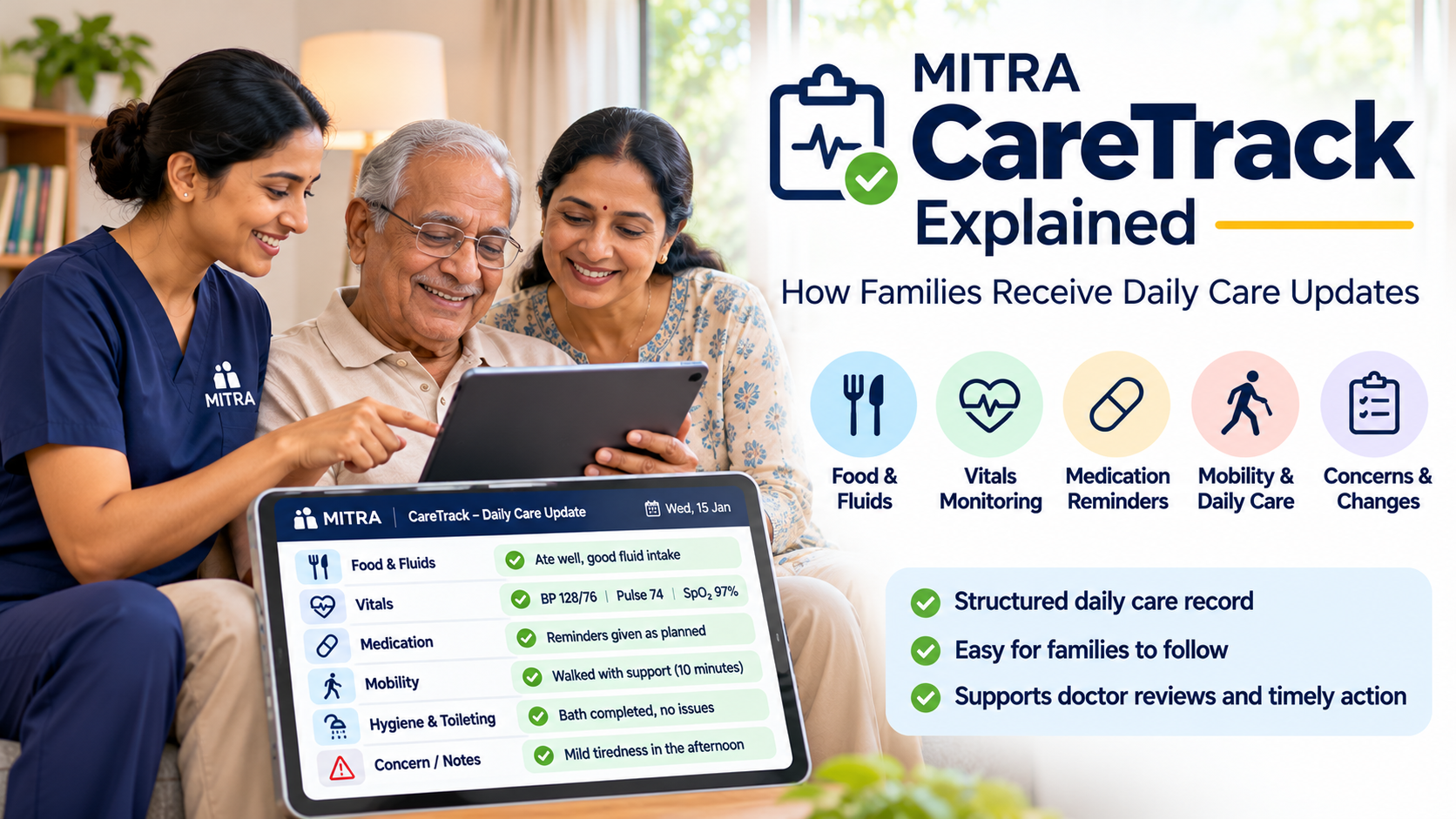
MITRA CareTrack Explained: How Families Receive Daily Care Updates
CareTrack is MITRA's structured daily care record for home caregiving. See what caregivers document, how families can follow day-to-day care, how vitals and concerns are tracked, and how CareTrack supports doctor reviews, escalation and continuity when caregivers change.
Wed, 4 Nov 2026