Doctor-Guided Home Care at MITRA: What Doctor Check-Ins Actually Include
MITRA caregiving plans include doctor check-ins as part of ongoing home care. See what the doctor reviews, how CareTrack and LabTrack support the review, when the care plan may change, and what doctor oversight does not replace.
Written by Mr. Rahul B S
Published Thu, 5 Nov 2026 · 15 min read
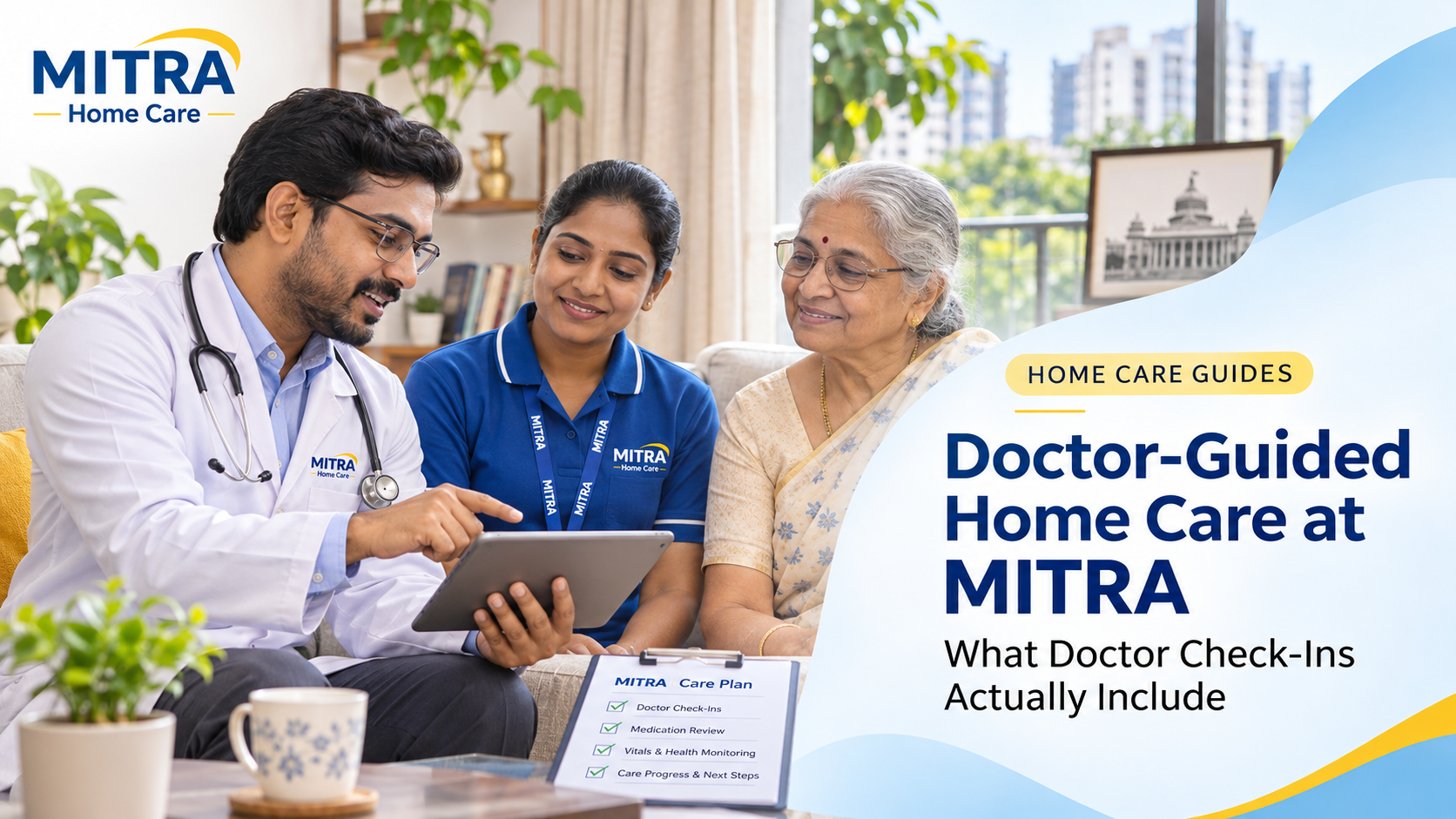
A caregiver may spend 12 or 24 hours with a patient, but that does not mean they should independently decide what a new symptom, changing vital sign or decline in mobility means. MITRA's managed home-care model adds scheduled doctor check-ins so relevant information from the home can be reviewed in clinical context. MITRA currently includes a doctor check-in every two weeks in its caregiving plans. The doctor reviews the care record, speaks with the family and can update the care plan when required.
What does doctor-guided home care mean?
The day-to-day care is still provided by the patient's caregiver or nurse. The doctor's role is different. The doctor can review relevant information from the care period, discuss changes with the family and help determine whether the existing care plan remains appropriate. Conceptually, the process is: Care plan → daily care → structured observations → doctor review → care-plan update when required MITRA describes this as part of its wider managed-care model rather than a standalone doctor-consultation service.
What is the difference between the caregiver's role and the doctor's role?
| Caregiver | Doctor | |||
| Provides day-to-day care | Yes | No | ||
| Observes changes during care | Yes | Reviews reported changes | ||
| Records relevant care information | Yes | Reviews relevant records | ||
| Diagnoses medical conditions | No | Where clinically appropriate | ||
| Independently changes medicines | No | Only after appropriate clinical assessment | ||
| Follows the care plan | Yes | Can review/update the care plan | ||
| Escalates concerns | Yes | Provides clinical guidance when appropriate |
What happens before home care begins?
Doctor-guided care starts before the first routine check-in. MITRA's current caregiving process considers the patient's:- Medical condition- Daily routine- Mobility- Feeding requirements- Toileting needs- Medication support- Monitoring requirements- Existing clinical needswhen structuring the personalised care plan. The purpose is to decide what the caregiver is actually expected to do rather than placing someone in the home without a defined scope of care.
How often does the doctor check in?
MITRA currently states that a doctor check-in every two weeks is included in every caregiving plan. The doctor reviews the care record, speaks with the family and updates the care plan when required. This is a scheduled review. It should not be confused with continuous medical monitoring or an emergency-response service.
What can the doctor review during a check-in?
The exact information depends on the patient's condition and care plan. Relevant information may include:- Changes in mobility- Food and fluid intake- Toileting patterns- Sleep- Activity- Level of assistance required- Relevant symptoms reported by the patient or family- Recorded vital signs where monitoring forms part of the care plan- Caregiver concerns- Laboratory information where available- Changes reported by the family- Whether the existing care level remains appropriateThe purpose is not to review every possible data point. It is to identify information that may matter to the person's ongoing care.
Why are changes from the patient's usual baseline important?
A single observation can be difficult to interpret without knowing what is normal for that patient. Consider two updates: “Patient seems weak today.” versus: “Patient normally walks to the bathroom with one-person assistance. Today she required substantially more assistance on three occasions.” The second update provides more useful information because it explains:- The patient's usual baseline- What changed- When the change occurred- Whether it happened repeatedlyThe caregiver still has not diagnosed the cause. They have simply created a clearer clinical picture for review.
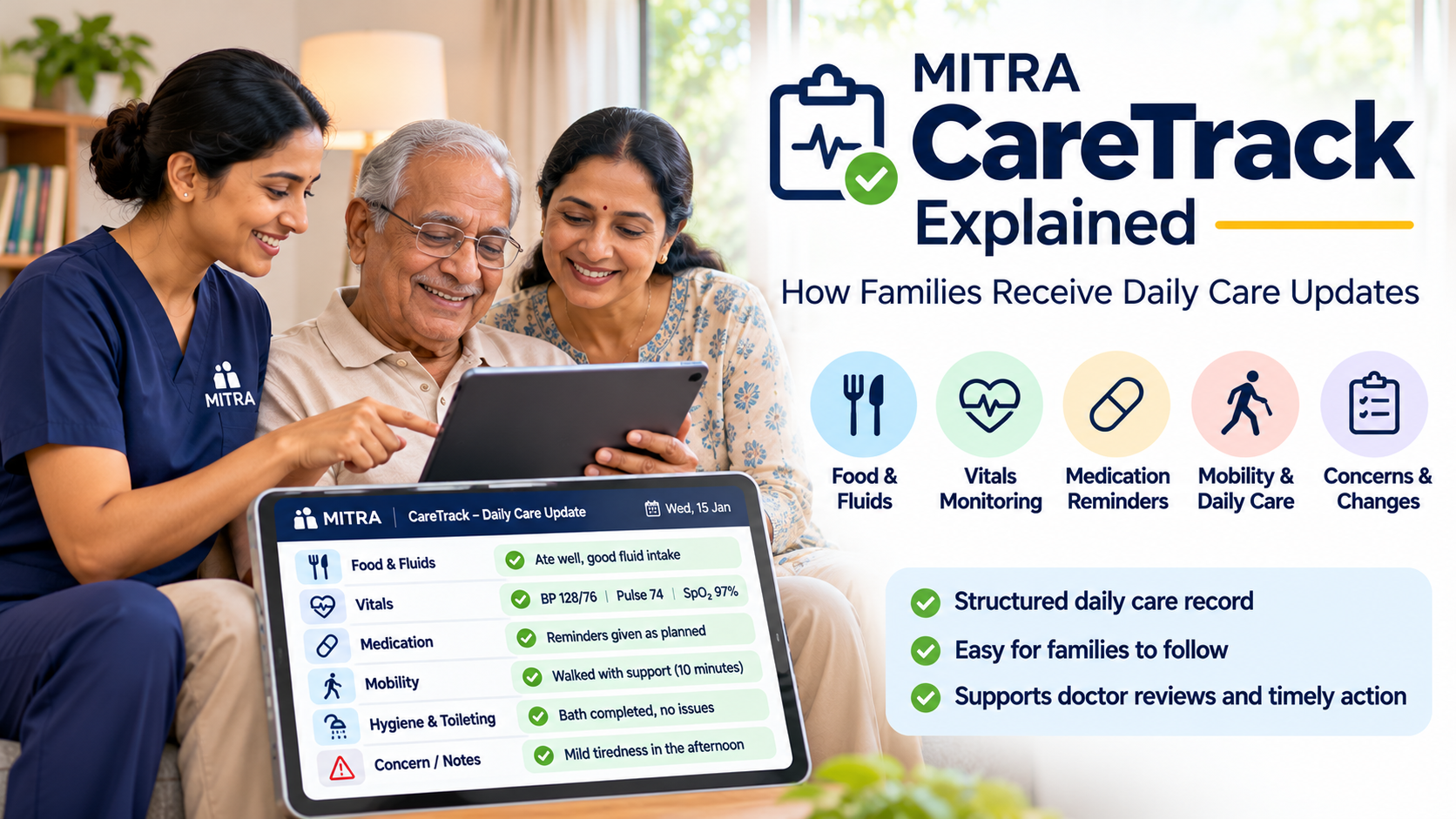
How does CareTrack support doctor check-ins?
MITRA's CareTrack records relevant day-to-day care information within its broader MiTrack system. Depending on the patient's care plan, this can include areas such as:- Food and fluids- Vitals- Mobility- Hygiene and toileting- Medication-related tasks within the caregiver's scope- Relevant concerns- Other observationsInstead of trying to reconstruct several days of care from memory, the doctor can review a more structured care history when appropriate.
See how CareTrack records everyday caregiving, observations and relevant changes
Why structured records matter during a doctor review
A doctor cannot directly observe everything that happens during a 12-hour or 24-hour caregiving arrangement. The quality of the review therefore depends partly on the quality of the information available. Compare: “Everything was okay this week.” with: “Food intake remained usual, but walking assistance increased from one person to two people on three occasions over the last two days.” The second version gives the doctor something specific to evaluate. Structured documentation does not replace clinical assessment. It can make the available information easier to review.
Can the doctor review vital signs recorded at home?
Where vital-sign monitoring forms part of the care plan, the home record may include measurements such as:- Blood pressure- Pulse rate- Oxygen saturation- Temperature- Blood glucose where relevantMITRA currently states that daily vitals can form part of MiTrack and that readings outside normal limits can be flagged. A doctor can then interpret relevant readings in the context of the patient's overall condition.
Does every abnormal reading automatically mean something is wrong?
No. An unusual reading can be useful information, but its significance depends on the situation. For example:- A single measurement may be inaccurate- A value may be normal for one patient but unusual for another- Symptoms may make a reading more clinically important- Repeated change may matter more than one isolated value- Individual treatment targets may differThis is why monitoring systems should support clinical interpretation rather than attempt to replace it.
What happens if the caregiver notices a new concern?
MITRA's managed-care model includes a defined communication and escalation pathway when the caregiver notices a concern or is unsure about a change in the patient's condition. The caregiver is not expected to independently make medical decisions. Instead, the relevant information can be communicated through the care pathway so the appropriate response can be determined.
What kind of caregiver update is useful to a doctor?
| Less useful | More useful | ||
| Patient looks weak | Patient required more assistance walking than usual | ||
| BP is bad | BP reading, time, repeat reading and associated symptoms recorded | ||
| Eating less | Approximate change from usual intake and when it began | ||
| Patient confused | Specific change in behaviour compared with usual baseline | ||
| Patient not walking well | What assistance was normally required versus today | ||
| Medicine problem | Which scheduled medicine, what happened and when |
Can the doctor review medication-related concerns?
Medication information may become relevant during home care. Examples include:- A scheduled medicine being missed- The patient refusing medication- Difficulty taking an oral medicine- A recently changed prescription- Family uncertainty about discharge instructions- A new symptom after a medication changeThe caregiver should not independently prescribe, stop or change a medication. Where medication decisions are required, they need appropriate clinical review.
How does LabTrack support doctor check-ins?
MITRA's LabTrack organises relevant laboratory reports and individual test results within the broader MiTrack history. For testing performed through MITRA, the system can retain:- Test- Result- Unit- Laboratory reference range- Date- Previous results over timeThis can give the doctor a more organised historical view when laboratory information is relevant to the patient's care.
See how LabTrack keeps laboratory reports and test-result trends organised during home care
How CareTrack and LabTrack can support the same review
CareTrack and LabTrack answer different questions. For example, imagine an older adult becomes progressively more tired. CareTrack may show:- Reduced mobility- Lower food intake- Increased assistance requiredIf laboratory testing is clinically indicated: LabTrack may later contain:- Relevant laboratory results- Previous values for comparisonNeither system determines the diagnosis. Together, they can provide additional context for an appropriate clinical review.
Can the doctor change the home care plan?
The patient's needs can change over time. A person who initially needs help with:- Bathing- Feeding- Toileting- Walking- Companionshipmay later develop requirements that need a different level of provider. MITRA's model allows the care requirement to be reassessed when the patient's condition or support needs change.
Example: when basic caregiving may no longer be enough
Imagine a patient originally required help only with daily activities. Later, the patient develops a new requirement involving a clinical procedure that is outside the caregiver's permitted scope. The correct response is not to ask the existing caregiver to perform a task they are not trained or authorised to perform. The care requirement should instead be reassessed so the appropriate provider level can be considered.
Does a doctor check-in replace the patient's regular physician or specialist?
No. A MITRA doctor check-in forms part of the home-care management process. It does not automatically replace the patient's:- Family physician- Surgeon- Cardiologist- Neurologist- Diabetologist- Oncologist- Other treating specialistThe treating clinician may still remain responsible for disease-specific decisions and follow-up.
Is this the same as booking a doctor home visit?
No. A doctor home visit is a separate medical service in which a physician physically visits the patient for consultation or examination. MITRA's scheduled doctor check-ins are part of its managed caregiving model. The purpose of this page is to explain that ongoing care-management process, not to advertise on-demand physician home visits.
Does a doctor see every CareTrack entry in real time?
Families should not interpret doctor-guided care as continuous real-time surveillance of every entry. CareTrack helps organise relevant information. MITRA describes scheduled doctor reviews and pathways for communicating concerns, rather than 24-hour continuous physician monitoring.
Is MiTrack an emergency monitoring system?
No. MiTrack can organise care information, vitals and laboratory results. It should not be treated like:- ICU monitoring- A medical emergency alarm- Continuous telemetry- Continuous bedside nursing observation- An ambulance-response systemMITRA is not an emergency service.
What if the patient's condition suddenly becomes serious?
A routine doctor check-in should never delay emergency medical care. Examples of potentially serious symptoms include:- Severe chest pain- Major difficulty breathing- Loss of consciousness- New severe weakness or suspected stroke- Major bleeding- Seizure- Another rapidly deteriorating medical conditionIn an emergency, families should contact the appropriate emergency medical service or go to the nearest emergency department rather than waiting for a scheduled home-care review.
Why does family communication still matter if a doctor reviews the record?
The family may know important information that is not obvious from routine caregiving entries. For example:- Recent hospital visits- Specialist advice- New prescriptions- Previous level of independence- Behavioural changes- Patient preferences- Upcoming investigations or appointmentsDoctor-guided home care works best when the care record, caregiver observations and family information are considered together.
What does the doctor actually do during MITRA's scheduled check-in?
- Reviewing the patient's available care record.
- Looking at relevant changes since the previous review.
- Considering recorded observations and vitals where applicable.
- Speaking with the family.
- Clarifying clinically relevant concerns.
- Determining whether the existing care plan continues to fit the patient's needs.
- Updating the care plan when appropriate.
What can happen after a doctor review?
Not every review needs to produce a major change. Depending on the situation, the outcome may simply be:- Continue the current care plan- Continue current observations- Clarify an existing instruction- Discuss a concern with the family- Recommend formal medical review- Recommend follow-up with the treating doctor- Reassess the required caregiver or nursing level- Update part of the care plan The response should depend on the individual situation rather than changing treatment simply because a review occurred.
Why scheduled reviews can be useful even when nothing seems wrong
Home care is often focused on problems only when something goes wrong. Scheduled review introduces a different approach. It creates a defined opportunity to ask:- Has anything changed?- Is the person needing more assistance?- Are existing observations still useful?- Are there new family concerns?- Is the caregiver still appropriate for the current needs?- Does the care plan still reflect what is actually happening at home?A review can therefore be useful even when no urgent concern has been raised.
Doctor-guided care during long-term elderly care
Long-term elderly care needs can evolve gradually. Changes may occur in:- Mobility- Continence- Feeding- Cognition- Sleep- Medication burden- Level of assistance- Medical conditions- Family availabilityBecause some changes develop slowly, an organised care history and scheduled review can make it easier to recognise that today's needs are no longer the same as those present when care began.
Doctor-guided care after hospital discharge
Needs may also change relatively quickly after hospitalisation or surgery. A recovering patient may initially need substantial assistance and later regain independence. Alternatively, a new clinical concern may mean a higher level of support is required. Doctor-guided review can help keep the home-care arrangement aligned with the patient's changing recovery needs while the treating hospital team remains responsible for disease- or procedure-specific follow-up.
Doctor oversight does not remove caregiver boundaries
Having a doctor involved in the care system does not authorise the caregiver to perform procedures outside their permitted role. The caregiver must still work within the scope of the assigned care level. If the patient's requirements change, the solution is to reassess the care plan and provider level — not simply expand the existing caregiver's duties.
How MITRA's managed-care pieces fit together
MITRA's caregiving model combines several elements: Initial assessment + personalised care plan + trained caregiver + CareTrack + LabTrack where applicable + doctor check-ins + family communication + escalation pathway + reassessment when needs change The individual components have different functions. The value of the model comes from connecting them rather than treating each as an isolated service.
Frequently asked questions
How often does a MITRA doctor check in during caregiving?
MITRA currently states that one doctor check-in every two weeks is included in its caregiving plans. The doctor reviews the care record, speaks with the family and can update the care plan where appropriate.
Does the doctor monitor my parent 24 hours a day?
No. The service includes scheduled doctor check-ins and defined escalation pathways. It should not be interpreted as continuous physician monitoring or an emergency-monitoring service.
Does the doctor review CareTrack?
MITRA states that the doctor reviews the patient's care record during the scheduled check-in. CareTrack forms part of MiTrack and contains relevant day-to-day care and monitoring information.
Can the caregiver contact the care team before the next doctor check-in?
Relevant concerns do not need to be deliberately held until a routine review. MITRA's managed-care model includes a communication and escalation pathway when the caregiver notices a medical concern or when the patient's care requirements appear to change.
Can the doctor change my parent's medicines during a check-in?
Medication decisions require appropriate clinical assessment and depend on the doctor's role in that patient's medical care. A routine home-care review should not be interpreted as automatic authority to change every medicine prescribed by another treating doctor or specialist.
Does doctor-guided care replace my parent's specialist?
No. MITRA's doctor check-ins form part of ongoing home-care management. The patient's existing treating physician or specialist may still remain responsible for management of the underlying medical condition.
What happens if my parent's condition changes?
The change can be documented and communicated through the care pathway. Depending on the situation, the care plan may continue unchanged, require modification, need a higher level of provider, or require formal medical evaluation. Emergencies should be handled through emergency medical services rather than waiting for a routine doctor review.
Is doctor-guided home care available with every MITRA caregiving plan?
MITRA's current public information states that a doctor check-in every two weeks is included in every caregiving plan. The exact care delivered by the caregiver or nurse still depends on the selected care level and the patient's requirements.
Doctor-guided care as part of MITRA's managed home care
Doctor involvement is most useful when it is connected to what actually happens in the home. MITRA's current model links: Caregiver observations → CareTrack → relevant LabTrack information → family communication → doctor review → care-plan reassessment when required The aim is not to medicalise every part of everyday caregiving. It is to provide a more organised pathway when clinically relevant information needs to move from the home to someone who can interpret it appropriately.
Need care at home in Bengaluru? See MITRA services.
Related articles
Home Care Guides · 19 min read
Personalised Home Care Plans: How MITRA Decides What Care a Patient Actually Needs
A home care plan should be based on what a person actually needs help with — not simply their age or diagnosis. See how MITRA assesses daily activities, mobility, nursing requirements, night needs, family support and preferences before structuring personalised home care.
Fri, 6 Nov 2026
Home Care Guides · 12 min read
MITRA CareTrack Explained: How Families Receive Daily Care Updates
CareTrack is MITRA's structured daily care record for home caregiving. See what caregivers document, how families can follow day-to-day care, how vitals and concerns are tracked, and how CareTrack supports doctor reviews, escalation and continuity when caregivers change.
Wed, 4 Nov 2026
Home Care Guides · 11 min read
MITRA LabTrack Explained: How Home Test Results Stay Organised
LabTrack is MITRA's structured record for laboratory results during home care. See how reports, individual test values, reference ranges and dates are organised, how trends can be followed over time, and how LabTrack works alongside CareTrack and doctor check-ins.
Wed, 4 Nov 2026