MITRA CareTrack Explained: How Families Receive Daily Care Updates
CareTrack is MITRA's structured daily care record for home caregiving. See what caregivers document, how families can follow day-to-day care, how vitals and concerns are tracked, and how CareTrack supports doctor reviews, escalation and continuity when caregivers change.
Written by Mr. Rahul B S
Published Wed, 4 Nov 2026 · 12 min read
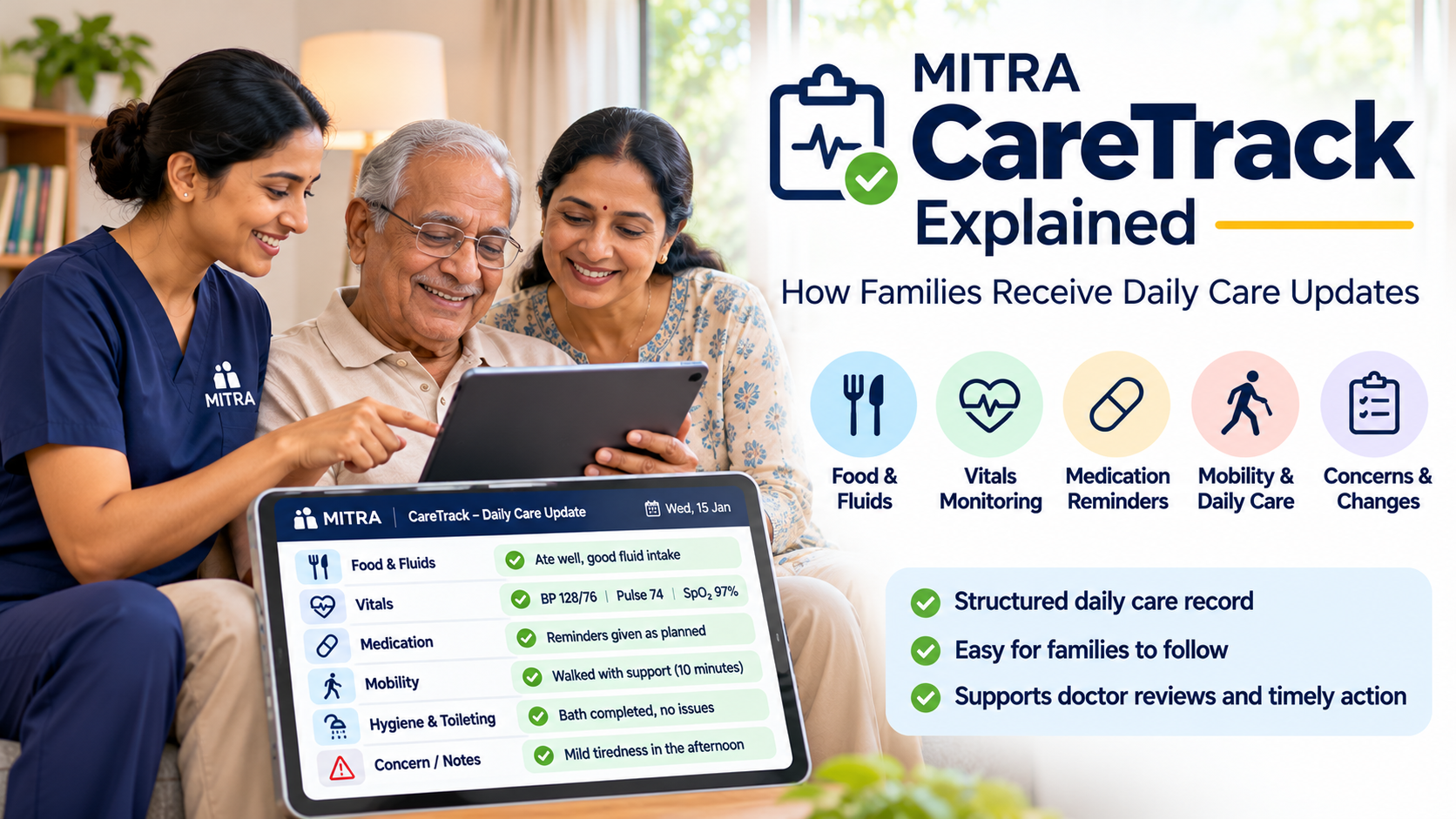
When a caregiver spends 12 or 24 hours with a parent at home, families often have a simple question: “How do I know what actually happened during the day?” A phone call saying “everything is fine” gives very little information. MITRA's CareTrack is designed to create a structured daily record of relevant care activities, observations and vital signs so home care does not depend entirely on memory, WhatsApp messages or verbal handovers. MITRA currently includes daily care tracking in its managed caregiving services.
What is MITRA CareTrack?
CareTrack is MITRA's daily caregiving and observation record. The caregiver records relevant information from the patient's routine so that important details are not lost between:- Caregiver- Family- MITRA care team- Doctor reviewsMITRA's existing provider guide describes CareTrack as the structured record used to follow day-to-day care information after a caregiver joins the home.
CareTrack, LabTrack and MiTrack: what is the difference?
| System | Main purpose ||||| CareTrack | Daily caregiving activities, observations and vitals || LabTrack | Laboratory reports and test-result trends || MiTrack | The broader MITRA record bringing CareTrack and LabTrack information together |
Why are structured daily care updates useful?
Home care happens continuously, but family members may only see the patient for a few hours each day — or may live in another city or country. Without structured documentation, information can disappear into conversations such as:- “She ate less today.”- “BP was a little high.”- “He did not walk much.”- “There was some loose motion.”- “He seemed unusually sleepy.”A care record helps preserve what happened, when it happened and whether it is changing over time.
What does a caregiver record in CareTrack?
The exact documentation depends on the patient's care plan, but CareTrack can cover major areas of everyday home care. MITRA's current public descriptions include food and fluid intake, medication routines, mobility, bowel and bladder patterns, basic observations and changes noticed by the provider.
| CareTrack area | Examples | ||
| Food & fluids | Meals, reduced intake, hydration concerns | ||
| Vitals | BP, pulse, temperature, oxygen saturation where prescribed | ||
| Medication reminders | Whether scheduled reminders were provided | ||
| Mobility | Walking, transfers, repositioning | ||
| Hygiene & toileting | Bathing, toileting, continence support | ||
| Concern / other | New symptoms, behaviour changes, unusual observations |
Food and fluid tracking
Reduced food or fluid intake can be easy to miss when different family members and caregivers are involved. Structured recording can help identify patterns such as:- Eating progressively less- Refusing meals- Drinking very little- Difficulty feeding- Increased assistance required during mealsThis can be particularly relevant in older adults, patients recovering after hospitalisation and people with cognitive impairment.
Vital-sign tracking
Where monitoring forms part of the care plan, CareTrack can record relevant vital signs. MITRA's current service pages include vitals monitoring in managed caregiving, and MITRA states that its monitoring kit can include devices such as a blood-pressure monitor, pulse oximeter and glucometer.
Examples of vitals that may be tracked
- Blood pressure
- Pulse
- Temperature
- Oxygen saturation
- Blood glucose when instructed
- Other prescribed basic observations
What happens if a reading is abnormal?
MITRA states that readings outside configured normal ranges can be flagged within MiTrack, allowing changes to be identified during care and review. A flagged reading does not automatically mean there is an emergency or establish a diagnosis. It signals that the observation may need attention, repeat checking or escalation according to the care plan.
Medication reminders in CareTrack
Caregivers can provide medication reminders according to the patient's prescribed schedule when this is part of the care plan. CareTrack can help document the medication-reminder routine so that families and the care team have a clearer record of day-to-day support. A non-clinical caregiver should not independently prescribe, stop or change medicines. MITRA's Essential Daily Care service specifically distinguishes medication reminders from nursing procedures.
CareTrack is not a prescription chart
The system should not be interpreted as permission for a caregiver to make clinical decisions. Medication changes still require the appropriate doctor or treating team. Where medication administration requires nursing skill or another clinical procedure, the patient may require a nursing-level service rather than routine caregiving.
Mobility tracking
Changes in mobility can be important in home care. A caregiver may record whether the patient:- Walked as usual- Needed more assistance- Required a walker- Needed help transferring- Spent more time in bed- Could not complete a usual activityA gradual decrease in mobility may be clinically relevant even if there was no single dramatic event.
Hygiene and toileting updates
CareTrack can also provide structure around activities such as:- Bathing- Grooming- Toileting- Continence assistance- Repositioning- Personal hygieneThese are core elements of MITRA's Essential Daily Care service.
Why bowel and bladder changes matter
A caregiver may be the first person to notice a change such as:- New constipation- Increased loose stools- Reduced urine output- Increased toileting frequency- New continence difficultyCareTrack does not determine the cause, but recording a change makes it easier for the family or clinical team to decide whether further assessment is needed.
Recording concerns that do not fit a checkbox
Not every important observation belongs under meals, vitals or mobility. A Concern / Other entry allows relevant changes to be documented, such as:- New confusion- Unusual sleepiness- A fall- New pain- Behaviour change- Skin concern- Reduced interaction- Any observation the caregiver believes should be communicated
How do families receive daily care updates?
CareTrack creates an ongoing structured care history that families can use to follow what has been happening rather than relying only on occasional verbal summaries. MITRA's public service pages currently describe daily care updates through its care-tracking system as part of managed Essential Daily Care. This is especially useful when the main decision-maker is not physically present throughout the day.
CareTrack for children living away from their parents
For a son or daughter living elsewhere, the central problem is often not arranging a caregiver. It is visibility. Structured care tracking can help answer practical questions such as:- Did my parent eat?- Were the usual observations recorded?- Was mobility worse today?- Was there a new concern?- Is anything changing compared with previous days?MITRA specifically positions CareTrack and its family communication model as useful for relatives managing care remotely.
CareTrack is more useful than a daily WhatsApp message
WhatsApp remains useful for communication, but informal messages have limitations. They can be:- Inconsistent- Difficult to compare over time- Lost in a long chat- Dependent on who remembered to send the update- Difficult for a new caregiver to review retrospectivelyA structured care record creates continuity across days and caregivers.
How CareTrack supports doctor check-ins
MITRA includes scheduled doctor involvement within its managed caregiving model. MITRA currently states that its doctor checks the care record during scheduled reviews and can use the recorded information when considering changes to the care plan. This gives the doctor more context than a family trying to remember everything that happened during the previous two weeks.
How CareTrack supports clinical escalation
When a caregiver notices a concerning change, the purpose is not simply to record it and move on. MITRA's managed-care model includes a defined pathway for caregiver-to-care-team communication and escalation of relevant concerns. The appropriate response may range from continued observation to contacting the treating clinician or seeking urgent medical assessment.
CareTrack is not an emergency-monitoring service
This distinction is important. CareTrack does not continuously monitor the patient like a hospital bedside monitor, and MITRA is not an emergency-response service. If a patient develops severe chest pain, significant breathlessness, collapse, major bleeding or another medical emergency, families should seek emergency medical care rather than waiting for CareTrack review. MITRA's current support information explicitly states that its service does not replace emergency care.
CareTrack during post-surgery nursing
CareTrack is also used in MITRA's postoperative nursing services. Current Post-Surgery Care Advanced pages state that registered nurses document relevant observations and care activities through CareTrack while maintaining communication with the MITRA doctor. This makes the system useful beyond basic elderly caregiving.
CareTrack helps when the patient's condition changes
The patient's original care plan may no longer be enough if daily records begin showing: - Increasing dependency- Reduced mobility- More frequent concerns- New monitoring requirements- Repeated abnormal observations- New nursing needs MITRA's current managed-care model allows the care requirement to be reassessed when the patient's condition changes.
CareTrack helps when a caregiver is replaced
One of the biggest problems with changing caregivers is loss of continuity. A new caregiver may otherwise arrive knowing very little about what happened during the previous weeks. MITRA specifically notes that the care plan and MiTrack history mean a replacement caregiver does not have to start from zero.
CareTrack and caregiver attendance are different
MITRA's provider-management system separately supports caregiver check-in and check-out monitoring, including OTP-based attendance workflows. Together, attendance and care documentation answer two different questions: Did the caregiver attend?andWhat happened during care?
CareTrack vs a handwritten notebook
| Handwritten care notebook | CareTrack | ||
| Can be inconsistent | Structured fields | ||
| Difficult to search | Historical record | ||
| May be lost | Digitally maintained | ||
| Hard to compare trends | Easier longitudinal review | ||
| Depends on individual writing style | Standardised categories | ||
| Often stays inside the home | Can support wider care-team communication |
Does CareTrack mean every patient needs constant vital monitoring?
No. Monitoring should match the patient's actual care plan. A stable person who primarily needs bathing, meals and companionship may not need frequent vitals simply because the equipment exists. More monitoring is not automatically better care. The useful question is whether the information being collected can reasonably help manage that particular patient.
Does CareTrack replace the caregiver's judgement?
No. A digital record cannot replace observation and communication. If a caregiver sees a significant change, they should follow the appropriate escalation pathway rather than assuming that entering the information into CareTrack is enough. The system supports caregiving; it does not automate responsibility.
Does the family need to buy monitoring equipment?
MITRA currently states that its managed caregiving plans include a monitoring kit for the duration of care, which can include devices such as a BP monitor, pulse oximeter and glucometer. The equipment is collected when the care plan ends; routine consumables such as glucometer strips remain the family's responsibility.
How is CareTrack different from LabTrack?
CareTrack focuses primarily on day-to-day care and observations. LabTrack focuses on laboratory results. MITRA states that when tests are performed through its system, LabTrack can store the report and structured values such as:- Test- Result- Unit- Reference range- DateThis allows laboratory trends to be reviewed separately from daily caregiver observations.
See how MITRA organises laboratory reports and tracks test-result trends
Is CareTrack included in every MITRA caregiving option?
CareTrack forms part of MITRA's managed-care offerings, but not every stripped-down caregiver option necessarily includes the same technology and clinical-support layer. For example, MITRA's current Caregiver Lite page specifically lists daily care updates through its care-tracking system among the features not included in that lower-service offering.
Frequently asked questions
What is MITRA CareTrack?
CareTrack is MITRA's structured digital record for relevant daily caregiving activities, observations and vital signs. It helps create continuity between the caregiver, family and MITRA care team.
What does CareTrack record?
Depending on the patient's care plan, it can include information about:- Food and fluids- Vitals- Medication reminders- Mobility- Hygiene and toileting- Relevant concerns or changesOther plan-specific observations may also be documented.
Can families use CareTrack when they live outside Bengaluru?
Yes. Structured care tracking is particularly useful for families who are not physically present throughout the day because it provides a clearer history of care than relying entirely on verbal updates. MITRA's current managed-care model combines CareTrack with family communication and clinical support.
Does CareTrack alert a doctor automatically in an emergency?
CareTrack and MiTrack can flag relevant abnormal observations and support MITRA's escalation pathway, but they should not be treated as an emergency alarm system. A medical emergency requires immediate emergency assessment rather than waiting for a digital notification or scheduled doctor review.
Can CareTrack help if the caregiver changes?
Yes. The historical care record can help the replacement caregiver and care team understand recent routines, observations and changes rather than rebuilding the patient's history entirely from memory. MITRA specifically highlights continuity of the care plan and MiTrack history during replacements.
Need care at home in Bengaluru? See MITRA services.
Related articles
Home Care Guides · 19 min read
Personalised Home Care Plans: How MITRA Decides What Care a Patient Actually Needs
A home care plan should be based on what a person actually needs help with — not simply their age or diagnosis. See how MITRA assesses daily activities, mobility, nursing requirements, night needs, family support and preferences before structuring personalised home care.
Fri, 6 Nov 2026
Home Care Guides · 15 min read
Doctor-Guided Home Care at MITRA: What Doctor Check-Ins Actually Include
MITRA caregiving plans include doctor check-ins as part of ongoing home care. See what the doctor reviews, how CareTrack and LabTrack support the review, when the care plan may change, and what doctor oversight does not replace.
Thu, 5 Nov 2026
Home Care Guides · 11 min read
MITRA LabTrack Explained: How Home Test Results Stay Organised
LabTrack is MITRA's structured record for laboratory results during home care. See how reports, individual test values, reference ranges and dates are organised, how trends can be followed over time, and how LabTrack works alongside CareTrack and doctor check-ins.
Wed, 4 Nov 2026