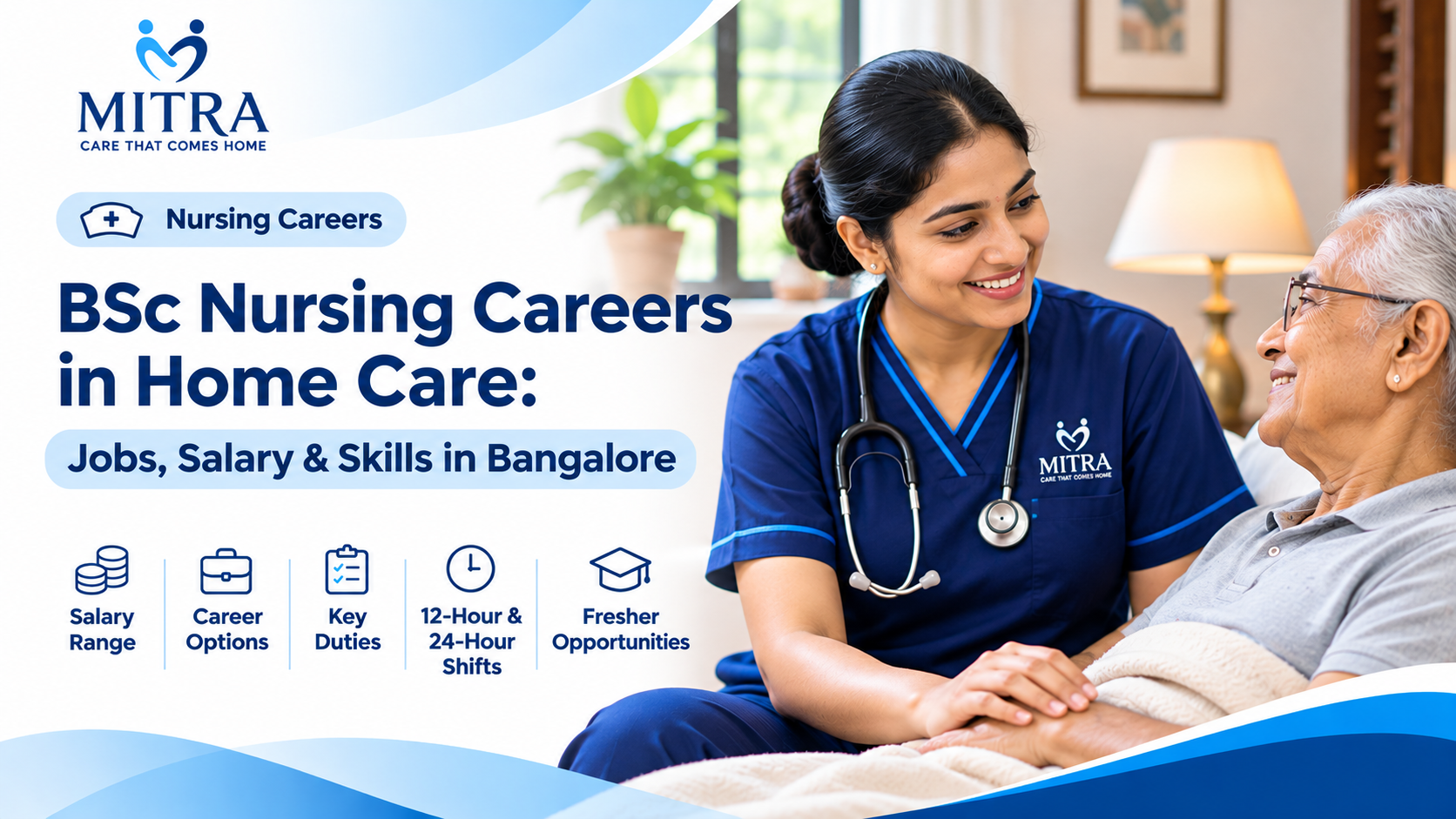
BSc Nursing Careers in Home Care: Jobs, Salary & Skills in Bangalore
Completed BSc Nursing and considering home healthcare in Bangalore? Learn what BSc nurses do in home care, salary ranges, 12-hour and 24-hour shifts, opportunities for freshers, clinical responsibilities and the skills that help build a career outside the hospital.
Written by Dr. Sanjay Kumar K A
Published Sun, 8 Nov 2026 · 16 min read
After four years of nursing education, many BSc Nursing graduates immediately begin looking for:- Staff nurse vacancies- Hospital jobs- ICU positions- Ward nursing- OT nursing- Emergency nursingBut a hospital is not the only place where professional nursing happens. A growing part of patient care takes place inside the patient's home. For BSc Nursing graduates, home healthcare can offer a career built around one-to-one patient care, long-term recovery, elderly care and greater continuity with the same patient.
What is BSc Nursing?
The Indian Nursing Council lists Basic BSc Nursing as a four-year university nursing programme leading to R.N. & R.M. registration. It also separately recognises Post-Basic BSc Nursing as an additional nursing qualification for eligible registered nurses. Both BSc and Post-Basic BSc Nursing candidates can pursue employment across multiple healthcare settings, including home healthcare
Can BSc Nursing graduates work in home healthcare?
Yes. Current Bengaluru home-care recruitment includes BSc Nursing alongside qualifications such as GNM, ANM, Post-Basic BSc and MSc Nursing. Some current listings also explicitly welcome freshers. MITRA currently accepts:- BSc Nursing- Post-Basic BSc Nursing- MSc Nursing- GNM- ANMunder its medical-background home-care pathway.
What kind of career can a BSc nurse build in home care?
Home healthcare can expose BSc nurses to areas such as:- Elderly care- Post-surgical recovery- Post-hospitalisation care- Bedridden patient care- Neurological recovery- Long-term nursing- Medication administration- Wound care- Tube and catheter care- Patient monitoring- Rehabilitation support- Family communication- Care documentation Unlike short procedure-based visits, long-duration home-care assignments may allow the nurse to follow the same patient's progress over several weeks or months.
What does a BSc home care nurse actually do?
A home nurse usually combines: everyday patient care with prescribed nursing responsibilities appropriate to their qualification and competency. At MITRA, nursing and allied-health providers perform the same basic daily care expected from other caregivers, with additional clinical duties where prescribed.
Personal care remains part of home nursing
This is one of the most important things for BSc Nursing candidates to understand. MITRA explicitly states that its nurses and allied-health providers may also need to provide:- Bathing or sponge bathing- Oral hygiene- Dressing- Toileting- Bedpan or urinal assistance- Diaper changes- Feeding- Hydration support- Mobility assistance- Transfers- Positioning and repositioning MITRA specifically tells medical-background applicants that bathing, toileting and feeding are part of its home-care jobs.
What clinical responsibilities may a BSc nurse have at home?
Depending on the patient's prescription, condition and the nurse's competency, responsibilities may include:- Blood-pressure monitoring- Pulse monitoring- Temperature monitoring- Oxygen-saturation monitoring- Blood-glucose monitoring- Prescribed oral medicines- Prescribed injections- Insulin administration- Ryle's-tube feeding- Urinary catheter care- Tracheostomy care- Suctioning- Colostomy care- Wound dressings- Bedsore care- Nebulisation- Home oxygen support- Post-discharge monitoring MITRA currently limits these activities to what is prescribed by the patient's doctor and within the provider's qualification
Does every BSc home nurse perform advanced procedures?
No. A BSc degree does not automatically mean every placement will involve complex clinical procedures. One patient may mainly need: - Medicines- Vitals- Mobility support- Personal care Another may need: - Tube feeding- Catheter care- Wound dressings A higher-dependency patient may require:- Tracheostomy care- Suction- More frequent monitoring The assignment should be based on the patient's actual care requirement and the nurse's competency.
Does BSc Nursing automatically mean a higher salary than GNM?
Not necessarily. Qualification is only one part of home-care pay. At MITRA, the medical-background pay level is based on the provider's:- Qualification- Skills- Experience- Care level- ShiftMITRA's careers page states that providers can move to higher levels as they gain experience and positive feedback. A newly graduated BSc nurse therefore should not assume that the degree automatically places them above an experienced GNM nurse in every home-care assignment.
Can BSc Nursing freshers work in home care?
Yes. MITRA currently states that fresh nursing graduates are welcome to apply under its medical-background pathway. Current Bengaluru home-healthcare listings also include BSc Nursing freshers among eligible candidates for some positions.However, the complexity of the patient should match the fresher's actual practical skills.
What kind of first patient is suitable for a BSc Nursing fresher?
here is no universal answer. But a first home-care assignment should ideally involve clinical responsibilities the nurse can safely and confidently perform. Before accepting, understand:- Patient mobility- Level of dependency- Feeding requirements- Toileting needs- Existing medical devices- Nursing procedures- Nighttime requirements- Frequency of medications- Escalation support A fresher should be particularly cautious about accepting a patient whose requirements exceed their practical experience.
What skills should a BSc Nursing fresher strengthen?
Important skills include: - Accurate vital-sign measurement- Medication safety- Infection prevention- Patient positioning- Safe transfers- Pressure-area care- Basic wound care- Tube-feeding principles- Catheter-care principles- Communication- Documentation- Clinical observation- Escalation- Emergency recognition Home healthcare also requires confidence working independently.
Why home nurses need strong observation skills
A nurse may spend 12 or 24 hours with a patient. That gives them an opportunity to notice subtle changes that may not be obvious during a short consultation. Examples include:- Reduced appetite- New confusion- Increasing assistance required for walking- New breathlessness- Fever- Reduced urine output- Worsening pain- Changes in wounds- Reduced activity- Changes in behaviour The nurse's responsibility is to observe, document and escalate appropriately, not independently diagnose every change.
Documentation can become one of your strongest skills
Good documentation is specific. For example: Poor note:“Patient tired.” Better note:“Patient remained in bed for most of the afternoon despite normally sitting in the chair after lunch and required more assistance than usual during transfer.” The second entry communicates an observable change rather than an unsupported conclusion. MITRA currently requires providers to document daily care through CareTrack, with medical staff also maintaining relevant clinical records.
Communication with families is part of the job
In hospital nursing, much of your professional communication is with other healthcare workers. In home nursing, family communication becomes much more important. A BSc nurse may need to explain:- What happened during the shift- Whether medicines were given- How much the patient ate- Mobility changes- Relevant observations- Concerns that were escalated- What the next caregiver should watch for Being clinically competent but unable to communicate clearly can make a home assignment difficult.
How much can a BSc home nurse earn in Bangalore?
There is no single Bengaluru salary for every BSc home nurse. Current public vacancies vary significantly. For example, recent Bengaluru listings reviewed for this article include home-care roles advertising ranges from approximately ₹20,000–₹25,000 in some fresher/live-in roles to broader ranges extending above ₹40,000 in other home-healthcare listings. These are individual job advertisements, not a guaranteed market salary. Actual pay depends on:- Employer- Shift- Experience- Patient requirements- Clinical complexity- Food/accommodation- Role type- Duration
What does MITRA currently pay BSc Nursing and other medical-background providers?
| Care level | 12-hour shift | 24-hour live-in | ||
| Basic caregiving | ₹25,000/month | ₹30,000/month | ||
| Advanced caregiving | ₹30,000/month | ₹35,000/month |
What is a 12-hour BSc Nursing home-care job?
A 12-hour assignment usually involves either a day or night shift in the patient's home. MITRA currently describes typical timings as: Day: around 8 AM–8 PMNight: around 8 PM–8 AM For current MITRA 12-hour placements:- The nurse returns home after the shift- Accommodation is not provided- Lunch is provided by the familyExact timings can differ by family.
What is a 24-hour live-in BSc Nursing role?
In a 24-hour placement, the provider stays at the patient's residence. Under MITRA's current model:- Accommodation is provided by the family- Three meals are provided- Rest time is agreed before the placement starts MITRA currently offers placements of 1, 3 or 6 months, with some families renewing beyond the original period.
Does 24-hour duty mean working continuously for 24 hours?
A live-in arrangement should not be understood as 24 hours of nonstop physical work. However, nighttime requirements matter enormously. Before accepting a live-in case, ask:- Does the patient sleep through the night?- Is toileting required?- Does the patient need repositioning?- Is suctioning required?- Is medication required overnight?- Is the patient confused or wandering?- How often is the nurse expected to wake? MITRA states that rest arrangements should be agreed before the placement begins.
12-hour vs 24-hour BSc Nursing work
| 12-hour | 24-hour live-in | ||
| Return home after duty | Stay with patient | ||
| Daily commute | Usually no daily commute | ||
| Day/night options | Residential arrangement | ||
| Accommodation not included | Accommodation provided | ||
| Lunch provided by MITRA family | Three meals provided | ||
| ₹25k–₹30k current MITRA medical range | ₹30k–₹35k current MITRA medical range | ||
| Clearer work/home separation | Work and living environment overlap |
What should a BSc nurse ask before taking a patient?
- What is the patient's diagnosis?
- What is their present functional condition?
- Can they walk?
- Are they bedridden?
- Can they eat independently?
- Is diaper care required?
- Are transfers required?
- Is there an NG/Ryle's tube?
- Is there a catheter?
- Is there a tracheostomy?
- Is suctioning required?
- Are injections required?
- Are wound dressings required?
- What happens at night?
- What documentation is expected?
- Who should you contact when the condition changes?
- What is the shift?
- What is the salary?
- How long is the assignment?
- What are the leave and rest arrangements?
What does a normal home nursing shift look like?
The exact routine depends on the patient's care plan. A typical day may include: Morning: handover, toileting, bathing, breakfast, medicines and vitals. Late morning: mobility, repositioning, prescribed nursing procedures and documentation. Afternoon: meals, hydration, toileting, observation and medication. Evening: personal care, medicines, clinical observations, CareTrack update and handover. MITRA publishes a similar sample 12-hour day on its careers page.
Is BSc home nursing only for elderly patients?
No. Although elderly care is a major part of home healthcare, assignments may also involve:- Younger patients recovering from trauma- Post-operative patients- Neurological rehabilitation- Long-term disability- Chronic illness- Post-hospitalisation recovery- Patients requiring ongoing nursing proceduresThe care environment is the patient's home; the age group can vary.
Can BSc nurses work in post-surgery home care?
Yes. Depending on the patient's discharge plan and the nurse's competency, post-surgical home nursing may involve:- Medication administration- Vitals- Wound observation or prescribed dressing care- Mobility assistance- Feeding- Toileting- Monitoring recovery- Following discharge advice- Escalating concernsMITRA currently lists post-hospital and post-surgery recovery as areas in which its nurses can build experience.
Can BSc nurses work with bedridden patients?
Yes. Bedridden patient care may involve substantial hands-on work including:- Bathing- Diaper care- Positioning- Repositioning- Feeding- Skin observation- Pressure-area care- Mobility assistance- Bed-to-chair transfer where appropriate- Clinical procedures required by the care planCandidates should be comfortable with this level of personal care before accepting such an assignment.
What personal qualities matter in home nursing?
A strong BSc nurse in home care should be: - Reliable- Patient- Observant- Respectful- Comfortable with intimate personal care- Calm under pressure- Good at documentation- Clear in communication- Able to maintain boundaries- Willing to ask for help- Comfortable working independently The patient's family sees the nurse's work closely every day. Professional behaviour therefore matters as much as technical skill.
Why dignity is a clinical skill too
Patients receiving home care may depend on the nurse for very private activities. Good care includes:- Explaining before touching the patient- Providing privacy during bathing- Keeping the patient covered appropriately- Avoiding unnecessary exposure- Allowing the patient to move at their own pace- Supporting independence where possible- Speaking respectfully- Remaining patient when cognition is impaired MITRA makes dignity and respectful behaviour explicit expectations for every provider.
Do BSc nurses need nursing council registration?
Basic BSc Nursing is listed by the Indian Nursing Council as leading to R.N. & R.M. registration. Professional nursing roles should comply with applicable registration requirements. MITRA currently asks nurses to provide their council-registration information during verification.
What documents should BSc Nursing applicants keep ready?
MITRA's current verification process asks candidates to keep documents such as:- Aadhaar- PAN- Recent photograph- Active WhatsApp number- Nursing qualification certificates- Nursing council registration- Experience letters where availableBackground verification is completed before a provider begins with a family.
Do BSc nurses have to pay MITRA for placement?
No. MITRA currently states that: application + training + placement are free. Providers do not pay MITRA a placement fee.
Who pays the nurse?
Under MITRA's current model, the family hires the provider and pays the monthly salary directly. The amount is agreed before the placement begins. MITRA is paid separately by the family for matching and ongoing support.
Does applying guarantee a job?
No. Applying places an eligible candidate into MITRA's provider pathway. Placement depends on:- Patient requests- Qualification- Skills- Experience- Location- Languages- Shift availability- Whether the provider accepts the assignment- Whether the family selects themMITRA explicitly states that joining its pool does not guarantee work or salary.
Can BSc nurses choose day, night or live-in work?
Yes. MITRA currently allows applicants to indicate whether they prefer:- Day shifts- Night shifts- 24-hour live-in assignmentsCandidates can also indicate the Bengaluru areas they are willing to work in.
Does a BSc nurse need to speak English?
Not for every patient. MITRA states that English is not compulsory for every placement. Candidates provide the languages they speak and can be matched accordingly. In Bengaluru, languages such as:- Kannada- Hindi- Tamil- Telugu- Malayalam- Englishmay help a nurse communicate with different families.
Can male BSc nurses apply?
Yes. MITRA currently accepts both men and women. Some families may prefer a male or female provider depending on:- Patient preference- Personal-care requirements- Mobility needs- Cultural comfort MITRA matches accordingly.
What support does MITRA provide during a placement?
MITRA currently describes provider support including: - Patient information before acceptance- Free training- Free uniform- Salary agreed before joining- Coordinator support- Doctor support- Safety support- Experience certificates- Matching with another family after a placement ends For nursing-care assignments, MITRA currently states that doctor check-ins occur every two weeks.
Can home care experience strengthen a BSc Nursing CV?
It can demonstrate practical experience in:- Elderly care- Bedside nursing- Long-term care- Post-surgical recovery- Patient monitoring- Medication management- Nursing procedures- Documentation- Family communication- Independent working MITRA currently gives providers an experience certificate after completed placements showing their role, care type and dates.
BSc home care nursing vs hospital nursing
| Home care | Hospital | ||
| Often one patient | Multiple patients | ||
| Long continuity | Frequent patient turnover | ||
| More independent work | Larger team immediately available | ||
| Personal care commonly included | Responsibilities may be shared | ||
| Patient's home | Hospital environment | ||
| Family interaction is frequent | More clinical-team interaction | ||
| 12-hour/live-in work common | Hospital roster system | ||
| Care plan revolves around one patient | Ward workflow manages several patients |
Does working in home care waste a BSc Nursing degree?
No. The setting does not determine whether nursing is “real nursing.” A home-care nurse may still use:- Assessment skills- Medication knowledge- Clinical observation- Nursing procedures- Documentation- Patient education- Communication- Escalation- Long-term care principlesThe important question is whether the role develops the skills relevant to the career you want.
Can BSc home care lead to higher-responsibility roles later?
Potential career progression depends on the employer and experience accumulated. Over time, home-healthcare nurses may build experience relevant to roles involving:- Senior home-care nursing- Complex-care assignments- Patient coordination- Care-plan implementation- Provider supervision- Clinical operations- Training- Case management MITRA currently states that medical-background providers can move to higher care levels as they gain experience and good feedback.
Frequently asked questions
Can a BSc Nursing fresher apply to MITRA?
Yes. MITRA currently welcomes fresh nursing graduates under the medical-background pathway. The care level and salary depend on skills and experience.
What is the current MITRA salary for BSc nurses?
MITRA's current medical-background structure ranges from: ₹25,000/month for basic 12-hour care to ₹35,000/month for advanced 24-hour live-in care. A BSc qualification alone does not automatically determine the care level.
Do BSc nurses have to bathe patients?
Yes, bathing and other personal-care tasks can be part of MITRA's home nursing roles. MITRA specifically states that nurses and allied-health professionals must be comfortable with bathing, toileting and feeding.
Can BSc nurses give injections at home?
Prescribed injections may form part of a home nursing assignment where the procedure falls within the nurse's qualification and competency. The nurse should not independently prescribe or change treatment.
Does MITRA provide food and accommodation?
For current MITRA placements: 12-hour: accommodation is not provided; lunch is provided. 24-hour live-in: accommodation and three meals are provided by the family.
Do I have to pay MITRA to get a placement?
No. MITRA states that application, training and placement are free for providers.
Can I choose only night duty?
Candidates can indicate their preferred shift, including night work. Actual placement depends on available patient requirements.
How long are MITRA placements?
MITRA currently describes placements of: 1 month3 months6 months Some families extend the arrangement further.
How BSc Nursing candidates join MITRA
- Apply through the medical-background form.
- Select BSc or Post-Basic BSc Nursing as your qualification.
- Provide nursing-registration details.
- Share your languages and preferred work areas.
- Select your shift preferences.
- Complete screening and background verification.
- Complete required training or competency review.
- Join MITRA's eligible provider pool.
- Receive suitable patient opportunities when available.
- Review the patient requirements.
- Decide whether you want the placement.
- The family considers suitable candidates.
- If selected and accepted, begin the assignment.
- The family pays your agreed salary monthly.
- MITRA continues coordination during the placement.
Completed BSc Nursing and looking for home-care opportunities in Bengaluru? MITRA currently accepts: BSc NursingPost-Basic BSc NursingGNMANMMSc Nursing for its medical-background provider pool. Freshers can apply. Available placements may include: 12-hour day duty12-hour night duty24-hour live-in workElderly carePost-hospital recoveryLong-term nursing
Need care at home in Bengaluru? See MITRA services.
Related articles
Nursing Careers · 10 min read
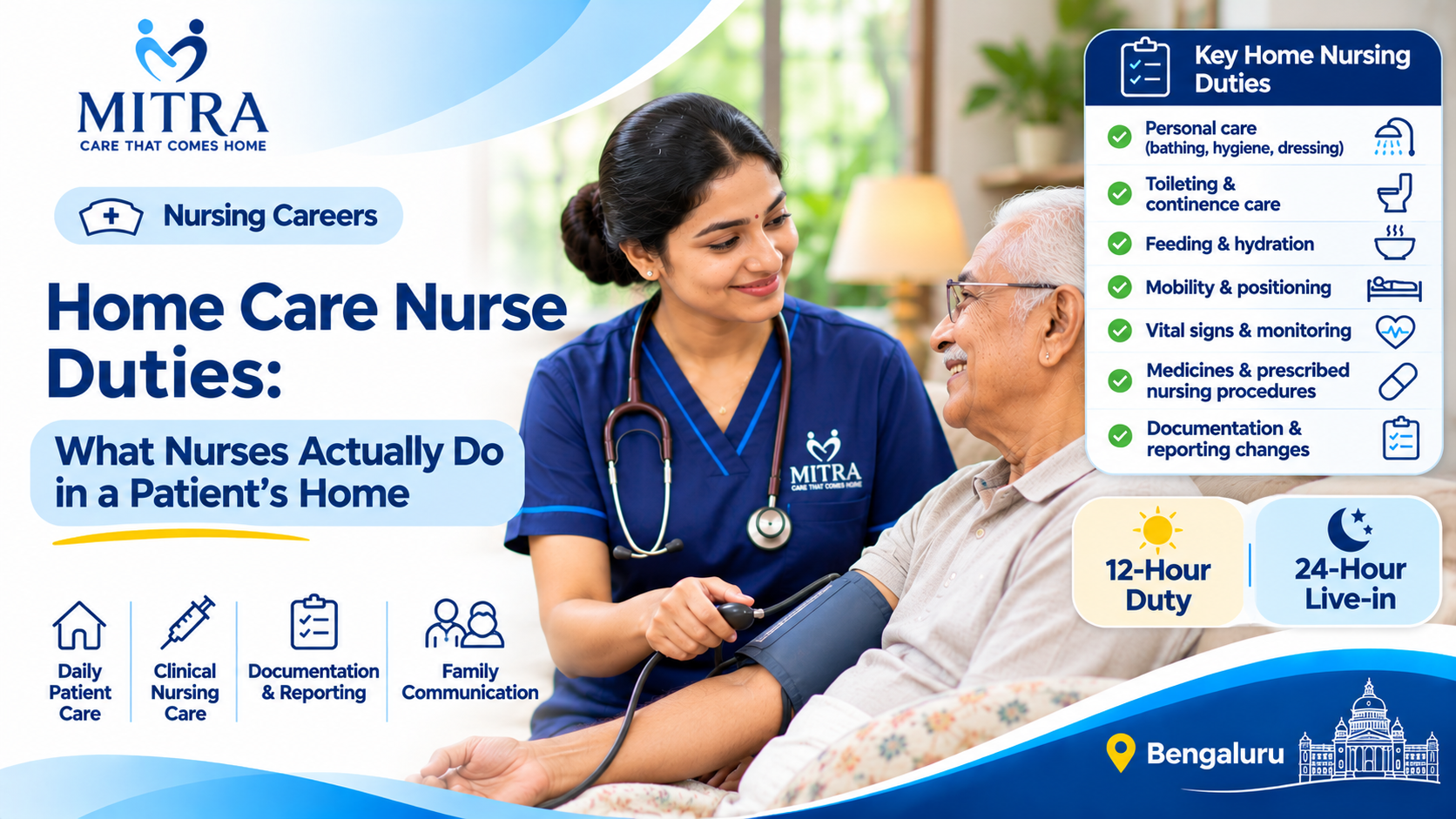
Home Care Nurse Duties: What Nurses Actually Do in a Patient’s Home
What does a home care nurse actually do during a 12-hour or live-in assignment? Understand personal care, medicines, vitals, feeding, mobility, nursing procedures, documentation, family communication and the duties that should remain outside the role.
Tue, 10 Nov 2026
Nursing Careers · 9 min read
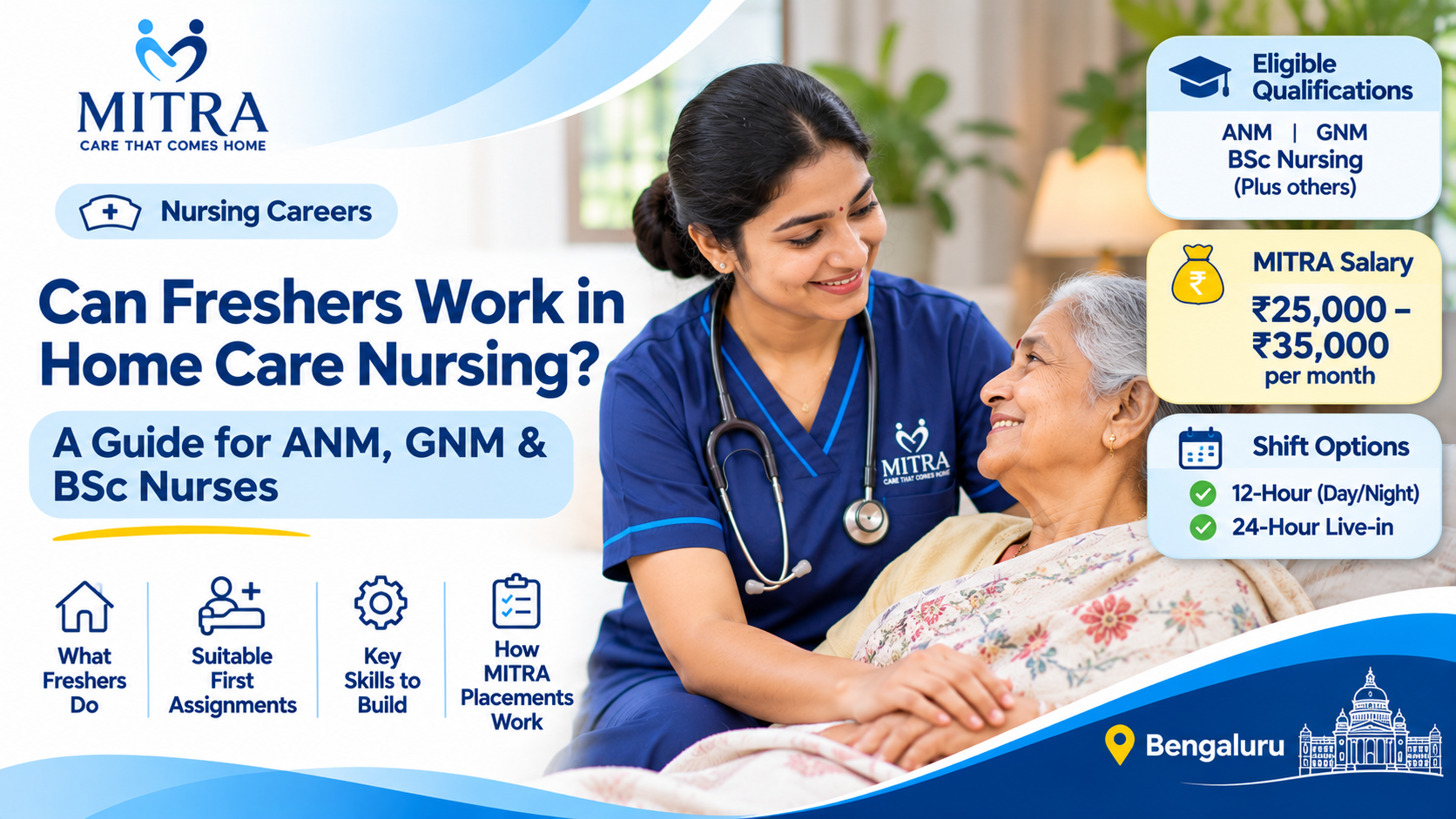
Can Freshers Work in Home Care Nursing? A Guide for ANM, GNM & BSc Nurses
Can ANM, GNM and BSc Nursing freshers work in home healthcare? Learn what fresh nurses can expect in Bangalore, suitable first assignments, salaries, 12-hour and 24-hour shifts, essential skills and how MITRA placements work.
Tue, 10 Nov 2026
Nursing Careers · 16 min read
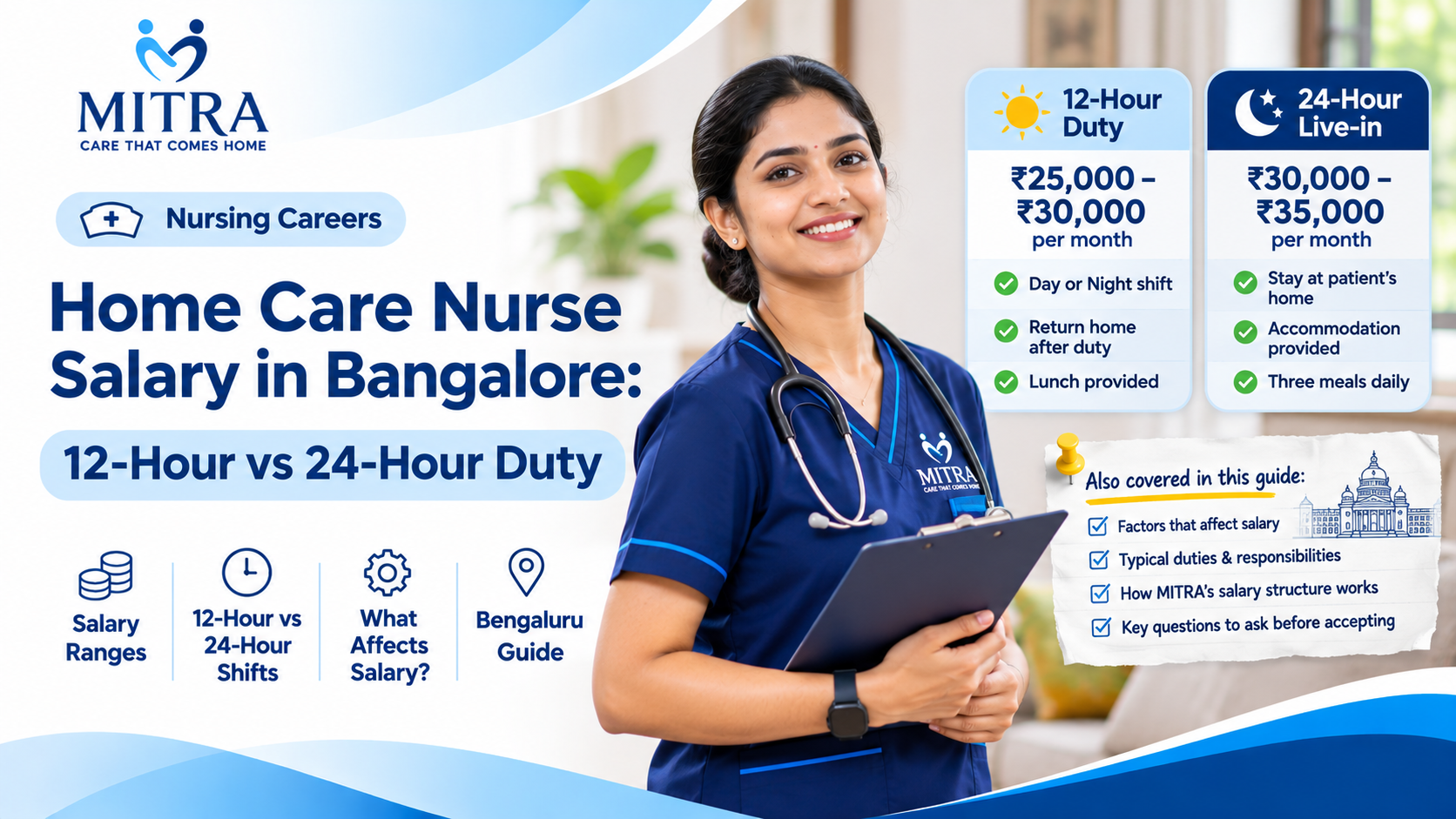
Home Care Nurse Salary in Bangalore: 12-Hour vs 24-Hour Duty
How much do home care nurses earn in Bangalore? Compare 12-hour and 24-hour live-in nursing salaries, understand what changes pay, what food and accommodation may be included, and see MITRA's current medical-background salary structure.
Mon, 9 Nov 2026