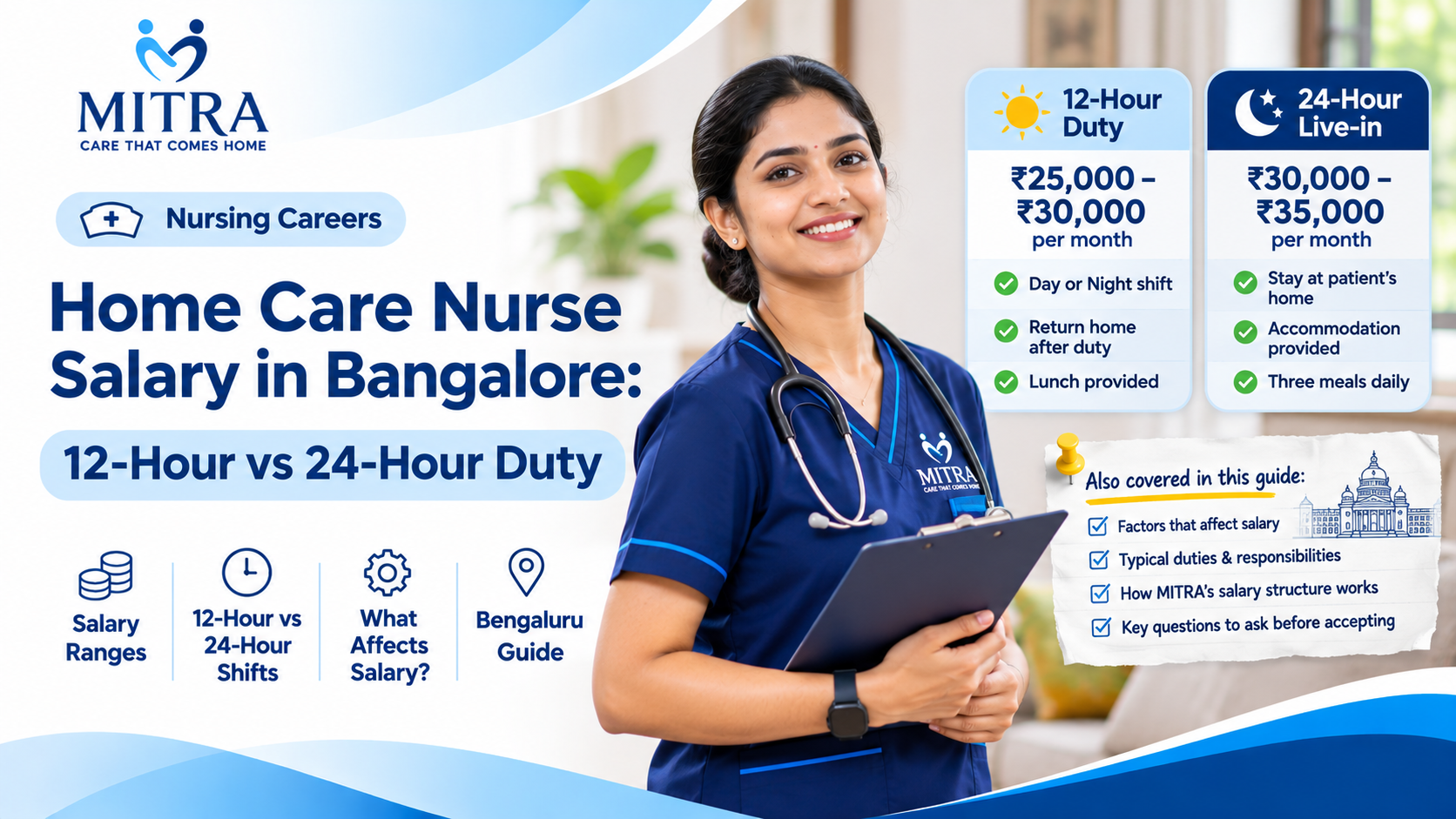
Home Care Nurse Salary in Bangalore: 12-Hour vs 24-Hour Duty
How much do home care nurses earn in Bangalore? Compare 12-hour and 24-hour live-in nursing salaries, understand what changes pay, what food and accommodation may be included, and see MITRA's current medical-background salary structure.
Written by Dr. Sanjay Kumar K A
Published Mon, 9 Nov 2026 · Updated Mon, 9 Nov 2026 · 16 min read
One of the first questions nurses ask before considering home healthcare is: “How much will I earn?” The answer is not one fixed number. In Bengaluru, home nursing salaries can vary according to:- Qualification- Experience- Patient dependency- Clinical responsibilities- 12-hour or 24-hour duty- Day or night shift- Food and accommodation- Employer or placement model- Duration of the assignmentA salary figure makes sense only when you understand the job attached to it.
What is the average home care nurse salary in Bangalore?
There is no single reliable salary figure that applies to every home care nurse in Bengaluru. Current public salary sources and job advertisements show substantial variation. Indeed currently reports an average home care nurse salary of about ₹37,554 per month in Karnataka, but that figure is based on only two reported salaries, so it should not be treated as a precise Bengaluru market benchmark. The same page lists Bengaluru at about ₹24,981 per month among nearby salary locations and shows current individual openings ranging from the low ₹20,000s to ₹50,000 or more. The more useful question is therefore: “What salary is being offered for this specific patient, shift and role?”
Why do home nursing salaries vary so much?
Home nursing is not one standard job. One nurse may care for an elderly person who needs:- Medicines- Vitals- Mobility support- Toileting- FeedingAnother may care for a patient requiring:- Tube feeding- Catheter care- Wound dressing- Suction- Tracheostomy care- Closer clinical observation Even if both jobs are advertised as “home nurse”, the workload and required skills are very different.
The main factors that affect home care nurse salary
- Nursing qualification.
- Practical experience.
- Clinical skills.
- Patient dependency.
- Procedures required.
- 12-hour vs 24-hour duty.
- Day vs night duty.
- Live-in requirement.
- Food and accommodation.
- Location and daily commute.
- Placement duration.
- Employer or placement model.
- Previous family feedback.
- Ability to manage higher-dependency patients.
What does MITRA currently pay medical-background providers?
| Care level | 12-hour shift | 24-hour live-in | ||
| Basic caregiving | ₹25,000/month | ₹30,000/month | ||
| Advanced caregiving | ₹30,000/month | ₹35,000/month |
Who qualifies for MITRA's medical-background salary pathway?
MITRA currently accepts candidates including:- ANM- GNM- BSc Nursing- Post-Basic BSc Nursing- MSc Nursing- OT technicians- Phlebotomists- Lab technicians- Dialysis technicians- Emergency medical technicians- Physiotherapy assistants- Other selected allied-health professionals The published medical-background range is currently ₹25,000–₹35,000 per month depending on care level and shift.
Does qualification alone decide the salary?
No. A BSc Nursing graduate does not automatically receive the highest salary simply because they hold a degree. Similarly, an experienced GNM nurse may be better suited to a complex patient than a newly qualified graduate. MITRA currently states that provider level is determined by:- Qualification- Skills- Experienceand that providers can move up as they gain experience and good feedback.
How much does a 12-hour home nurse earn at MITRA?
MITRA's current medical-background structure lists: ₹25,000/month for basic 12-hour care and ₹30,000/month for advanced 12-hour care. The exact level is confirmed for the individual placement before the provider begins.
What does a 12-hour shift mean?
MITRA currently describes two common 12-hour arrangements: Day shift: usually around 8 AM to 8 PM Night shift: usually around 8 PM to 8 AM. A 12-hour provider returns home after duty rather than staying at the patient's residence.
What is included in a MITRA 12-hour placement?
MITRA currently states that for 12-hour placements:- Accommodation is not provided- The provider goes home after duty- The family provides lunch The salary is paid monthly by the family.
How much does a 24-hour live-in nurse earn at MITRA?
MITRA's current medical-background salary structure lists: ₹30,000/month for basic 24-hour live-in care and ₹35,000/month for advanced 24-hour live-in care.
What does 24-hour live-in mean?
In a 24-hour placement, the provider stays at the family's home. MITRA currently states that the family provides:- Accommodation- Three meals per day The provider's rest arrangement is discussed before the placement begins.
Does 24-hour duty mean working continuously for 24 hours?
It should not. A live-in provider stays at the patient's home, but human beings still require adequate rest. MITRA currently states that rest time should be agreed before the placement begins. The actual workload depends heavily on what happens at night.
Why nighttime needs matter when comparing salary
Consider two 24-hour placements. Patient A:- Sleeps through most nights- Needs no regular overnight procedures- Needs occasional assistance onlyPatient B:- Wakes every two hours- Needs frequent toileting- Needs repositioning- Has confusion at night- Requires nursing procedures overnightBoth might be described as 24-hour live-in work. They are not equivalent workloads.
12-hour vs 24-hour salary at MITRA
| 12-hour | 24-hour live-in | |||
| Basic medical-background care | ₹25,000 | ₹30,000 | ||
| Advanced medical-background care | ₹30,000 | ₹35,000 | ||
| Accommodation | No | Yes | ||
| Meals | Lunch | 3 meals | ||
| Daily commute | Yes | Usually no | ||
| Stay at patient's home | No | Yes | ||
| Night responsibility | Only for night shift | Depends on patient needs |
Is a 24-hour salary automatically better?
Not necessarily. A nurse earning ₹35,000 in a live-in role may save on:- Daily commuting- Accommodation during the placement- MealsBut they may also: - Spend most of the month away from home- Have nighttime responsibilities- Have less separation between work and personal life- Need to adapt to living inside another family's homeThe better job depends on the individual candidate.
When a 12-hour job may be better
A 12-hour placement may suit nurses who:- Want to return home every day- Live close to the patient's area- Prefer clear work/home separation- Have family responsibilities- Prefer day or night duty rather than live-in work- Do not want residential assignmentsThe lower headline salary may still be the better personal option.
When a 24-hour job may be better
A live-in placement may suit candidates who:- Are comfortable staying at the patient's home- Want to avoid daily commuting- Are open to longer residential assignments- Are comfortable with the patient's nighttime needs- Prefer the higher live-in salary- Are willing to stay for the full placement The patient and rest arrangement still need to be appropriate.
Does day duty pay differently from night duty?
Not necessarily. MITRA's published table currently separates salary by 12-hour versus 24-hour and basic versus advanced care, rather than publishing a different standard salary for day and night 12-hour shifts. Individual arrangements should still be confirmed before joining.
Why a night shift can feel very different from a day shift
A night nurse may need to manage: - Toileting- Diaper changes- Repositioning- Confusion- Wandering- Sleep disturbance- Overnight medication- Monitoring- Staying alert while the household sleeps MITRA currently describes its typical 12-hour night duty as involving turning, toileting and remaining alert through the night.
Does the patient condition affect salary?
It should affect the level of provider required. MITRA distinguishes between basic and advanced medical-background caregiving. A patient needing straightforward daily assistance plus basic medical-background support may fit one level. A patient requiring greater skills or responsibility may require an advanced provider. MITRA currently states that role and level are based on qualification, skills and experience.
What kinds of duties can medical-background roles include?
MITRA currently describes medical-background responsibilities including, where prescribed and within qualification:- BP, pulse and temperature- Oxygen saturation- Blood glucose- Medication administration- Prescribed injections and insulin- Ryle's-tube feeding- Existing catheter care- Tracheostomy care- Suctioning- Colostomy care- Wound and bedsore dressings- Nebulisation- Home oxygen- Post-hospital recovery careThese are in addition to everyday patient-care duties.
Personal care is part of the salary too
Nurses should not assume that their salary covers only clinical procedures. At MITRA, medical-background providers are also expected to participate in everyday care such as:- Bathing- Toileting- Diaper changes- Feeding- Mobility- Transfers- Repositioning- Maintaining a safe patient environment- Companionship- Daily documentationMITRA explicitly states that bathing, toileting and feeding are part of its nursing and allied-health roles.
Does experience affect home nurse salary?
Yes. Experience can influence whether a nurse is considered suitable for higher-dependency patients. Useful experience can include:- Medical ward- Surgical ward- ICU- Elderly care- Post-surgery nursing- Rehabilitation- Long-term patient care- Home healthcareMITRA also states that providers may move to higher levels as they gain experience and good family feedback.
Can freshers earn the same as experienced nurses?
Not automatically. MITRA currently welcomes fresh nursing graduates but states that their care level and pay depend on their skills and experience. A fresher may therefore begin at a different level from an experienced nurse who can safely manage more complex patients.
Does BSc Nursing automatically pay more than GNM or ANM?
Not automatically under MITRA's current structure. MITRA publishes salary by care level and shift, not separate fixed salaries for ANM, GNM and BSc Nursing. Qualification matters, but so do:- Practical competency- Experience- Patient complexity- Care level
See how BSc Nursing graduates can build a career in home healthcare
See the GNM-specific home-care career and salary guide
See how ANM-qualified candidates fit into home healthcare
How do public home nursing salaries compare?
Public job advertisements in Bengaluru vary widely. Current listings surfaced by Indeed include examples around:- ₹21,500–₹24,500/month- ₹35,000–₹50,000/month- Broader annual salary ranges depending on employer and roleIndeed's Karnataka home-care nurse salary page also currently reports ₹37,554/month, although that average is based on only two salary reports and should be interpreted cautiously.
What should you compare between two salary offers?
| Question | Job A | Job B | ||
| Monthly salary | ? | ? | ||
| 12h or 24h | ? | ? | ||
| Patient walks? | ? | ? | ||
| Bedridden? | ? | ? | ||
| Diaper care | ? | ? | ||
| Night waking | ? | ? | ||
| Tube/catheter/tracheostomy | ? | ? | ||
| Wound care | ? | ? | ||
| Injections | ? | ? | ||
| Accommodation | ? | ? | ||
| Meals | ? | ? | ||
| Travel required | ? | ? | ||
| Placement length | ? | ? | ||
| Leave arrangement | ? | ? | ||
| Support available | ? | ? |
How much does commuting reduce the value of a 12-hour salary?
Consider a nurse who spends: 1.5 hours travelling each way for a 12-hour shift. That can turn a 12-hour workday into a 15-hour day away from home. Travel also creates:- Transport expense- Fatigue- Greater risk of lateness- Less personal timeThis is why location matters when evaluating a 12-hour placement. MITRA currently allows candidates to indicate which Bengaluru areas they are willing to work in.
Why food and accommodation have financial value
A live-in placement that includes accommodation and three meals may reduce some everyday expenses during the assignment. However, this should not be used to ignore:- Workload- Lack of privacy- Night interruptions- Living away from family- Rest requirementsBenefits have value, but they do not replace fair working conditions.
Who pays a MITRA nurse?
Under MITRA's current placement model: the family hires the provider and pays the salary directly. MITRA states that the amount is agreed before the provider starts and is paid monthly on the same date as the joining date.
Does MITRA deduct commission from the nurse's salary?
MITRA currently states that providers do not pay MITRA for matching, training or placement. Families pay MITRA separately for finding and supporting their caregiver or nurse.
When is salary paid?
MITRA currently states that the family pays the provider on the same date every month as the date they started. The agreed amount is confirmed before the placement begins.
Does joining the MITRA pool mean you start earning?
No. The MITRA pool is a list of screened providers ready to be matched with families. Joining the pool is free, but it is not salaried employment by itself. You begin earning once a family hires you for a placement.
Does applying guarantee a ₹25,000–₹35,000 salary?
No. The published range describes MITRA's current medical-background placement structure. Actual placement depends on:- Available family requirements- Your qualification- Skills- Experience- Shift preference- Location- Whether you accept the patient- Whether the family selects youMITRA explicitly states that joining its pool does not guarantee work.
How long are MITRA placements?
MITRA currently describes placements of: 1 month 3 months 6 months Families may renew longer-term arrangements. A longer placement can create more stable income, provided the patient and working arrangement are suitable.
Is monthly salary the same as permanent employment?
Not necessarily. Under MITRA's current model, providers are hired directly by the individual family for a placement. The placement has a defined duration. When it ends, MITRA can return the provider to its pool and look for another suitable family.
Can good performance lead to better-paying assignments?
MITRA currently states that providers can move up levels as they gain:- Experience- Positive family feedback It also advises providers to: - Respond quickly to opportunities- Keep availability updated- List all languages spoken- Maintain good feedback These factors can help a provider get chosen for future placements
Does language affect salary?
MITRA does not currently publish a standard language-based salary premium. However, language compatibility can affect how many families a provider can be matched with. MITRA asks providers to list all languages they speak and uses language during matching. In Bengaluru, useful languages may include:- Kannada- Hindi- Tamil- Telugu- Malayalam- English
Does gender affect salary?
MITRA does not currently publish different standard salaries for male and female providers. Both men and women can apply. Some families may request a particular gender based on patient preference or care requirements, but the published salary structure is based on care level and shift.
Questions to ask before accepting a salary
- What is the monthly salary?
- Who pays me?
- What date is salary paid?
- Is this 12-hour or 24-hour duty?
- Day or night shift?
- What is the patient's condition?
- Can the patient walk?
- Is the patient bedridden?
- Is diaper care required?
- What nursing procedures are required?
- What happens at night?
- How often will I be woken?
- Is food provided?
- Is accommodation provided?
- What is the rest arrangement?
- How far is the patient from my home?
- How long is the placement?
- What is the leave arrangement?
- Who supports me if there is a problem?
- What happens when the placement ends?
Red flags when discussing salary
Be cautious if someone:- Refuses to explain the patient's condition- Promises an unusually high salary but gives no duty details- Asks for a large placement fee- Changes the salary after you arrive- Says “24 hours” without discussing rest- Expects nursing procedures outside your competency- Adds household work that was not agreed- Refuses to confirm who will pay you- Cannot explain the duration of the assignment Clear terms protect both the provider and the patient.
Housework should not be hidden inside the salary
MITRA currently states that general household work for the family is not part of any standard MITRA caregiver or nursing job. That includes:- Cooking for the whole family- Cleaning the whole house- Washing the family's clothes- ChildcareIf a family wants extra household help, MITRA states that it must be agreed with the provider before the placement and paid separately.
What support comes with a MITRA placement?
MITRA currently describes provider support including:- Patient details before acceptance- Free training- Free uniform- Salary confirmed before joining- Coordinator support- Doctor support- Safety support- Experience certificate- Help finding another family after the placement endsFor nursing care, MITRA currently states that doctor check-ins occur every two weeks.
Frequently asked questions
What is the home care nurse salary in Bangalore?
There is no single salary across Bengaluru. Current public job listings vary considerably depending on qualification, employer, shift and patient requirements. MITRA's current published medical-background range is ₹25,000–₹35,000/month.
What is MITRA's 12-hour nurse salary?
MITRA currently publishes: ₹25,000/month for basic 12-hour medical-background care and ₹30,000/month for advanced 12-hour care
What is MITRA's 24-hour nurse salary?
MITRA currently publishes: ₹30,000/month for basic 24-hour live-in medical-background care and ₹35,000/month for advanced 24-hour care.
Is accommodation included in a 12-hour job?
No. MITRA currently states that accommodation is not provided for 12-hour work. The family provides lunch and the provider returns home after the shift.
Is accommodation included in a 24-hour job?
Yes, under MITRA's current live-in model. The family provides accommodation and three meals per day.
Do night-shift nurses get a different salary?
MITRA does not currently publish a separate standard day-versus-night salary table. Its published structure is based on care level and 12-hour versus 24-hour shift.
Who pays the nurse at MITRA?
The family pays the provider directly every month. MITRA states that the amount is confirmed before the placement begins.
Does MITRA charge nurses a placement fee?
No. MITRA currently states that applying, training and placement are free for providers.
Can freshers apply for these salaries?
Fresh nursing graduates can apply. Their actual care level and pay depend on skills and experience
How to think about home nurse salary
A good home-care offer is not simply the highest monthly number. A better question is: “Is this salary reasonable for the patient, workload, shift and living arrangement I am accepting?” For one candidate, a nearby ₹25,000 day-shift placement may work better than a ₹35,000 live-in assignment. For another candidate, the live-in option may be ideal. The right salary is connected to the right placement.
Looking for home nursing opportunities in Bengaluru? MITRA currently accepts medical-background applicants including: ANMGNMBSc NursingPost-Basic BSc NursingMSc NursingSelected allied-health professionals Current published medical-background salaries range from: ₹25,000 to ₹35,000 per month depending on care level and shift.
Need care at home in Bengaluru? See MITRA services.
Related articles
Nursing Careers · 10 min read
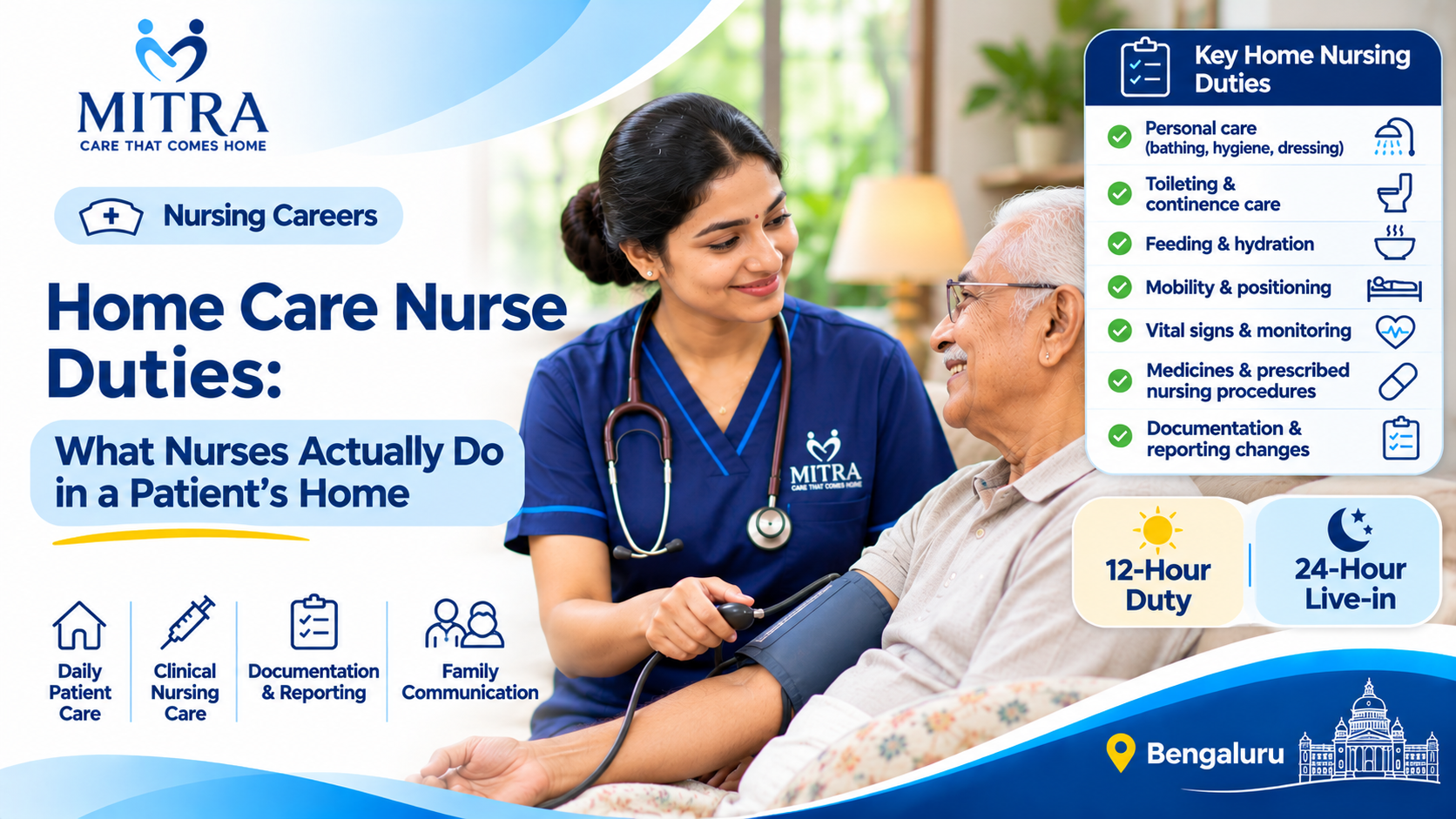
Home Care Nurse Duties: What Nurses Actually Do in a Patient’s Home
What does a home care nurse actually do during a 12-hour or live-in assignment? Understand personal care, medicines, vitals, feeding, mobility, nursing procedures, documentation, family communication and the duties that should remain outside the role.
Tue, 10 Nov 2026
Nursing Careers · 9 min read
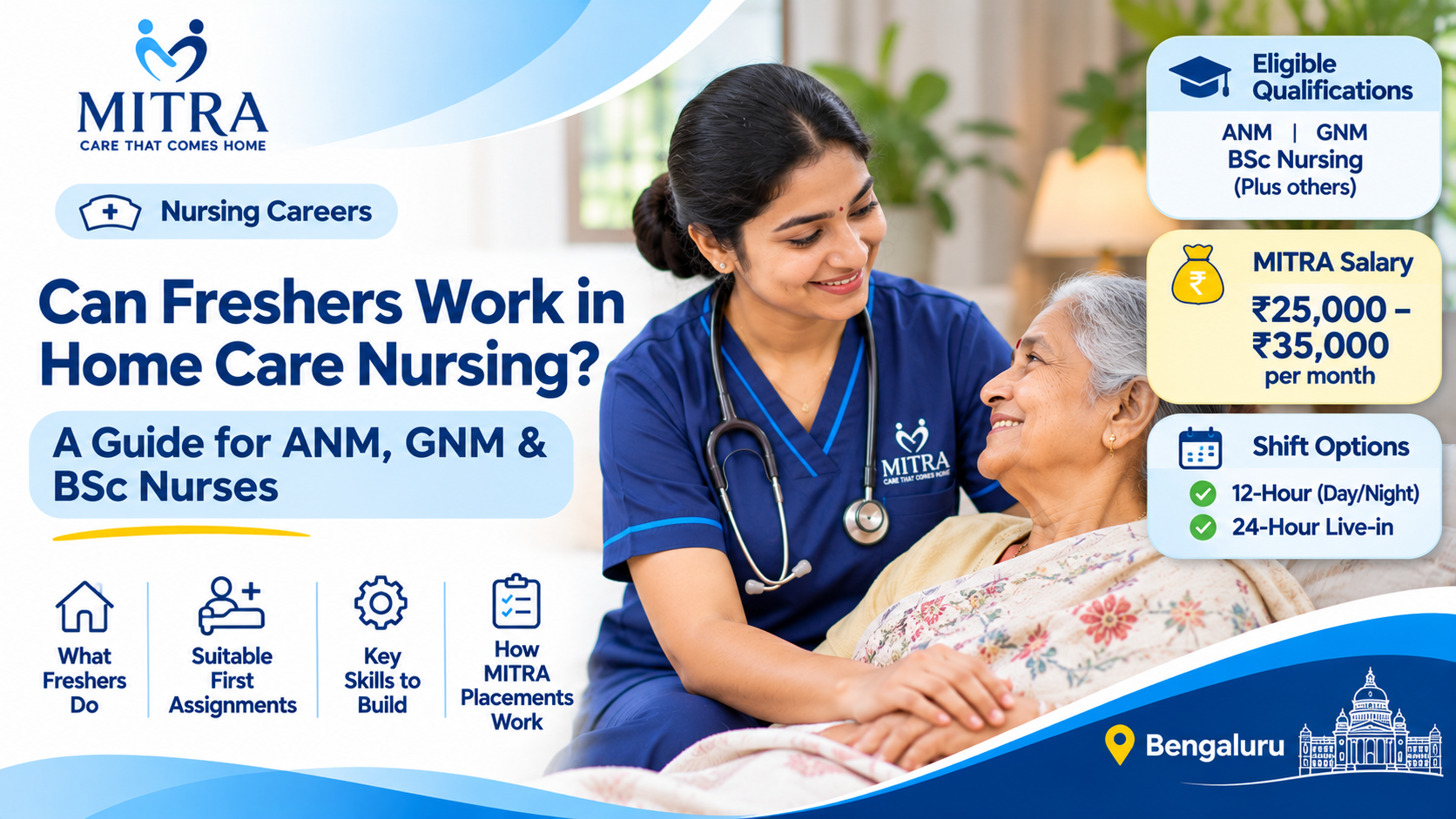
Can Freshers Work in Home Care Nursing? A Guide for ANM, GNM & BSc Nurses
Can ANM, GNM and BSc Nursing freshers work in home healthcare? Learn what fresh nurses can expect in Bangalore, suitable first assignments, salaries, 12-hour and 24-hour shifts, essential skills and how MITRA placements work.
Tue, 10 Nov 2026
Nursing Careers · 15 min read
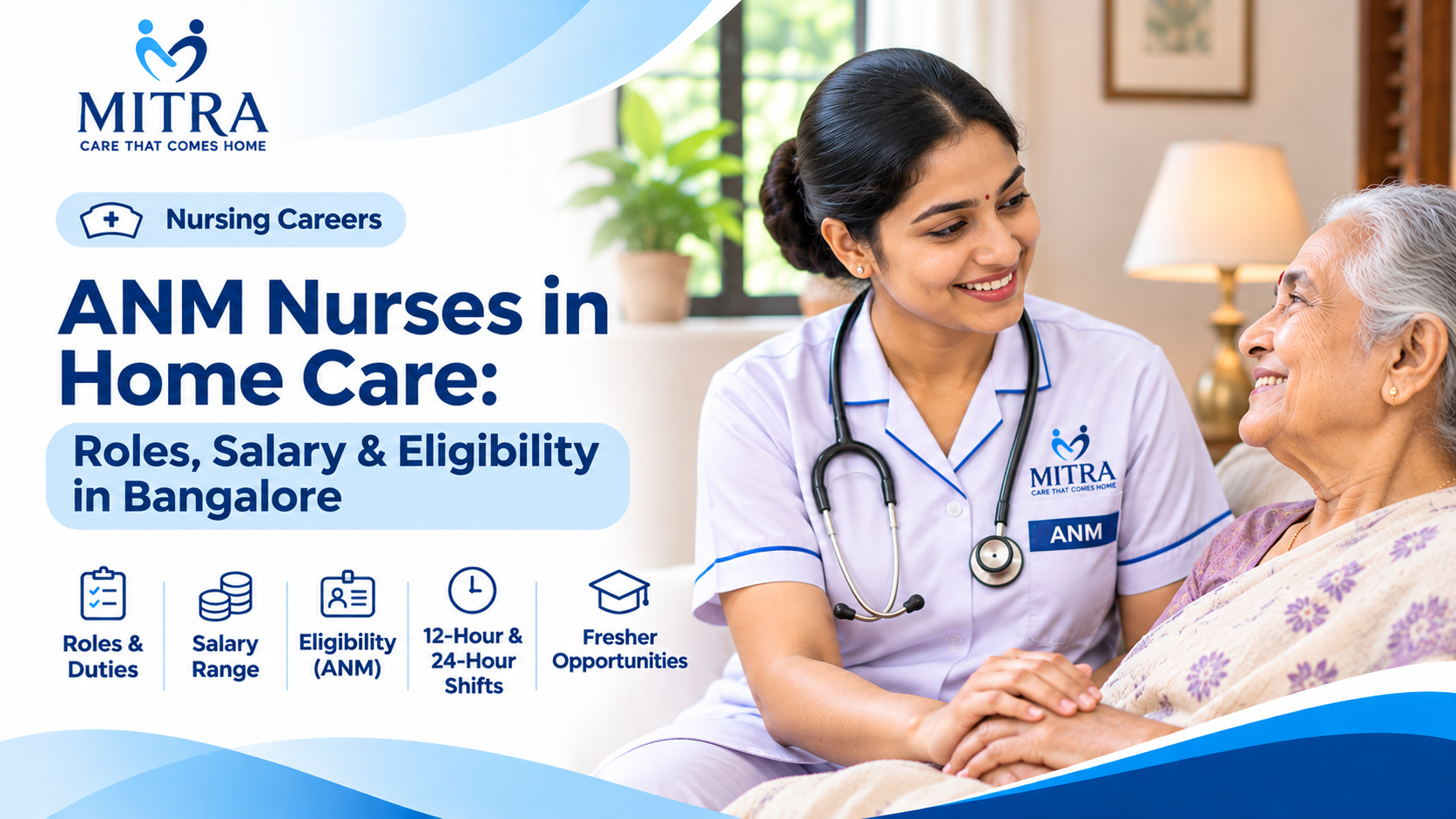
ANM Nurses in Home Care: Roles, Salary & Eligibility in Bangalore
Completed ANM and considering home healthcare in Bangalore? Learn where ANM nurses fit into home care, current salary ranges, 12-hour and 24-hour shifts, fresher opportunities, everyday duties, clinical responsibilities and how MITRA placements work.
Sun, 8 Nov 2026