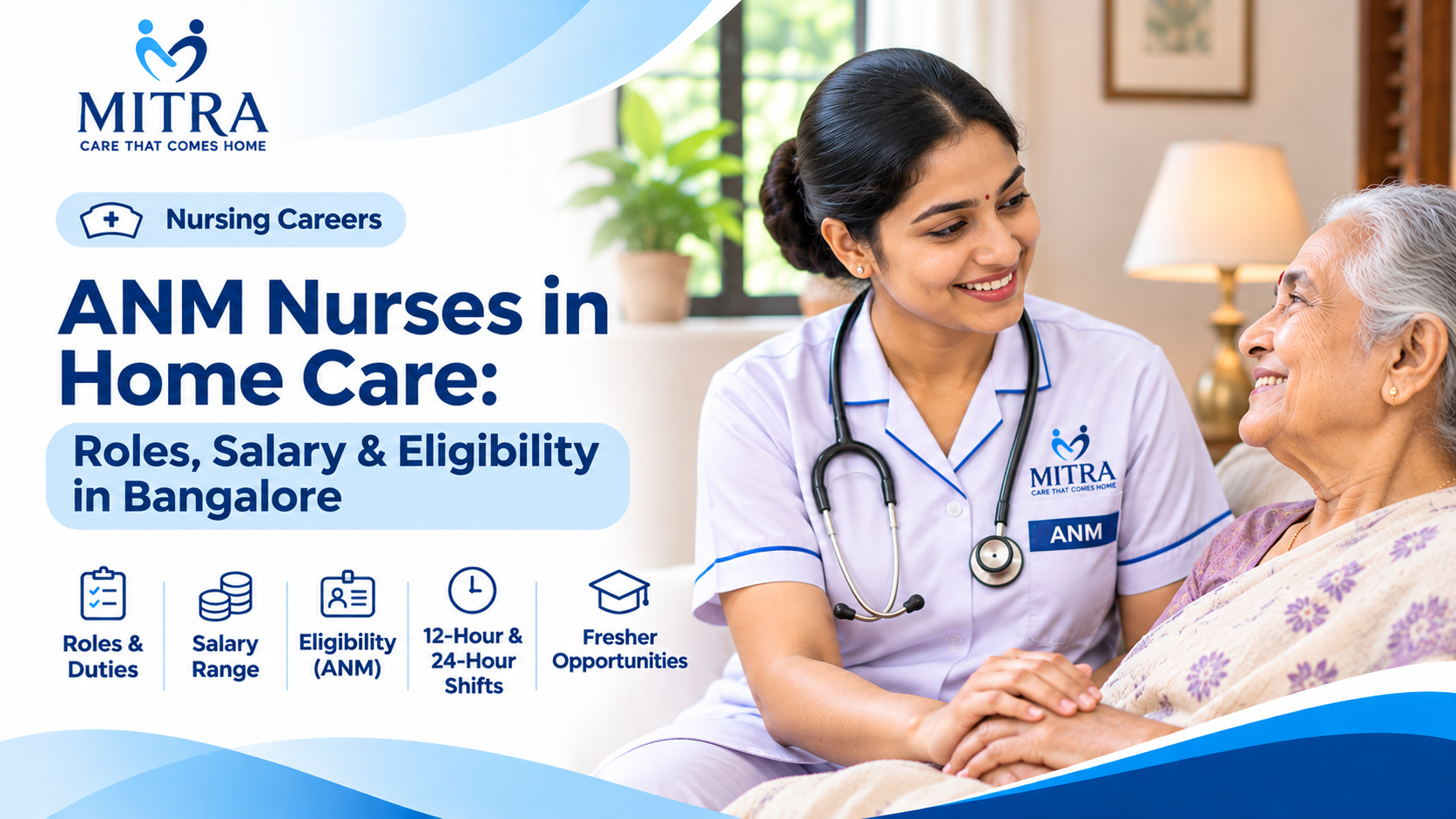
ANM Nurses in Home Care: Roles, Salary & Eligibility in Bangalore
Completed ANM and considering home healthcare in Bangalore? Learn where ANM nurses fit into home care, current salary ranges, 12-hour and 24-hour shifts, fresher opportunities, everyday duties, clinical responsibilities and how MITRA placements work.
Written by Dr. Sanjay Kumar K A
Published Sun, 8 Nov 2026 · 15 min read
After completing Auxiliary Nurse and Midwife (ANM) training, career options are not limited to clinics, community programmes or hospitals. Home healthcare is another possible pathway. An ANM-qualified provider may support an elderly, recovering or chronically ill patient inside their home — sometimes for a 12-hour shift and sometimes through a 24-hour live-in placement. The work can combine: everyday patient care + monitoring + nursing responsibilities appropriate to the provider's training and competency.
What is ANM nursing?
ANM stands for Auxiliary Nurse and Midwife. The Indian Nursing Council currently lists ANM as a two-year nursing programme with registration as R.ANM. ANM training creates opportunities across community, maternal, basic nursing and patient-care settings, including some home-healthcare roles.
Can ANM nurses work in home healthcare?
Yes. ANM is currently accepted in Bengaluru home-care recruitment alongside GNM and BSc Nursing. MITRA also currently includes ANM under its medical-background application pathway.
Where does ANM fit within MITRA home care?
MITRA groups candidates with nursing or allied-health certificates, diplomas or degrees under its medical-background pathway. That currently includes:- ANM- GNM- BSc Nursing- Post-Basic BSc Nursing- MSc Nursing- Selected allied-health qualificationsMedical-background providers deliver the everyday care expected from MITRA caregivers and may also provide prescribed clinical care that falls within their qualification.
What kind of patients can an ANM provider care for at home?
Depending on the person's needs and the provider's competency, home-care assignments may involve patients who are: - Elderly- Recovering after hospitalisation- Recovering after surgery- Weak or mobility-limited- Bedridden- Living with chronic illness- Requiring help with medicines- Requiring regular vital-sign monitoring- Dependent on assistance with everyday activities Some patients may also have nursing needs, but the exact assignment should be matched carefully to the ANM provider's training and demonstrated skills.
What does an ANM home-care role actually involve?
Home care is usually not a procedure-only job. At MITRA, medical-background providers are expected to provide the everyday care that every MITRA caregiver provides. That means the role can include:- Bathing- Grooming- Dressing- Toileting- Diaper changes- Feeding- Hydration- Mobility assistance- Transfers- Positioning- Companionship- Observation and reporting- Care documentationMITRA explicitly tells nursing and allied-health applicants that bathing, toileting and feeding are part of its medical-background roles.
What clinical work may medical-background providers perform?
MITRA's current medical-background pathway can include responsibilities such as: - Checking blood pressure- Pulse monitoring- Temperature monitoring- Oxygen-saturation monitoring- Blood-glucose monitoring- Keeping clinical notes- Giving prescribed medicines- Prescribed injections and insulin- Ryle's-tube feeding- Existing catheter care- Tracheostomy care- Suctioning- Colostomy care- Wound and bedsore dressings- Nebulisation- Home oxygen support These tasks should only be performed when prescribed and when they fall within the provider's qualification and competency.
Does that mean every ANM provider can perform every procedure on that list?
No. The list describes the broader medical-background home-care pathway. The actual procedures assigned to an individual ANM should depend on:- Their recognised qualification- Registration- Training- Demonstrated competency- Previous experience- The patient's prescribed care plan- The organisation's clinical policies Candidates should never assume that simply holding an ANM certificate makes them competent for every advanced patient.
What everyday care should ANM candidates be comfortable providing?
A typical home-care assignment may require assistance with: - Bathing or sponge bathing- Oral hygiene- Hair and grooming- Dressing- Bedpan or urinal- Diaper changes- Feeding- Fluids- Walking- Bed-to-chair transfers- Repositioning- Keeping the patient's immediate environment clean and safe These daily-care responsibilities can apply to nurses and allied-health professionals as well as other caregivers.
Why personal care matters in home nursing
A dependent elderly or recovering patient cannot separate their needs neatly into “nursing” and “non-nursing” hours. The same person may need: 8:30 AM — bathing assistance 9:30 AM — medicine 11:00 AM — mobility support 1:00 PM — feeding 3:00 PM — vital-sign check 5:00 PM — toileting The home-care provider supports the whole patient during the shift.
Can ANM freshers apply for home-care work?
Yes, some employers accept ANM freshers. MITRA currently states that fresh nursing graduates are welcome to apply under its medical-background pathway.
What should an ANM fresher learn before working independently at home?
Useful areas to strengthen include: - Accurate vital-sign measurement- Medication safety- Hand hygiene- Infection prevention- Safe patient handling- Bed mobility- Transfers- Repositioning- Pressure-area awareness- Feeding support- Documentation- Communication- Recognising deterioration- Escalation- Basic emergency response A home environment may not have another healthcare worker standing beside you, so knowing your limits is particularly important.
Why working alone changes the job
In a hospital, a nurse may quickly ask another nurse, resident or senior for help. At home, support may initially be available by phone rather than physically beside the patient. A good home-care provider therefore needs to know: What can I safely manage? What needs clarification? What should I report? What needs urgent medical help? Independent working should never become independent prescribing or treatment beyond scope.
What should an ANM home-care provider monitor?
Depending on the care plan, relevant observations can include: - Blood pressure- Pulse- Temperature- Oxygen saturation- Blood glucose- Food intake- Fluid intake- Mobility- Toileting- Pain- Alertness- Skin condition- Other changes from the patient's usual baseline
What changes should be reported?
Important changes may include: - Fever- New breathlessness- New confusion- Falls- Reduced food intake- Reduced fluid intake- Increasing weakness- New or worsening pain- Reduced urine output- Worsening skin condition- New mobility problems- Abnormal vital signs- A significant change from the person's normal behaviour Providers should report meaningful changes rather than ignoring them or independently changing treatment.
Good documentation matters
A useful note describes what happened. For example: Less useful:“Patient weak.” More useful:“Patient normally walks from bed to chair with one-person assistance. Needed substantially more support for both transfers this afternoon.” The second note records a change that another caregiver or clinician can understand.
How much can an ANM home-care provider earn in Bangalore?
There is no single salary for every ANM home-care role. Pay depends on factors such as:- Experience- Shift- Patient dependency- Care level- Employer- Accommodation- Meals- Clinical responsibilities- Duration of assignment Current Bengaluru recruitment can show substantial variation between employers, so candidates should evaluate the complete role rather than only the headline salary.
What does MITRA currently pay medical-background providers?
| Care level | 12-hour shift | 24-hour live-in | ||
| Basic caregiving | ₹25,000/month | ₹30,000/month | ||
| Advanced caregiving | ₹30,000/month | ₹35,000/month |
What is a 12-hour ANM home-care job?
A 12-hour placement usually means either: Day duty — approximately 8 AM to 8 PM or Night duty — approximately 8 PM to 8 AM. For MITRA's current 12-hour placements:- The provider returns home after duty- Accommodation is not provided- Lunch is provided by the familyExact timings depend on the family.
What is a 24-hour ANM live-in placement?
In a live-in placement, the provider stays at the patient's home. MITRA currently states that for 24-hour assignments: - Accommodation is provided- Three meals per day are provided- Rest time is agreed before starting Placements may run for 1, 3 or 6 months depending on the family requirement.
Does 24-hour duty mean nonstop work?
A live-in arrangement should not mean continuous physical work without rest. However, nighttime requirements can make two live-in cases very different. Before accepting, ask: - Does the patient sleep through the night?- Is toileting required?- Are diaper changes required?- Is repositioning required?- Is the patient confused or wandering?- Are medicines required overnight?- Are any nursing procedures required?- How is rest arranged?
12-hour vs 24-hour ANM home care
| 12-hour | 24-hour live-in | ||
| Return home after shift | Stay at patient's residence | ||
| Daily travel required | No regular daily commute | ||
| Day/night shifts | Residential placement | ||
| Accommodation not provided | Accommodation provided | ||
| Lunch provided | Three meals provided | ||
| Current MITRA medical range ₹25k–₹30k | Current MITRA medical range ₹30k–₹35k | ||
| Better work/home separation | Work and living environment overlap |
What should you ask before accepting a patient?
- What is the patient's diagnosis?
- What is the patient's present condition?
- Can the patient walk?
- Are they bedridden?
- Is bathing assistance required?
- Is diaper care required?
- Can the patient eat independently?
- Are transfers required?
- What vital signs need monitoring?
- What medicines are involved?
- Are injections required?
- Is there a feeding tube?
- Is there a catheter?
- Are wound dressings required?
- Is there a tracheostomy?
- What happens at night?
- What tasks specifically will I be expected to perform?
- Who do I contact if I am unsure?
- What is the salary?
- How long is the placement?
Why you should ask about procedures before saying yes
A job title such as: “ANM home nurse required” does not tell you enough. One patient may need only:- Personal care- Medication support- Vitals- MobilityAnother may have considerably more complex nursing needs. The assignment should be explained clearly before the provider accepts it.
What does a typical shift look like?
- Receive handover.
- Review the care plan.
- Help with toileting.
- Provide bathing and grooming assistance.
- Help with breakfast.
- Follow the medication plan.
- Check relevant vitals.
- Assist with movement or repositioning.
- Support lunch and fluids.
- Observe the patient through the afternoon.
- Provide evening care.
- Complete documentation.
- Give handover to the family or next provider.
What skills help ANM providers get selected?
Home-care employers and families may value: - Reliable attendance- Good communication- Patient handling- Elderly-care experience- Personal-care confidence- Accurate vitals- Medication discipline- Clean documentation- Relevant nursing skills- Language compatibility- Flexibility with location- Strong previous feedback
Patient dignity is part of the job
A home-care provider may help a patient with very private daily activities. Professional care includes: - Explaining before touching the patient- Closing the door during personal care- Keeping the patient appropriately covered- Moving gently- Avoiding unnecessary rushing- Letting the patient do what they still can- Remaining patient with memory impairment- Speaking respectfully- Protecting patient information
Do ANM providers need registration?
The Indian Nursing Council lists ANM with registration as R.ANM. Professional nursing roles should comply with applicable registration requirements. MITRA currently asks nurses to provide their council-registration information during verification.
What documents should ANM applicants keep ready?
MITRA currently asks candidates to keep: - Aadhaar card- PAN card- Recent photograph- WhatsApp-enabled mobile number- Relevant certificates- Nursing council registration where applicable- Experience letters if available Background verification is completed before a provider starts with a family.
Do ANM candidates have to pay MITRA for a job?
No. MITRA currently states: application, training and placement are free. Providers do not pay MITRA a recruitment fee.
Who pays the ANM provider's salary?
Under MITRA's current placement model, the family hires and pays the provider directly. The amount is agreed before the assignment starts and is paid monthly by the family. MITRA separately matches, trains and supports the provider.
Does applying guarantee a home-care job?
No. MITRA's provider pool is a list of screened candidates available for matching when suitable family requirements arise. Placement depends on:- Available patient demand- Qualification- Skills- Location- Languages- Shift preference- Whether you accept the patient- Whether the family selects you Joining the pool does not itself guarantee work or salary.
Can ANM candidates choose their shifts?
MITRA currently allows applicants to choose preferred: - Day shifts- Night shifts- Live-in placements Applicants can also indicate the Bengaluru areas they are willing to travel to.
Do you need to speak English?
Not for every placement. MITRA currently states that English is not mandatory. Candidates provide the languages they speak and language can be used as part of the family-matching process. Languages that may be useful in Bengaluru include: - Kannada- Hindi- Tamil- Telugu- Malayalam- English
Can male ANM-qualified candidates apply?
Yes. Both men and women can apply for MITRA home-care roles. Individual families may request a particular gender depending on patient preference and personal-care requirements.
What support does MITRA provide during the placement?
MITRA currently describes provider support including: - Honest patient matching- Free training- Free uniform- Salary confirmed before joining- Coordinator support- Doctor support- Safety support- Experience certificate- Help finding another family after a placement ends For nursing care, MITRA currently states that doctor check-ins occur every two weeks.
Can ANM home-care experience strengthen your career?
Home care can build practical experience in: - Elderly care- Bedside care- Activities of daily living- Patient monitoring- Post-discharge care- Long-term care- Documentation- Family communication- Independent working- Continuity of care MITRA currently provides an experience certificate after completed placements.
ANM home care vs hospital work
| Home care | Hospital/clinic | ||
| Often focused on one patient | Usually multiple patients | ||
| Longer continuity | Higher patient turnover | ||
| More independent work | Team physically nearby | ||
| Personal care is a major part | Duties vary by facility | ||
| Patient's home environment | Clinical environment | ||
| Family interaction is frequent | More staff interaction | ||
| 12-hour/live-in arrangements common | Facility roster system |
Is home care a good career option after ANM?
It may suit candidates who: - Enjoy elderly care- Prefer one-to-one patient interaction- Are comfortable providing personal care- Can work independently- Are patient and reliable- Want experience in long-term care- Are comfortable communicating with families It may be less suitable for someone who only wants short, procedure-based work or who is uncomfortable with intimate daily-care tasks.
ANM vs GNM in home care
Both ANM and GNM candidates may work within home healthcare. However, the programmes are different. The Indian Nursing Council currently lists:- ANM: two years, registration R.ANM- GNM: three years under the current programme structure, registration R.N. & R.M.An employer should not assume the two qualifications are interchangeable for every clinical requirement. Actual placement should depend on the provider's qualification, competency and the patient's care needs.
Compare the GNM pathway for home-care nursing in Bengaluru
Frequently asked questions
Can ANM nurses work in home care in Bangalore?
Yes. ANM is accepted in current Bengaluru home-care recruitment and is included in MITRA's medical-background pathway.
Can ANM freshers apply to MITRA?
Yes. MITRA currently states that fresh nursing graduates are welcome to apply under the medical-background pathway. Care level and pay depend on skills and experience.
What is the current MITRA salary for ANM providers?
MITRA's current medical-background structure ranges from: ₹25,000/month for basic 12-hour care to ₹35,000/month for advanced 24-hour live-in care. Qualification alone does not determine the level.
Do ANM home-care providers have to bathe patients?
Yes, personal care can be part of the role. MITRA specifically states that bathing, toileting and feeding apply to its nurses and allied-health providers as well as other caregivers.
Can an ANM provider give injections at home?
MITRA's broader medical-background pathway includes prescribed injections among possible clinical duties. However, any procedure must be appropriate to the individual's qualification and demonstrated competency and must follow the patient's prescribed care plan.
Do 24-hour placements include food and accommodation?
Under MITRA's current model, yes. For 24-hour live-in work, the family provides accommodation and three meals per day.
What about 12-hour placements?
MITRA currently states that accommodation is not provided for 12-hour work. The family provides lunch and the provider returns home after the shift.
Do I have to pay MITRA for placement?
No. MITRA currently states that application, training and placement are free for providers.
How long are MITRA assignments?
MITRA currently describes placements of: 1 month3 months6 months Families may sometimes renew longer-term arrangements.
How ANM candidates join MITRA
- Apply through the medical-background pathway.
- Select ANM as your qualification.
- Provide your certificates and registration information.
- Share the languages you speak.
- Select your preferred shifts.
- Tell MITRA which Bengaluru areas you can work in.
- Complete screening and background verification.
- Complete required MITRA training or competency review.
- Join the eligible provider pool.
- Receive suitable patient opportunities when available.
- Review the patient's requirements before accepting.
- The family considers suitable candidates.
- If both sides agree, begin the placement.
- The family pays the agreed monthly salary.
- MITRA provides coordination during the assignment.
Completed ANM and looking for home-care opportunities in Bengaluru? MITRA currently accepts ANM-qualified candidates through its medical-background provider pathway. Opportunities may include: 12-hour day shifts12-hour night shifts24-hour live-in placementsElderly careRecovery careLong-term patient support
Need care at home in Bengaluru? See MITRA services.
Related articles
Nursing Careers · 10 min read
Home Care Nurse Duties: What Nurses Actually Do in a Patient’s Home
What does a home care nurse actually do during a 12-hour or live-in assignment? Understand personal care, medicines, vitals, feeding, mobility, nursing procedures, documentation, family communication and the duties that should remain outside the role.
Tue, 10 Nov 2026
Nursing Careers · 9 min read
Can Freshers Work in Home Care Nursing? A Guide for ANM, GNM & BSc Nurses
Can ANM, GNM and BSc Nursing freshers work in home healthcare? Learn what fresh nurses can expect in Bangalore, suitable first assignments, salaries, 12-hour and 24-hour shifts, essential skills and how MITRA placements work.
Tue, 10 Nov 2026
Nursing Careers · 16 min read
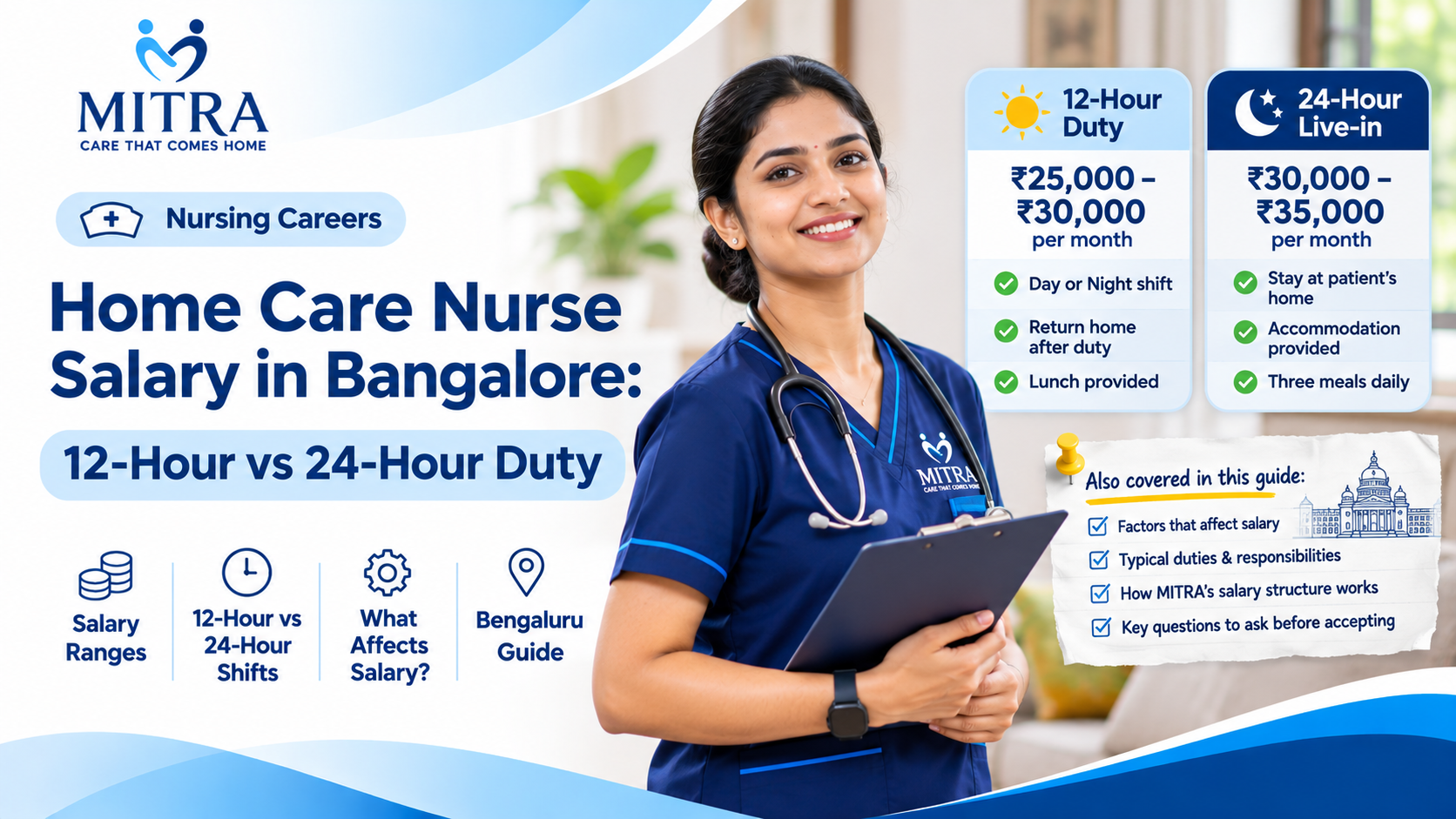
Home Care Nurse Salary in Bangalore: 12-Hour vs 24-Hour Duty
How much do home care nurses earn in Bangalore? Compare 12-hour and 24-hour live-in nursing salaries, understand what changes pay, what food and accommodation may be included, and see MITRA's current medical-background salary structure.
Mon, 9 Nov 2026