Home Care Nursing Career in Bangalore: Salary, Qualifications, Duties & Shifts
Considering a home care nursing career in Bangalore? Understand who can work as a home nurse, current salary ranges, 12-hour and 24-hour shifts, clinical duties, personal-care responsibilities, skills, freshers' opportunities and how MITRA home nursing placements work.
Written by Dr. Sanjay Kumar K A
Published Sat, 7 Nov 2026 · 18 min read
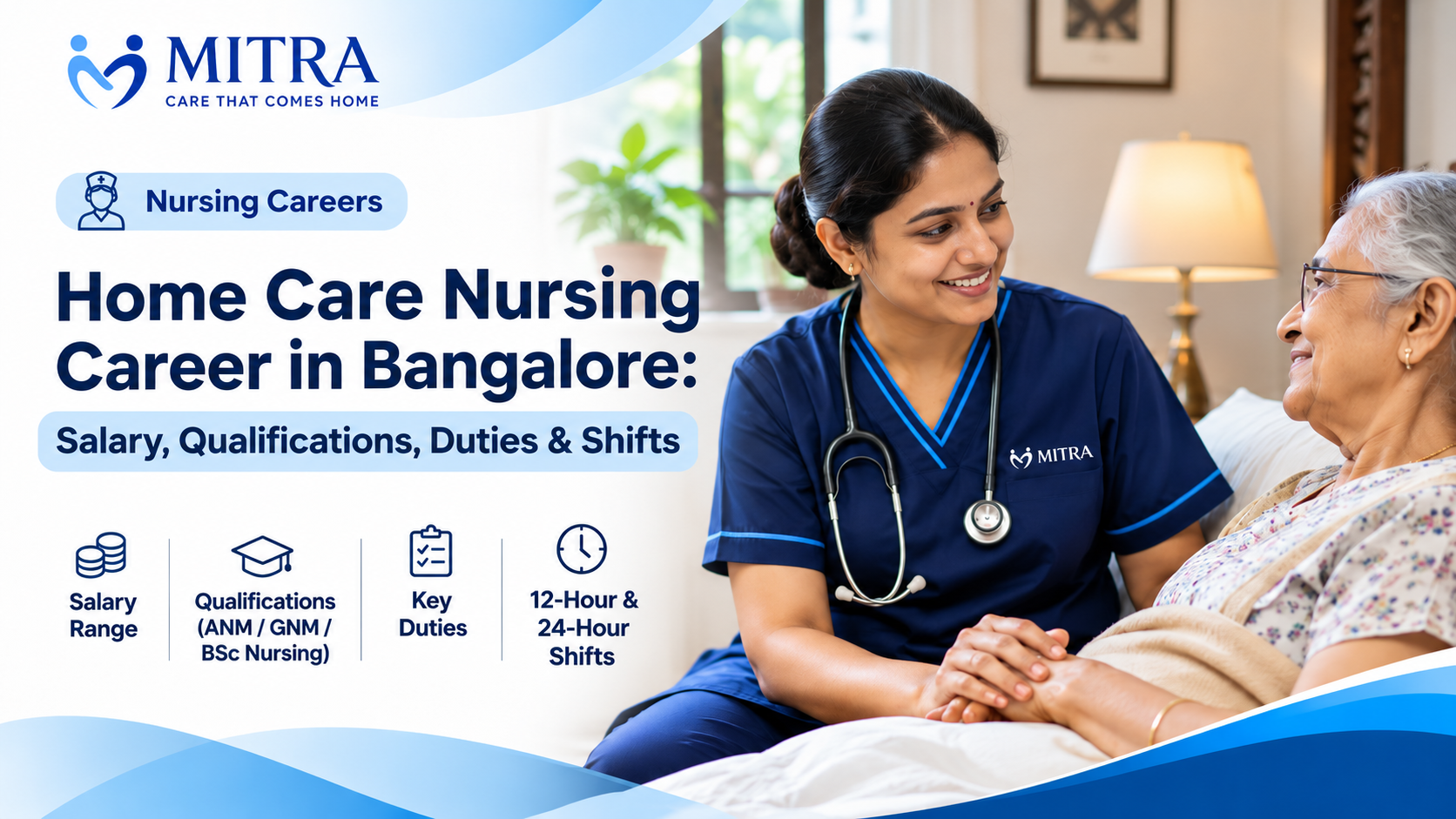
Most nurses begin their careers imagining a hospital ward, clinic or ICU. But nursing is increasingly delivered somewhere very different: the patient's own home. A home care nurse may care for one elderly, recovering or chronically ill patient for a 12-hour shift or live with the patient during a 24-hour assignment. The clinical skills remain important. But the work environment, responsibilities and relationship with the patient can be very different from hospital nursing.
What is home care nursing?
Home care nursing means providing nursing and personal care to a patient in their residence rather than inside a hospital or nursing facility. Patients may include:- Elderly people- Patients recovering after surgery- People recovering after hospitalisation- Bedridden patients- People with neurological conditions- Patients requiring long-term nursing support- Patients with feeding tubes or urinary catheters- People requiring wound care- Patients requiring prescribed injections or other nursing proceduresThe exact responsibilities depend on the patient's care plan and the nurse's qualification and competency.
Is home care nursing different from hospital nursing?
| Hospital nursing | Home care nursing | ||
| Usually responsible for multiple patients | Often focused on one patient | ||
| Works within a hospital team | Works more independently in the patient's home | ||
| Doctors and other staff are physically nearby | Clinical support may be remote | ||
| Equipment is readily available | Works with the equipment available in the home | ||
| Shift routine follows ward workflow | Routine follows the individual patient's care plan | ||
| Personal care may be shared with attendants | Nurse may provide both nursing and personal care | ||
| Frequent handovers between staff | Longer periods with the same patient and family |
Who can build a career in home care nursing?
Home nursing opportunities can be available to candidates with recognised nursing qualifications. MITRA's current medical-background pathway accepts candidates including:- ANM- GNM- BSc Nursing- Post-Basic BSc Nursing- MSc NursingMITRA also accepts some allied-health qualifications through the same medical-background application pathway. Fresh nursing graduates can apply, although the care level and placement offered depend on skills and experience. The Indian Nursing Council separately lists ANM, GNM, Basic BSc Nursing, Post-Basic BSc Nursing and MSc Nursing among recognised nursing programmes.
Can ANM nurses work in home care?
Yes. ANM-qualified candidates are commonly recruited for home healthcare roles in Bengaluru, although the exact duties should remain appropriate to the nurse's training, registration, competency and the employer's care model. Current Bengaluru home-care vacancies include ANM alongside GNM and BSc Nursing as accepted qualifications. MITRA also currently accepts ANM candidates under its medical-background pathway.
Can GNM nurses work in home care?
Yes. GNM is one of the most commonly requested qualifications in home nursing recruitment. A GNM nurse may work with elderly, post-surgical or long-term-care patients depending on their skills and the clinical requirements of the assignment. MITRA currently accepts GNM applicants for home nursing and medical-background caregiving placements across Bengaluru.
Can BSc Nursing graduates work in home care?
Yes. BSc Nursing graduates can work in home healthcare just as they can pursue opportunities in hospitals, clinics and other healthcare environments. Home care can provide experience in areas such as:- Elderly care- Post-surgery recovery- Long-term patient management- Medication administration- Wound care- Device care- Patient monitoring- Family communication- Documentation- Continuity of careMITRA currently welcomes BSc and Post-Basic BSc Nursing candidates in its medical-background pool.
Can fresh nursing graduates apply for home care work?
Yes, some home healthcare organisations accept freshers. MITRA currently states that fresh nursing graduates can apply under its medical-background pathway. However, being eligible to apply does not mean every fresher will immediately be suitable for every patient. The assignment should match the nurse's:- Qualification- Practical skills- Competency- Confidence- Experience- Ability to work independentlyMITRA states that care level and pay depend on skills and experience.
What does a home care nurse actually do?
The exact duties vary by patient. At MITRA, medical-background caregivers may provide everyday patient care together with prescribed clinical care that falls within their qualification and competency. This means the job can include both: Daily living support and Nursing responsibilities.
Personal care is part of home nursing
This is one of the most important things nurses should understand before applying. In many home-care assignments, the nurse is not present only to give injections or check vitals. MITRA explicitly tells nursing candidates that bathing, toileting and feeding are part of its medical-background roles. Depending on the patient, a nurse may help with:- Bathing or sponge bathing- Oral hygiene- Dressing- Diaper changes- Toileting- Feeding- Hydration- Bed-to-chair transfers- Walking assistance- Positioning- Repositioning bedridden patients
What clinical duties may a home nurse perform?
Depending on the patient's prescription, the nurse's qualification and demonstrated competency, home nursing responsibilities may include areas such as:- Checking and recording vital signs- Monitoring blood glucose where required- Administering prescribed medicines- Giving prescribed injections- Insulin administration- Ryle's or NG tube feeding- Existing urinary catheter care- Tracheostomy care- Suctioning- Colostomy care- Wound dressings- Bedsore care- Nebulisation- Home oxygen support- Post-discharge monitoring- Documentation and escalation MITRA's current medical-background job description includes these types of responsibilities while specifying that clinical work is performed as prescribed and within the provider's qualification.
Does a home nurse independently decide medicines or treatment?
No. A home nurse provides nursing care according to the patient's medical instructions and agreed care plan. The nurse should not independently:- Start a new medicine- Stop a prescribed medicine- Change a dose- Diagnose a new condition- Invent a new treatment planWhen something changes or an instruction is unclear, the appropriate response is to document, communicate and escalate.
Monitoring is a major part of home nursing
Depending on the patient, a home nurse may need to monitor and document:- Blood pressure- Pulse- Temperature- Oxygen saturation- Blood glucose- Food intake- Fluid intake- Urine output- Mobility- Pain or discomfort- Mental status- Wound condition- Other changes relevant to the care planMITRA's current job description expects medical-background caregivers to check relevant vitals, maintain records and report changes appropriately.
Home nursing requires good documentation
A nurse may spend considerably more time with the patient than the doctor does. That means the information you record can become important for continuity of care. Useful documentation should describe what actually happened. For example: Less useful:“Patient not well.” More useful:“Patient normally walks to the bathroom with one-person assistance. Required two-person assistance twice this evening and reported dizziness while standing.” The second entry gives the care team something meaningful to review.
You also need to communicate with the family
Unlike hospital nursing, home care happens inside the patient's personal environment. Family members may be involved every day. A home nurse therefore needs to communicate professionally about:- The patient's routine- Relevant changes- Medicines- Food and fluids- Mobility- Upcoming appointments- Concerns requiring escalation- Handover informationGood clinical skills without good communication can make a home assignment difficult.
How much do home care nurses earn in Bangalore?
There is no single salary for all home nurses in Bengaluru. Pay varies according to factors such as:- Qualification- Skill level- Experience- Patient dependency- Clinical requirements- 12-hour versus 24-hour work- Employer or placement model- Additional benefits- Whether accommodation or meals are includedCurrent Bengaluru job advertisements show substantial variation. Recent listings reviewed for this guide included advertised ranges such as ₹20,000–₹28,000, ₹30,000–₹60,000 and other employer-specific ranges. These advertisements should not be interpreted as a guaranteed citywide salary because requirements and benefits differ significantly between jobs.
What does MITRA currently pay for medical-background home care placements?
| Care level | 12-hour shift | 24-hour live-in | ||
| Basic caregiving | ₹25,000/month | ₹30,000/month | ||
| Advanced caregiving | ₹30,000/month | ₹35,000/month |
What is a 12-hour home nursing shift?
A 12-hour assignment generally means working in the patient's home for a defined daytime or nighttime period. MITRA currently describes common shifts as: Day shift: approximately 8 AM to 8 PMNight shift: approximately 8 PM to 8 AM For MITRA's current 12-hour placements:- The provider returns home after the shift- Accommodation is not provided- Lunch is provided by the family for the 12-hour arrangementExact timings depend on the placement.
What is a 24-hour home nursing assignment?
A 24-hour home-care placement is usually a live-in arrangement. The nurse stays at the patient's residence during the placement. Under MITRA's current model, the family provides:- Accommodation- Three meals a dayRest arrangements should be understood before accepting the placement. A live-in role does not mean a human being can work actively every minute of every day. Candidates should understand the patient's nighttime needs and expected rest pattern before agreeing to the assignment.
12-hour vs 24-hour home nursing: which is better?
| 12-hour | 24-hour live-in | ||
| Return home after duty | Stay at patient's residence | ||
| Better separation between work and home | Less daily commuting | ||
| Accommodation usually not included | Accommodation provided in MITRA placements | ||
| Lower current MITRA salary band | Higher current MITRA salary band | ||
| Works well if location is accessible | Useful for candidates open to residential assignments | ||
| Defined day/night duty | Night needs and rest arrangements matter significantly |
What does a typical home nursing day look like?
- Receive handover from the family or previous caregiver.
- Review the patient's care plan and recent notes.
- Assist with toileting and morning hygiene.
- Help with breakfast and prescribed medicines.
- Check relevant vital signs.
- Perform prescribed nursing procedures when due.
- Assist with mobility, transfers or repositioning.
- Monitor food and fluid intake.
- Help with lunch and toileting.
- Provide companionship and observe for changes.
- Complete evening care and prescribed medicines.
- Document the day's care.
- Give a clear handover to the family or next caregiver.
What patients might a home nurse care for?
Home nursing assignments can involve very different levels of dependency. Examples include patients who are:- Recovering after major surgery- Recovering after stroke- Bedridden- Living with neurological illness- Frail and elderly- Requiring tube feeding- Requiring catheter care- Requiring wound care- Living with a tracheostomy- Requiring long-term medication support- Recovering after prolonged hospitalisationBefore accepting a placement, understand the actual care requirements, not only the diagnosis.
What skills make someone a good home care nurse?
Clinical knowledge matters, but successful home care also requires personal qualities that are harder to teach. Useful skills include:- Safe patient handling- Good observation- Accurate documentation- Clear communication- Medication discipline- Infection-control awareness- Patience- Respect for privacy- Calmness during problems- Reliability- Time management- Ability to work independently- Knowing when to escalateHome nursing involves entering another person's private home, so professionalism is especially important.
Patient dignity matters as much as clinical skill
Many home-care patients are elderly, frail or dependent on someone else for intimate activities. A good home nurse should:- Explain before touching or moving the patient- Maintain privacy during bathing and changing- Avoid rushing the patient- Allow the person to do what they can independently- Speak respectfully- Remain patient with memory impairment- Avoid arguing with confused patients- Protect confidential informationMITRA makes these behaviours part of its caregiver expectations rather than treating them as optional soft skills.
Is home care nursing easier than hospital nursing?
Not necessarily. It is different. Home care may involve fewer patients at the same time, but it can require:- Long periods with one patient- More independent decision-making- Greater responsibility for recognising changes- Direct communication with relatives- Working without hospital infrastructure immediately around you- Providing personal care yourself- Adapting to different householdsSomeone who enjoys one-to-one care may prefer it. Someone who prefers the pace and team environment of a hospital may prefer ward-based nursing.
Can home care nursing build useful experience?
Yes. A well-supervised home nursing placement can build practical experience in:- Elderly care- Long-term patient management- Post-discharge care- Patient monitoring- Documentation- Medication administration- Wound care- Mobility support- Family counselling and communication- Working independently- Continuity of careMITRA currently provides an experience certificate for completed placements, showing the role, type of care and placement dates.
Do home nurses need nursing registration?
Nurses should maintain the registration required for their professional practice and role. MITRA currently asks nursing applicants to keep their nursing council registration available during its verification process. The Karnataka State Nursing Council provides registration and renewal services through its official website, while the Indian Nursing Council publishes information about recognised nursing programmes and registration categories.
What documents should a nurse keep ready?
For MITRA's current verification process, applicants are asked to keep documents such as:- Aadhaar- PAN- Recent photograph- Active mobile/WhatsApp number- Nursing certificates- Nursing council registration- Experience letters where availableMITRA states that background verification is completed before a provider begins with a family.
Do you have to pay to get a MITRA nursing placement?
No. MITRA currently states that: application + training + placement are free for caregivers and nurses. The provider does not pay MITRA a recruitment or placement fee.
Who pays a MITRA home nurse?
Under MITRA's current placement model, the family hires and pays the provider directly. The salary is agreed before the assignment begins and is paid monthly by the family. MITRA's role is to match, train and support the caregiver or nurse rather than deducting a placement commission from the provider's salary.
Does applying to MITRA guarantee a nursing job?
No. Applying can place an eligible candidate into MITRA's provider pool, but placement depends on:- Available patient requirements- Your qualification- Your competencies- Location- Language- Shift preference- Your willingness to accept that assignment- Family selection MITRA explicitly states that joining the pool does not guarantee immediate work and that providers remain free to do other work while waiting for a suitable match.
Can nurses choose which assignments they accept?
MITRA's current model matches available providers with family requirements based on factors such as:- Skills- Qualification- Languages- Location- Shift availability The candidate is informed about the placement before joining and can decide whether that particular assignment suits them. The family also participates in provider selection.
Why should you understand the patient before accepting?
“Home nursing patient” is not a sufficient job description. Before agreeing to an assignment, ask questions such as:- Is the patient walking or bedridden?- Can they eat independently?- Do they need diaper care?- Do they need help transferring?- Are there wounds?- Is there a catheter?- Is there an NG/Ryle's tube?- Is suction required?- Is there a tracheostomy?- Are injections required?- What happens at night?- Who else lives in the home?- What shift is expected?- What are the rest arrangements?Two 24-hour nursing placements can have completely different workloads.
Can men work as home nurses?
Yes. Home healthcare employs both male and female nursing providers. Some families may request a particular gender depending on the patient's needs, personal-care requirements or preference. MITRA currently accepts both men and women and matches according to the individual family requirement.
Do you need fluent English for home nursing work in Bangalore?
Not necessarily. Communication with the patient and family is more important than speaking one particular language. MITRA asks candidates to specify the languages they speak and uses language as part of the matching process. Its current careers page states that English is not mandatory for every placement. Knowing Kannada, Hindi, Tamil, Telugu, Malayalam or English may help with different Bengaluru families depending on the assignment.
Can you choose where in Bangalore you work?
MITRA currently recruits across Bengaluru. Candidates can provide the areas they are willing to travel to. Location matters especially for 12-hour jobs because the nurse must travel to and from the patient's residence each day. For a 24-hour live-in placement, the provider stays at the family's home during the assignment.
What should you check before taking a 24-hour nursing job?
- Patient diagnosis and current condition.
- Mobility and dependency.
- Toileting and diaper requirements.
- Feeding requirements.
- Nursing procedures required.
- Nighttime interruptions.
- Expected rest arrangement.
- Sleeping arrangement.
- Meals provided.
- Duration of the placement.
- Monthly salary.
- Leave process.
- Who to contact when a concern arises.
- Whether the job matches your competency.
What should you check before taking a 12-hour nursing job?
- Exact shift timing.
- Patient location.
- Daily travel time.
- Day or night duty.
- Patient dependency.
- Required procedures.
- Handover arrangements.
- Meal arrangements.
- Salary.
- Placement duration.
Home care nursing can be a career, not only a temporary job
Home healthcare exposes nurses to an area of healthcare that is likely to remain important as more elderly and chronically ill patients require support outside hospitals. A nurse can gradually build stronger experience in:- Elder care- Recovery care- Long-term nursing- Complex home care- Patient coordination- Home-health documentationMITRA's current provider pathway also allows providers to move to higher care levels as they gain experience and positive feedback
Home care nursing vs hospital nursing: which should you choose?
Consider home care if you prefer: - One-to-one nursing- Longer patient relationships- Working independently- Elderly or long-term care- A home environment- Longer shifts with fewer patient changes Hospital nursing may suit you better if you prefer: - Working inside a larger clinical team- Fast-changing caseloads- Immediate access to hospital infrastructure- Multiple patients- Ward, ICU, OT or emergency environments Neither pathway is automatically better. They develop different strengths.
Frequently asked questions
What is the salary of a home care nurse in Bangalore?
Salaries vary substantially according to qualification, experience, shift and patient requirements. MITRA's current medical-background placement structure lists ₹25,000 to ₹35,000 per month, depending on the care level and whether the placement is 12-hour or 24-hour live-in. Other public Bengaluru job advertisements can show both lower and higher ranges, so candidates should compare the complete job rather than only the headline salary.
Can a GNM fresher apply for home nursing work?
Yes. MITRA currently welcomes fresh nursing graduates. The complexity of the patient assigned should still match the candidate's practical skills, competency and experience.
Can BSc Nursing freshers apply?
Yes. BSc Nursing graduates can apply to MITRA's medical-background provider pool. Placement depends on available requirements, competency and family selection.
Is bathing and diaper care part of a home nurse's job?
It can be. MITRA explicitly includes personal care, toileting and feeding in the responsibilities of its nursing and allied-health home-care roles. Candidates should understand this before applying.
Do 24-hour home nurses get accommodation?
Under MITRA's current 24-hour live-in model, the provider stays at the patient's home and the family provides accommodation and three meals a day.Other employers may use different arrangements.
Do 12-hour home nurses get accommodation?
MITRA's current 12-hour placements do not include accommodation. The provider travels home after the shift, and the family provides lunch.
Do I have to pay MITRA to get a home nursing job?
No. MITRA currently states that application, training and placement are free for candidates.
Does applying guarantee that I will get a patient immediately?
No. Placement depends on patient demand, your qualification, skills, availability, location, shift preference and whether the family selects you. Joining MITRA's provider pool does not itself create a salary entitlement.
How long are MITRA home-care placements?
MITRA currently describes placements of 1, 3 or 6 months, with some families extending care further. The exact duration is communicated before joining.
How MITRA home nursing placements work
- Apply under the medical-background pathway.
- Provide your qualification and availability.
- Complete screening and verification.
- Attend required MITRA training or competency assessment.
- Join the eligible provider pool.
- MITRA receives a patient requirement.
- Suitable providers are matched according to skills, location, language and shift.
- You review the proposed placement.
- The family considers suitable provider profiles.
- If selected and you accept, the assignment begins.
- The family pays the agreed salary monthly.
- MITRA continues providing coordination and support during the placement.
Need care at home in Bengaluru? See MITRA services.
Related articles
Nursing Careers · 10 min read
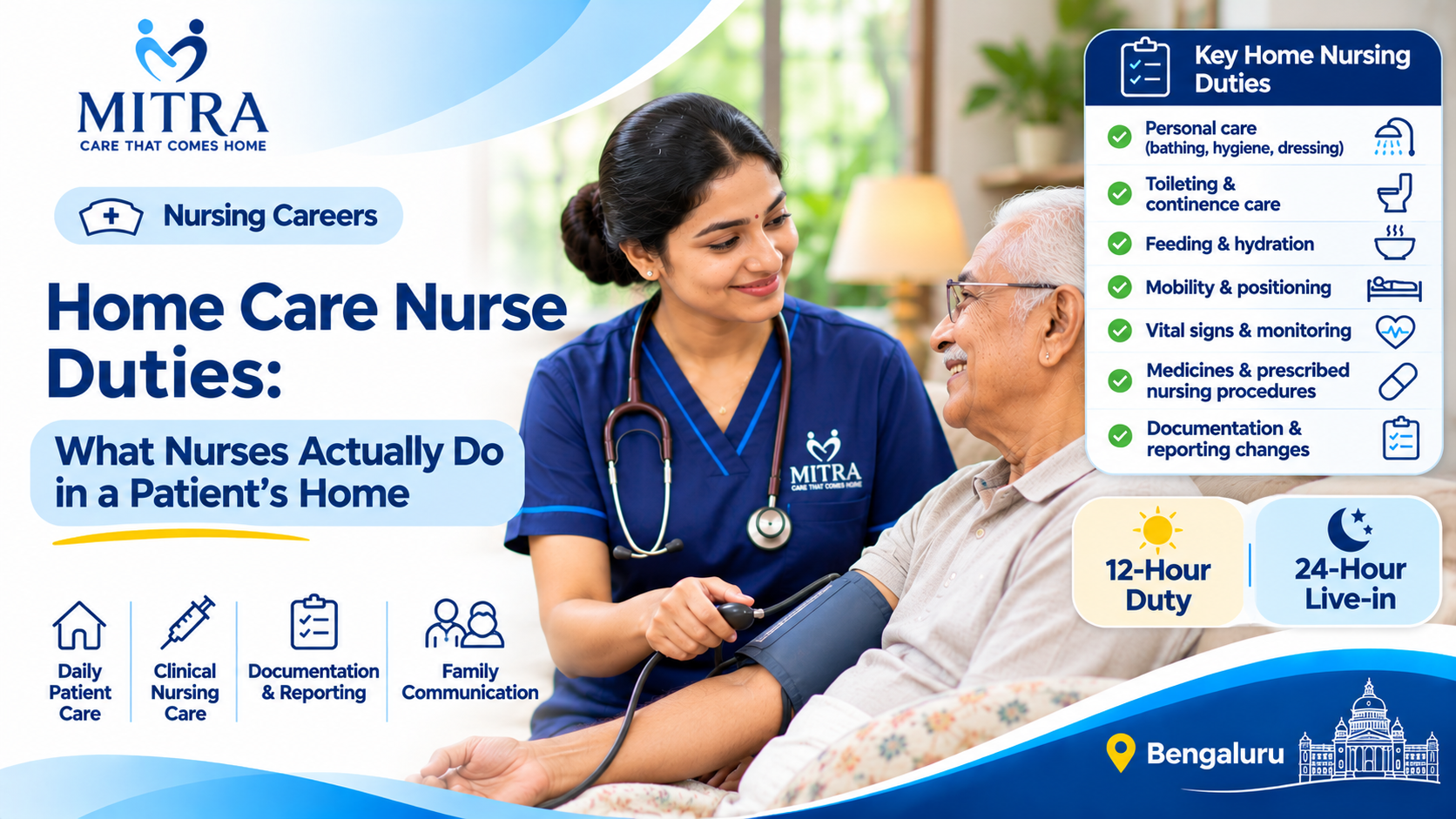
Home Care Nurse Duties: What Nurses Actually Do in a Patient’s Home
What does a home care nurse actually do during a 12-hour or live-in assignment? Understand personal care, medicines, vitals, feeding, mobility, nursing procedures, documentation, family communication and the duties that should remain outside the role.
Tue, 10 Nov 2026
Nursing Careers · 9 min read
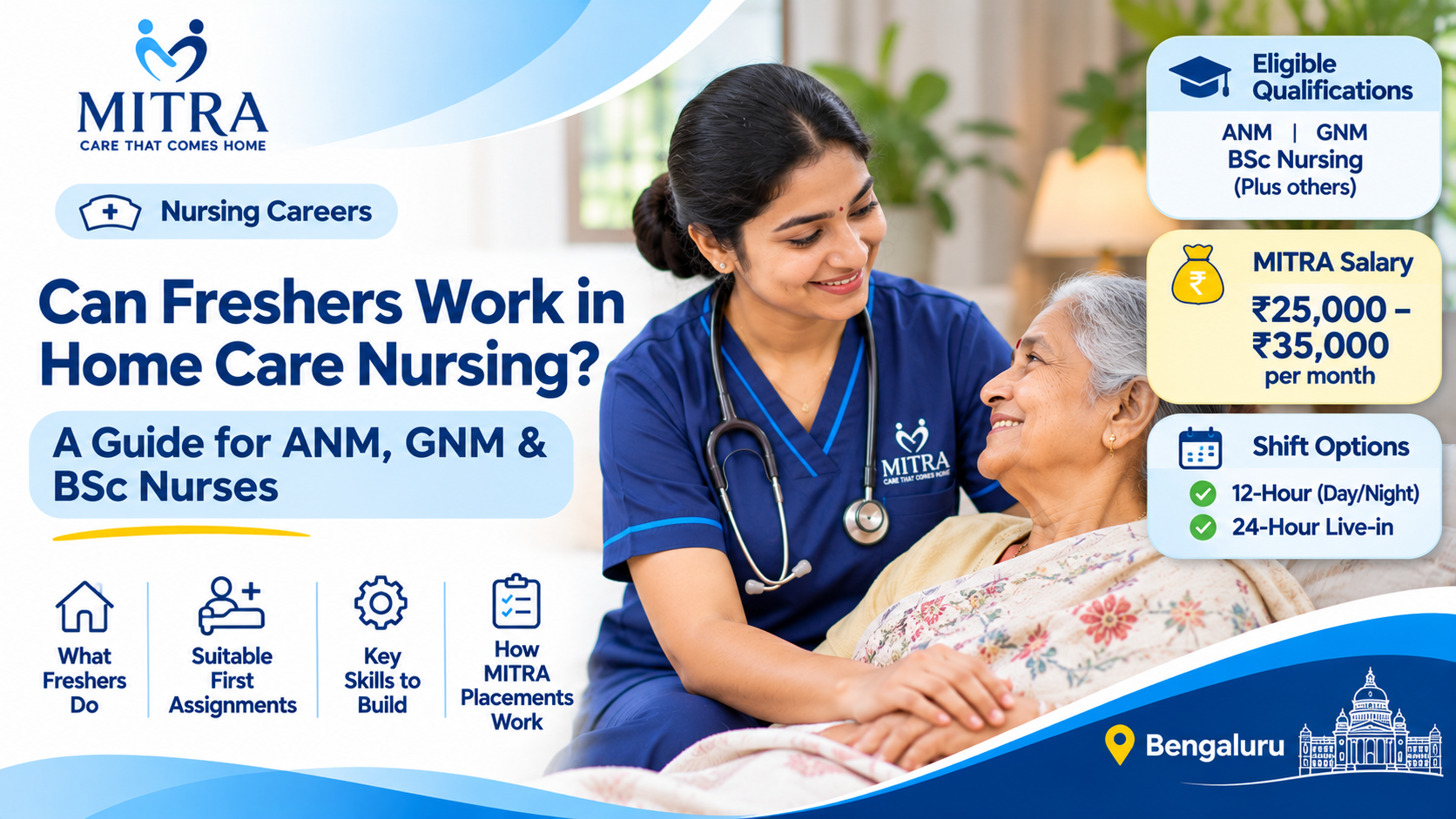
Can Freshers Work in Home Care Nursing? A Guide for ANM, GNM & BSc Nurses
Can ANM, GNM and BSc Nursing freshers work in home healthcare? Learn what fresh nurses can expect in Bangalore, suitable first assignments, salaries, 12-hour and 24-hour shifts, essential skills and how MITRA placements work.
Tue, 10 Nov 2026
Nursing Careers · 16 min read
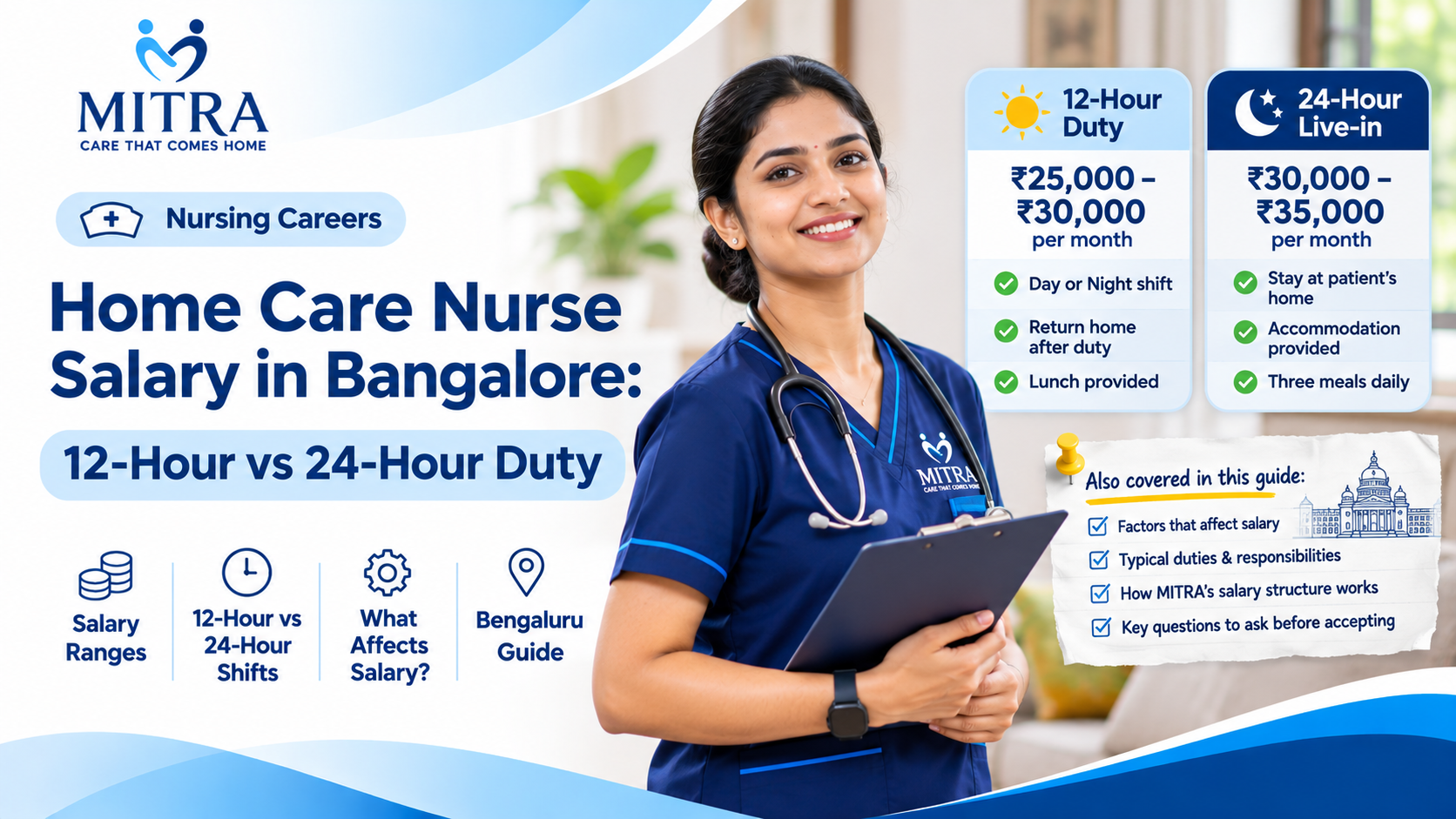
Home Care Nurse Salary in Bangalore: 12-Hour vs 24-Hour Duty
How much do home care nurses earn in Bangalore? Compare 12-hour and 24-hour live-in nursing salaries, understand what changes pay, what food and accommodation may be included, and see MITRA's current medical-background salary structure.
Mon, 9 Nov 2026