When HbA1c Can Be Wrong: Anaemia, Kidney Disease & Other Causes
HbA1c is useful for estimating long-term glucose levels, but certain conditions can make the result falsely high, falsely low or difficult to interpret. Learn how anaemia, blood loss, transfusion, kidney disease, haemoglobin variants, pregnancy and altered red-cell turnover can affect HbA1c.
Written by Dr. Sanjay Kumar K A · Medically reviewed by Dr. Sanjay Kumar K A, MD Anaesthesiology (Wed, 4 Nov 2026)
Published Wed, 4 Nov 2026 · 12 min read

HbA1c is one of the most useful tests for diabetes, but it is not infallible. A result may occasionally appear higher or lower than expected because HbA1c depends not only on glucose levels but also on haemoglobin and the lifespan of red blood cells. The American Diabetes Association recommends considering interference when there is persistent, substantial disagreement between HbA1c and measured glucose values.
Why can HbA1c sometimes be inaccurate?
HbA1c measures glucose attached to haemoglobin inside red blood cells. Because red blood cells circulate for roughly 120 days, HbA1c normally provides a weighted estimate of glucose exposure over the previous 2–3 months. More recent glucose contributes more strongly than older glucose.
This means HbA1c depends on two things: 1. How much glucose the red blood cells are exposed to2. How long those red blood cells remain in circulation Anything that substantially changes red-cell survival, production or haemoglobin structure can disturb that relationship.
What can cause a falsely high HbA1c?
- Significant iron-deficiency anaemia
- Some conditions affecting red-cell turnover
- Certain haemoglobin or assay interferences
- Kidney failure in some circumstances
- Liver disease in some circumstances
What can cause a falsely low HbA1c?
- Haemolytic anaemia
- Recent significant blood loss
- Conditions shortening red-cell lifespan
- Recovery after blood loss
- Erythropoietin treatment
- Some haemoglobin disorders
- G6PD deficiency
- Dialysis-related factors
Anaemia and HbA1c: why the type matters
It is not accurate to say simply: “Anaemia makes HbA1c high.” Different types of anaemia can affect HbA1c differently because they influence red-cell production and survival in different ways. The underlying cause of the anaemia matters.
Iron-deficiency anaemia and HbA1c
Significant iron-deficiency anaemia can raise HbA1c even when true glucose exposure has not increased by the same amount. NGSP notes that iron deficiency is associated with higher HbA1c and that HbA1c can fall after iron replacement.
Does treating iron deficiency change HbA1c?
It can. Because significant iron deficiency may distort HbA1c upward, correcting the deficiency can reduce HbA1c even without a corresponding major change in glucose. NGSP therefore recommends using alternative assessment of glycaemia when significant iron-deficiency anaemia is present until it has been successfully treated.
Haemolytic anaemia and HbA1c
Haemolysis causes red blood cells to be destroyed earlier than usual. Because the cells have less time to accumulate glycated haemoglobin, HbA1c can become falsely low relative to actual glucose exposure. This effect occurs regardless of the specific HbA1c assay used.
Recent blood loss and HbA1c
Significant recent blood loss can also shorten the average age of circulating red blood cells. As the body replaces the lost cells with younger cells, HbA1c may temporarily be lower than expected. Both ADA and NIDDK list recent blood loss among conditions that can alter the relationship between HbA1c and glucose.
Blood transfusion and HbA1c
A recent blood transfusion can make HbA1c difficult to interpret because the circulating blood now contains red cells from another person with a different age and previous glucose exposure. The direction of the effect is not reliably predictable in every case. For this reason, both ADA and NIDDK list recent transfusion as a factor that can interfere with HbA1c interpretation
Erythropoietin treatment and HbA1c
Erythropoietin and other drugs that stimulate red-cell production increase the proportion of younger red blood cells in circulation. This can alter HbA1c independently of glucose. ADA specifically lists erythropoietin treatment among circumstances in which HbA1c may not be suitable for diagnosis
Kidney disease and HbA1c accuracy
HbA1c interpretation can become more complicated in advanced kidney disease, especially in people with:- Anaemia- Kidney failure- Dialysis- Erythropoiesis-stimulating treatment- Significant changes in red-cell lifespanADA lists kidney failure and dialysis among factors capable of altering HbA1c accuracy.
Can kidney failure make HbA1c falsely low?
It can, particularly when kidney failure is associated with shortened red-cell survival, anaemia, dialysis or erythropoietin therapy. However, kidney failure creates a complex HbA1c bias rather than one predictable direction in every patient. Recent research in dialysis patients confirms that HbA1c can be biased by haemoglobin level and erythropoiesis-stimulating therapy.
Can kidney disease also interfere with the laboratory method?
Some HbA1c methods can also be affected by chemically modified haemoglobin such as carbamylated haemoglobin, which can occur in renal failure. Modern assays differ in how susceptible they are to this interference, which is why laboratory method matters
Haemoglobin variants and HbA1c
Haemoglobin variants can interfere with some HbA1c tests. Examples include:- HbS- HbC- HbE- HbD- Elevated fetal haemoglobinThe effect depends on both the haemoglobin variant and the particular laboratory assay.
Does sickle cell trait always make HbA1c inaccurate?
No. Many modern assays can measure HbA1c accurately in people with some heterozygous haemoglobin variants, including sickle cell trait. The important question is whether the specific laboratory method has interference from that particular variant. NGSP maintains an updated assay-by-assay interference table.
What about sickle cell disease?
This is different from sickle cell trait. ADA notes that HbA1c cannot be measured in the usual way in people with conditions such as HbSS where normal adult haemoglobin A is absent, and altered red-cell turnover further complicates interpretation.
Thalassaemia and HbA1c
Thalassaemia can affect HbA1c through changes in haemoglobin composition, anaemia, altered red-cell lifespan or transfusions. The exact impact varies considerably between individuals and laboratory methods. ADA explicitly lists thalassaemia among conditions in which altered haemoglobin or red-cell biology can affect HbA1c interpretation.
How would you know a haemoglobin variant is affecting HbA1c?
- HbA1c does not match repeated glucose measurements
- A major unexpected change occurs without an obvious explanation
- HbA1c differs substantially between laboratories
- A known haemoglobinopathy is present
- Family history of haemoglobin disorders exists
- The laboratory flags an abnormal haemoglobin pattern
G6PD deficiency and HbA1c
Glucose-6-phosphate dehydrogenase deficiency can shorten red-cell survival and alter the relationship between HbA1c and actual glucose exposure. ADA specifically lists G6PD deficiency among situations where plasma glucose criteria should be used for diabetes diagnosis instead of relying on HbA1c alone.
Pregnancy and HbA1c
Pregnancy changes red-cell turnover and therefore changes the relationship between HbA1c and glucose. ADA notes that HbA1c tends to be slightly lower during pregnancy because red blood cells turn over more rapidly.
Can HbA1c diagnose gestational diabetes?
HbA1c is not the standard diagnostic test for gestational diabetes. Glucose-based testing is used because pregnancy changes HbA1c physiology and because post-meal glucose is particularly important during pregnancy. NIDDK also advises that HbA1c should not be used to diagnose gestational diabetes.
Does iron deficiency during pregnancy matter too?
Yes. Pregnancy can lower HbA1c through faster red-cell turnover, while significant iron deficiency can exert an opposing effect and raise HbA1c. NGSP notes that iron deficiency can increase HbA1c in late pregnancy, illustrating why interpretation can become particularly complex.
Liver disease and HbA1c
Advanced liver disease can alter haemoglobin, anaemia and red-cell survival and may therefore make HbA1c less reliable. NIDDK includes liver disease among conditions capable of producing false HbA1c results, while ADA lists cirrhosis among individual factors that can alter HbA1c.
HIV and HbA1c
HbA1c may also behave differently in some people with HIV, particularly depending on treatment and red-cell effects. ADA includes HIV among situations where the relationship between HbA1c and glycaemia may be altered and recommends considering glucose-based criteria when appropriate.
Can laboratory methods themselves affect HbA1c?
Yes. Different HbA1c assays use different measurement technologies. Certain haemoglobin variants or chemically modified haemoglobin may interfere with one method but not another. NGSP therefore maintains a current database showing whether common HbA1c methods are affected by HbS, HbC, HbE, HbD and elevated fetal haemoglobin.
Should HbA1c be measured using a standardised laboratory method?
Yes. ADA recommends that HbA1c used for diagnosis be measured with an assay certified by the National Glycohemoglobin Standardization Program (NGSP) and traceable to the established reference system.
When should you suspect that HbA1c is wrong?
- HbA1c is unexpectedly high or low
- Repeated glucose readings consistently disagree
- CGM average is very different from HbA1c
- HbA1c changes dramatically without a clear glucose change
- Significant anaemia is present
- There was recent blood loss or transfusion
- Kidney failure or dialysis is present
- A haemoglobin disorder is known or suspected
- Pregnancy changes the clinical context
See why HbA1c and fasting glucose can disagree even when neither test is technically wrong
What should you do if HbA1c looks unreliable?
- Do not change diabetes treatment based on an unexplained value alone.
- Compare the result with previous HbA1c measurements.
- Review fasting, post-meal or home glucose readings.
- Check whether significant anaemia, blood loss or transfusion is present.
- Review kidney function and dialysis/erythropoietin treatment where relevant.
- Consider known haemoglobin variants.
- Discuss whether the HbA1c assay may be affected.
- Use alternative glucose assessment when clinically appropriate.
What can be used instead of HbA1c?
Depending on the situation, clinicians may use:- Fasting plasma glucose- Other plasma glucose testing- Home blood-glucose monitoring- Continuous glucose monitoring- Fructosamine- Glycated albumin ADA recommends glucose monitoring, CGM and/or glycated serum-protein assays when HbA1c interpretation is unreliable.
What is fructosamine?
Fructosamine measures glycated serum proteins rather than haemoglobin. Because these proteins turn over faster than red blood cells, fructosamine reflects a shorter period of glucose exposure than HbA1c. It may sometimes be considered when HbA1c cannot be interpreted reliably, although fructosamine has its own limitations.
What is glycated albumin?
Glycated albumin measures the proportion of albumin that has been glycated. Because it does not depend on red blood cells, it may be useful in selected situations where red-cell conditions distort HbA1c. NGSP specifically mentions glycated albumin or glycated serum protein as alternatives in some haemoglobin disorders.
Does an inaccurate HbA1c mean you do not have diabetes?
No. It means that HbA1c may not be the best test for determining your actual glucose status. Diabetes can still be diagnosed or monitored using appropriate glucose-based testing or other methods. ADA specifically recommends plasma glucose criteria for diagnosis when the relationship between HbA1c and glycaemia is substantially altered.
Frequently asked questions
Can anaemia make HbA1c high?
Yes, particularly significant iron-deficiency anaemia, which can raise HbA1c independently of an equivalent rise in glucose. Other forms of anaemia can have different effects, so the type of anaemia matters.
Can anaemia make HbA1c low?
Yes. Anaemias associated with shortened red-cell survival — such as haemolytic anaemia — can falsely lower HbA1c because red cells have less time to accumulate glycated haemoglobin.
Can kidney disease affect HbA1c?
Yes, particularly kidney failure, dialysis, renal anaemia and erythropoietin treatment. The effect can be complex, so HbA1c may need to be interpreted alongside glucose monitoring or other biomarkers.
Can a blood transfusion change HbA1c?
Yes. A transfusion introduces donor red blood cells with a different age and previous glucose exposure, making the HbA1c difficult to interpret for a period after transfusion.
Can thalassaemia affect HbA1c?
Yes. The effect depends on the type of thalassaemia, red-cell turnover, transfusions and the laboratory method used. HbA1c may therefore not accurately represent glucose exposure in every person with thalassaemia.
What if my HbA1c and glucometer readings do not match?
Small differences are common because HbA1c and individual glucose measurements represent different things. However, persistent, substantial discordance should prompt consideration of HbA1c interference, glucose-testing issues or true glucose variability.
Convert HbA1c into mmol/mol and estimated average glucose before comparing results
When should you seek medical review?
Discuss an unexpected HbA1c with a clinician if:- It differs substantially from previous results- It does not match repeated glucose measurements- You have significant anaemia- You recently received a blood transfusion- You have advanced kidney disease or dialysis- You have a known haemoglobin disorder- You are pregnant- Treatment decisions would change substantially because of the result The solution is usually better interpretation or alternative testing, not ignoring the result.
References
This article is for general health education and does not replace advice from your doctor. Please consult a qualified professional about your specific situation.
Need care at home in Bengaluru? See MITRA services.
Related articles
Diabetes · 13 min read
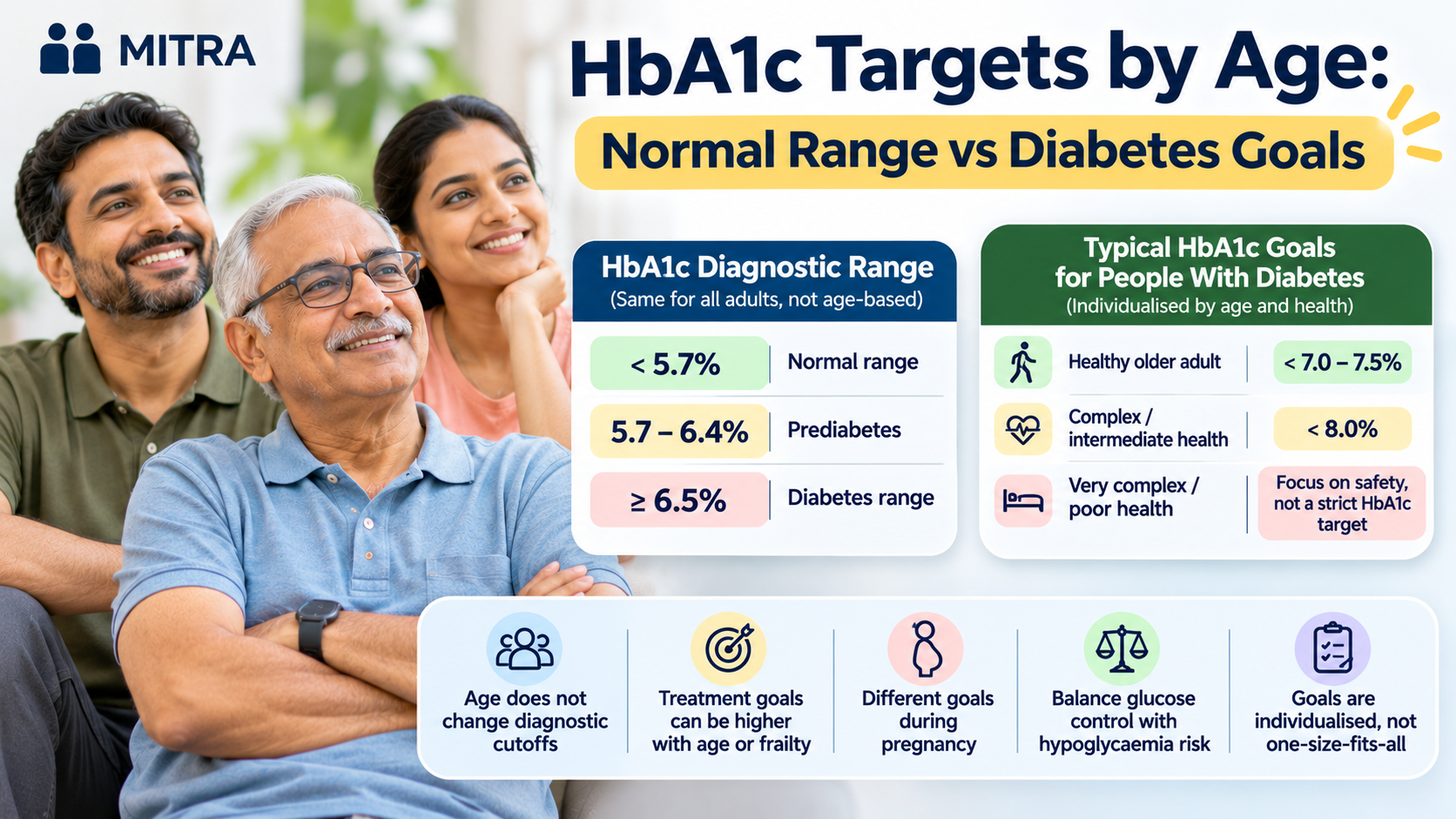
HbA1c Targets by Age: Normal Range vs Diabetes Goals
Does the normal HbA1c range change with age? Learn the difference between HbA1c diagnostic cutoffs and personal diabetes treatment targets, including goals for healthy adults, older adults, frailty and pregnancy.
Wed, 4 Nov 2026
Diabetes · 11 min read
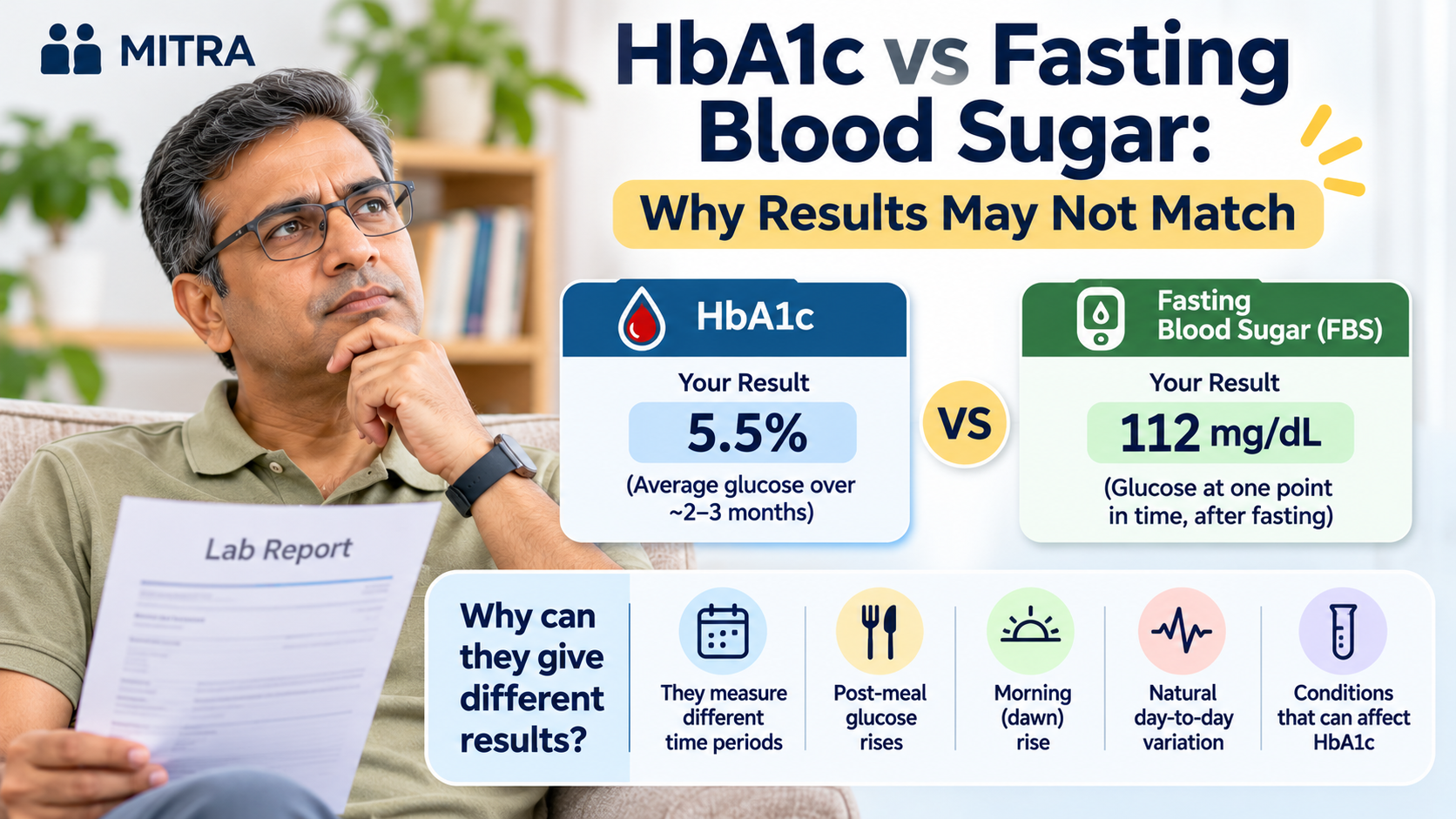
HbA1c vs Fasting Blood Sugar: Why Results May Not Match
Is your fasting blood sugar high but HbA1c normal — or HbA1c high despite a normal fasting glucose? Learn why these diabetes tests can disagree, which result matters, when testing should be repeated and when HbA1c may be unreliable.
Wed, 4 Nov 2026
Diabetes · 9 min read
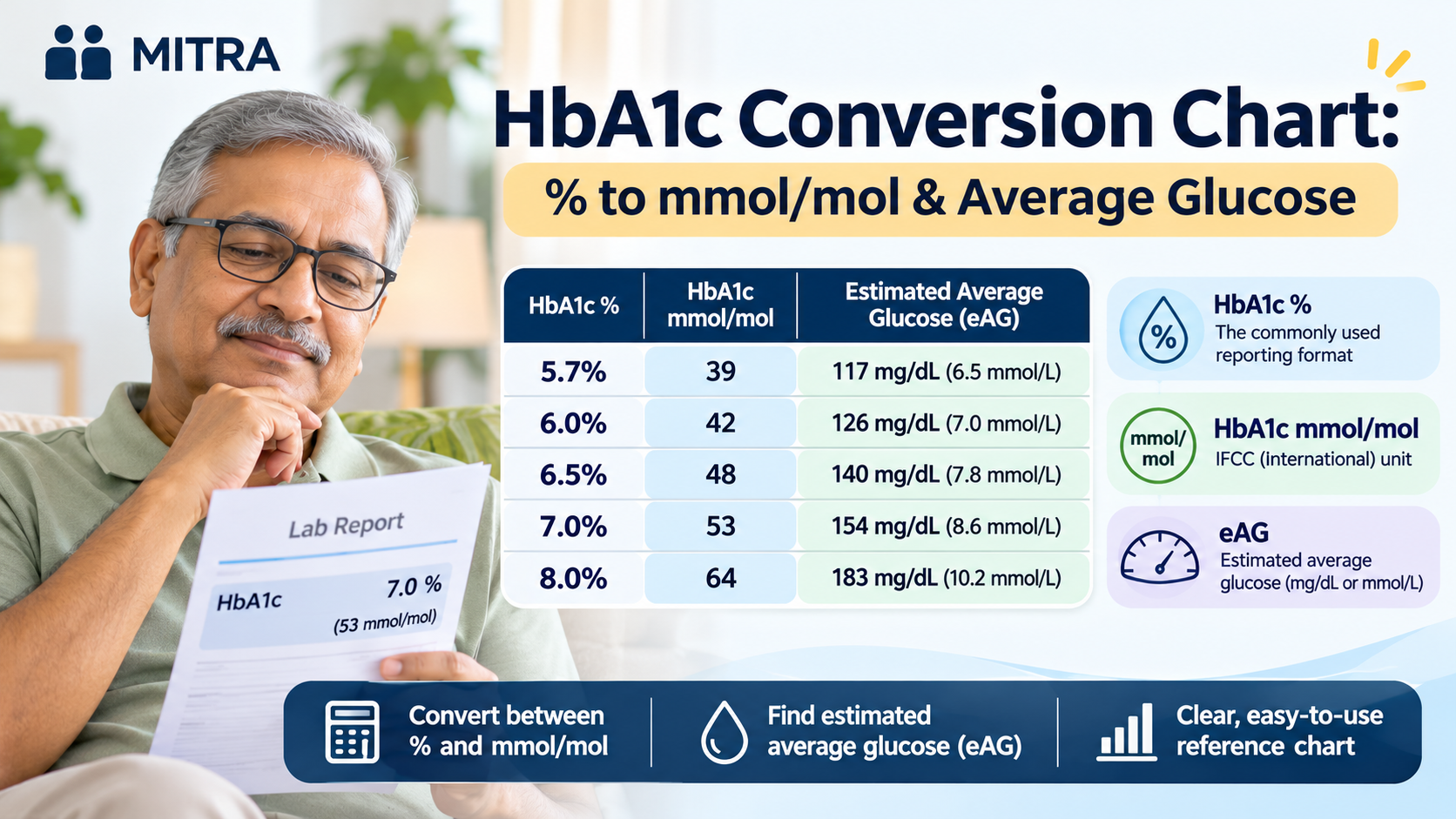
HbA1c Conversion Chart: % to mmol/mol & Average Glucose
Convert HbA1c between percentage and mmol/mol, and estimate the corresponding average glucose in mg/dL or mmol/L. Includes common values from HbA1c 5% to 12%, IFCC conversions and eAG calculations.
Wed, 4 Nov 2026