HbA1c Targets by Age: Normal Range vs Diabetes Goals
Does the normal HbA1c range change with age? Learn the difference between HbA1c diagnostic cutoffs and personal diabetes treatment targets, including goals for healthy adults, older adults, frailty and pregnancy.
Written by Dr. Sanjay Kumar K A · Medically reviewed by Dr. Sanjay Kumar K A, MD Anaesthesiology (Wed, 4 Nov 2026)
Published Wed, 4 Nov 2026 · 13 min read
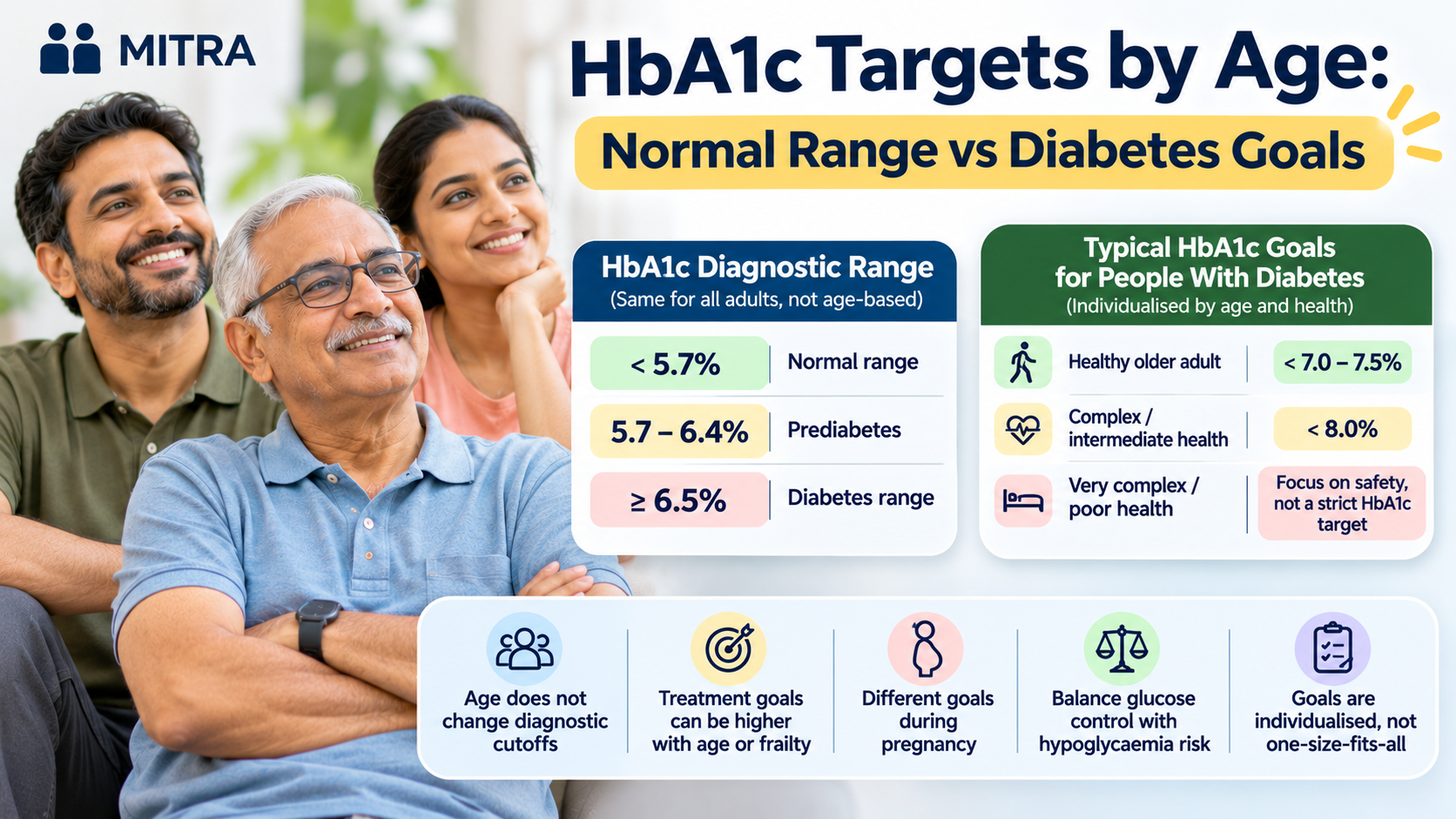
People often search for a “normal HbA1c by age” — for example, the normal HbA1c for a 40-year-old, 60-year-old or 70-year-old. But there is an important distinction: The standard HbA1c thresholds used to diagnose prediabetes and diabetes do not simply increase as you get older. What can change with age and health is the treatment target for someone who already has diabetes.
HbA1c normal range by age: quick answer
| Age | HbA1c diagnostic interpretation | ||
| 20–39 years | <5.7% normal; 5.7–6.4% prediabetes; ≥6.5% diabetes range | ||
| 40–59 years | Same diagnostic thresholds | ||
| 60–69 years | Same diagnostic thresholds | ||
| 70–79 years | Same diagnostic thresholds | ||
| 80+ years | Same diagnostic thresholds |
Why do people think HbA1c should rise with age?
HbA1c levels can vary across populations and may trend somewhat higher with age in people without diagnosed diabetes. But that does not mean doctors simply redefine a higher HbA1c as “normal” every decade. Clinical diagnostic thresholds are designed to identify glucose levels associated with increased risk of diabetes and its complications, not merely to describe what is statistically common in an age group.
What is the normal HbA1c range for adults?
| HbA1c | Diagnostic meaning | ||
| <5.7% | Normal range | ||
| 5.7–6.4% | Prediabetes | ||
| ≥6.5% | Diabetes range* |
See the full guide to interpreting an HbA1c result
What is an HbA1c treatment target?
Once someone already has diabetes, HbA1c is no longer being used simply to answer: “Do you have diabetes?” It also helps answer: “How well is your diabetes being controlled, and what glucose goal is appropriate for you?” Those treatment goals can be individualised.
What HbA1c target is recommended for most adults with diabetes?
For many nonpregnant adults with diabetes, the American Diabetes Association currently considers an HbA1c goal of below 7% (53 mmol/mol) appropriate when it can be achieved without severe or problematic hypoglycaemia
Some people may appropriately have a lower goal, such as below 6.5%, when:- Overall health is good- Treatment burden is low- Hypoglycaemia risk is low- The goal can be achieved safelyOthers may need a less stringent target.
HbA1c targets for older adults
Age becomes particularly relevant to treatment targets, but chronological age alone is still not enough. For older adults, ADA guidance considers:- Overall health- Frailty- Cognitive function- Ability to perform daily activities- Other medical conditions- Life expectancy- Medication burden- Hypoglycaemia risk- Patient preferences
HbA1c target chart for older adults with diabetes
| Health status | Reasonable HbA1c approach | ||
| Healthy older adult | Often <7.0–7.5% | ||
| Complex/intermediate health | Often <8.0% | ||
| Very complex/poor health | Avoid relying primarily on HbA1c; focus on avoiding hypoglycaemia and symptomatic hyperglycaemia |
What is a good HbA1c for a 60-year-old?
If the person does not have diagnosed diabetes, the standard diagnostic interpretation still applies: <5.7% normal5.7–6.4% prediabetes≥6.5% diabetes range If the person already has diabetes, the target depends more on overall health and treatment risk than on being exactly 60 years old.
What is a good HbA1c for a 65-year-old?
There is no special diagnostic HbA1c cutoff that starts at age 65. A healthy, independent 65-year-old with diabetes may still have a relatively tight treatment goal. A frail 65-year-old with multiple illnesses and recurrent hypoglycaemia may appropriately have a less stringent target. Health status matters more than the birthday itself.
What is a good HbA1c for a 70-year-old?
For an otherwise healthy and functionally independent 70-year-old with diabetes, ADA's older-adult framework suggests a reasonable HbA1c goal may be around <7.0–7.5%. That goal may be relaxed when significant frailty, cognitive impairment or complex illness increases the risks of intensive glucose treatment.
What is a good HbA1c for an 80-year-old?
There is no single number for every 80-year-old. An active, cognitively intact 80-year-old with relatively few medical problems is very different from an 80-year-old with:- Dementia- Recurrent falls- Severe heart disease- Advanced kidney disease- Dependence for daily activities- Repeated hypoglycaemiaTheir diabetes treatment goals may therefore be very different even though their age is identical.
Why might an older adult need a less strict HbA1c goal?
The benefit of very tight glucose control often takes years to translate into prevention of some long-term complications. At the same time, aggressive treatment can create immediate harms such as:- Hypoglycaemia- Falls- Confusion- Medication errors- Treatment burdenADA therefore recommends balancing benefits against risks rather than automatically pursuing the lowest possible HbA1c in every older person.
Why hypoglycaemia matters more in some older adults
Low blood sugar can be particularly dangerous in older adults because it may contribute to:- Falls- Injury- Confusion- Loss of consciousness- Hospitalisation- Difficulty safely managing medicinesThis is why ADA's older-adult framework places strong emphasis on avoiding hypoglycaemia, especially in people with frailty, cognitive impairment or complex health needs
Healthy older adult vs frail older adult
| Healthy older adult | Frail / complex older adult | |||
| Independence | Usually intact | May need help | ||
| Cognitive function | Usually intact | May be impaired | ||
| Other diseases | Few/stable | Multiple/severe | ||
| Hypoglycaemia consequences | Important | Often particularly high | ||
| Treatment complexity tolerated | Usually higher | Often needs simplification | ||
| HbA1c goal | Can often remain relatively strict | Often less stringent | ||
| Main aim | Prevent complications safely | Safety + symptom prevention + quality of life |
What does “complex/intermediate health” mean?
ADA uses this category for older adults who may have factors such as:- Multiple chronic illnesses- Two or more impairments in daily activities- Mild to moderate cognitive impairment- Frailty- Higher medication riskFor this broad group, HbA1c <8.0% may be a reasonable starting framework, but the goal still needs individualisation.
What if an older adult has very poor health?
In very complex or poor health — such as end-stage chronic illness, significant cognitive impairment or major functional dependency — ADA recommends avoiding reliance on HbA1c as the main treatment goal. The priority becomes avoiding:- Symptomatic high glucose- Dangerous low glucose- Excessive treatment burden
Does HbA1c normal range differ for men and women?
There is not a separate standard diagnostic HbA1c range for adult men and women. For nonpregnant adults, the same diagnostic thresholds are generally used:- <5.7%- 5.7–6.4%- ≥6.5%
What is the normal HbA1c for women?
For a nonpregnant woman, the standard diagnostic thresholds are the same as for other nonpregnant adults. There is no separate rule such as: “Women should have HbA1c X while men should have Y.” Pregnancy is a separate clinical situation.
What is the normal HbA1c for men?
Again, the standard diagnostic categories do not use a separate male-specific cutoff. Age, sex and individual circumstances may affect diabetes risk and treatment planning, but they do not create a separate basic diagnostic range for every demographic group.
HbA1c targets during pregnancy are different
Pregnancy is one important exception where glycaemic goals require a different framework. Red blood cells turn over more rapidly during pregnancy, so HbA1c tends to run somewhat lower. For people with diabetes during pregnancy, ADA currently states that an HbA1c goal of <6% is ideal when achievable without significant hypoglycaemia, with relaxation toward <7% when needed to avoid hypoglycaemia.
Diagnosis vs treatment target: the most important distinction
| Question | Relevant number | ||
| “Is my HbA1c normal?” | Diagnostic range | ||
| “Do I have prediabetes?” | 5.7–6.4% | ||
| “Does this meet the diabetes threshold?” | ≥6.5% | ||
| “What should my HbA1c be if I have diabetes?” | Individual treatment target | ||
| “What should my elderly parent's HbA1c goal be?” | Depends on health/function | ||
| “What should HbA1c be during pregnancy?” | Pregnancy-specific treatment goal |
Can a treatment target be above the diabetes diagnostic cutoff?
Yes — and this is where many online charts become confusing. Suppose someone already has diabetes and their personalised treatment goal is: HbA1c <7.5% That does not mean 7.4% is now considered “non-diabetic.” The person still has diabetes. The number simply reflects the agreed management goal.
Can a target be below 6.5% even though that is the diabetes threshold?
Yes. For selected people with diabetes who are healthy and can achieve tighter control without significant hypoglycaemia or excessive treatment burden, ADA states that lower goals such as <6.5% may be appropriate Again, diagnostic thresholds and treatment targets are different concepts.
Should everyone with diabetes aim for HbA1c below 7%?
No. Below 7% is appropriate for many adults, not every individual. The goal may need to be higher or lower depending on:- Diabetes duration- Cardiovascular disease- Kidney disease- Frailty- Cognitive function- Hypoglycaemia history- Medication type- Functional status- Treatment burden- Patient preference
Can HbA1c targets change over time?
Yes. Someone's goal at age 55 may not remain appropriate at age 80 — but the change is usually because health and treatment risk changed, not because a birthday automatically changed the acceptable HbA1c. ADA recommends reassessing glycaemic goals as health, function and circumstances change.
When might diabetes treatment need to be simplified?
In older adults, treatment may need simplification when the regimen becomes difficult or unsafe. Examples include:- Recurrent hypoglycaemia- Cognitive decline- Difficulty managing insulin- Multiple medicines- New functional dependency- Changing living circumstances- Inconsistent eatingADA specifically recommends considering simplification and deintensification where treatment burdens or harms outweigh benefits.
What if HbA1c is 7% in a person without diagnosed diabetes?
That is very different from an HbA1c of 7% in someone already receiving diabetes treatment. In a person without a previous diagnosis, 7% is above the diabetes diagnostic threshold. In the absence of unequivocal hyperglycaemia, the result generally requires confirmation with another abnormal test.
What if HbA1c is 7% in a person already treated for diabetes?
For many nonpregnant adults with established diabetes, an HbA1c around 7% may be consistent with a commonly recommended treatment goal. But whether it is ideal for that individual depends on the personalised target.
What if HbA1c is 8% in an elderly person?
The answer depends on health status. In a healthy, independent older adult, 8% may be above the preferred target. In someone with complex health, frailty or substantial treatment risk, a target around <8% may be reasonable. In very poor health, clinicians may place less emphasis on HbA1c altogether.
Why an “HbA1c normal range by age chart” can be misleading
Charts that simply say: Age 40 → XAge 50 → YAge 60 → ZAge 70 → higher number mix together two different questions:1. What level helps diagnose diabetes?2. What treatment goal is appropriate after diabetes is diagnosed?A clinically useful chart should keep those questions separate.
What factors should determine a personal HbA1c goal?
- Age
- Overall health
- Diabetes duration
- Cardiovascular disease
- Chronic kidney disease
- Frailty
- Cognition
- Independence
- Hypoglycaemia history
- Medication risks
- Life expectancy
- Patient priorities
- Ability to manage the treatment plan
What if your HbA1c target seems different from someone else's?
That can be completely appropriate. Two people may both have type 2 diabetes but receive different targets because one:- Is younger- Has no cardiovascular disease- Has low hypoglycaemia risk while the other: - Is frail- Lives alone- Uses insulin- Has recurrent low glucose- Has significant cognitive impairmentPersonalised treatment is not inconsistent treatment.
What if your HbA1c result seems impossible?
Sometimes the problem is not the target at all. Conditions such as significant anaemia, kidney failure, blood loss, transfusion and haemoglobin disorders can make HbA1c less reliable. If the value does not match glucose measurements, investigate possible interference rather than adjusting the target to explain the mismatch.
See which medical conditions can make HbA1c falsely high or low
Frequently asked questions
Does HbA1c normal range increase with age?
The standard diagnostic thresholds do not simply increase with age. For nonpregnant adults, HbA1c below 5.7% remains the usual normal diagnostic range, 5.7–6.4% indicates prediabetes and ≥6.5% reaches the diabetes threshold.
What should HbA1c be for someone over 60?
If they do not have diabetes, use the usual diagnostic thresholds. If they already have diabetes, the treatment target depends on health and hypoglycaemia risk. Many healthy older adults may have targets around <7–7.5%, while less stringent goals may be appropriate with more complex health.
What is a good HbA1c for someone over 70?
There is no single age-based number. For a healthy older adult with diabetes, ADA suggests approximately <7.0–7.5% as a reasonable framework. For complex health, <8% may be appropriate.
Is HbA1c 7% normal for a 70-year-old?
Not in the diagnostic sense. An HbA1c of 7% is in the diabetes range regardless of being 70. However, if the person already has diabetes, 7% may be a reasonable treatment result depending on their individual goal.
Is HbA1c 8% acceptable in an 80-year-old?
Sometimes, but not automatically. An HbA1c around 8% may be reasonable for an older adult with complex health, functional limitations or greater hypoglycaemia risk. A healthy 80-year-old may have a lower target.
Is the normal HbA1c different for women?
Not for nonpregnant adults. Men and women generally use the same standard diagnostic thresholds. Pregnancy requires separate glucose and HbA1c treatment considerations.
Should older adults try to get HbA1c as low as possible?
No. Lower is not always safer. Excessively intensive diabetes treatment can increase hypoglycaemia and treatment burden, particularly in frail older adults or those using insulin or medicines that can cause low glucose.
The simplest way to interpret HbA1c by age
| Situation | Best approach | ||
| Adult without diabetes | Use standard diagnostic cutoffs | ||
| Older adult without diabetes | Same diagnostic cutoffs | ||
| Adult with diabetes | Individual treatment goal | ||
| Healthy older adult with diabetes | Often around <7–7.5% | ||
| Complex older adult | Often around <8% | ||
| Very poor health | Focus more on symptoms and hypoglycaemia than HbA1c | ||
| Pregnancy with diabetes | Pregnancy-specific goals |
References
This article is for general health education and does not replace advice from your doctor. Please consult a qualified professional about your specific situation.
Need care at home in Bengaluru? See MITRA services.
Related articles
Diabetes · 12 min read
When HbA1c Can Be Wrong: Anaemia, Kidney Disease & Other Causes
HbA1c is useful for estimating long-term glucose levels, but certain conditions can make the result falsely high, falsely low or difficult to interpret. Learn how anaemia, blood loss, transfusion, kidney disease, haemoglobin variants, pregnancy and altered red-cell turnover can affect HbA1c.
Wed, 4 Nov 2026
Diabetes · 11 min read
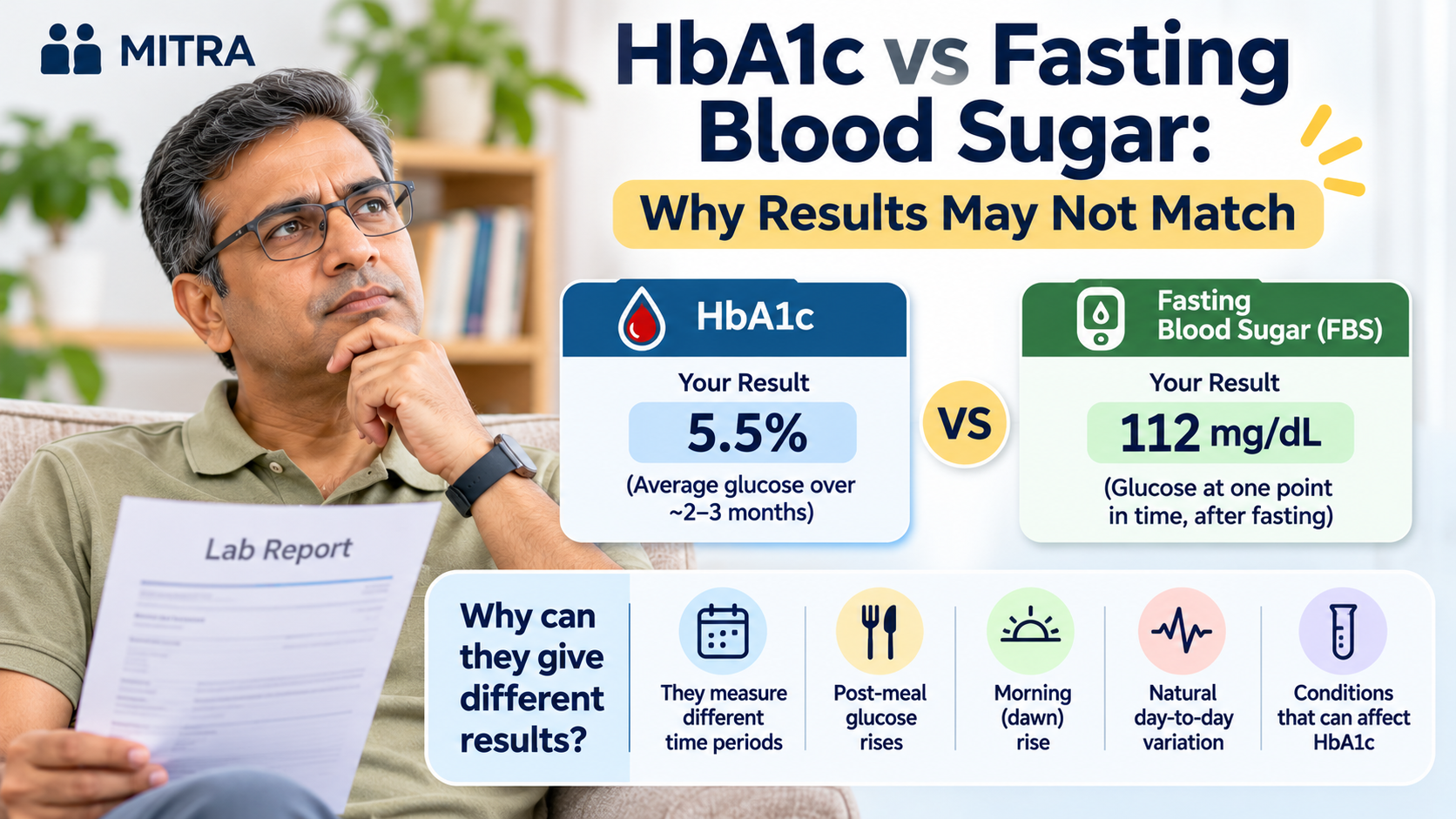
HbA1c vs Fasting Blood Sugar: Why Results May Not Match
Is your fasting blood sugar high but HbA1c normal — or HbA1c high despite a normal fasting glucose? Learn why these diabetes tests can disagree, which result matters, when testing should be repeated and when HbA1c may be unreliable.
Wed, 4 Nov 2026
Diabetes · 9 min read
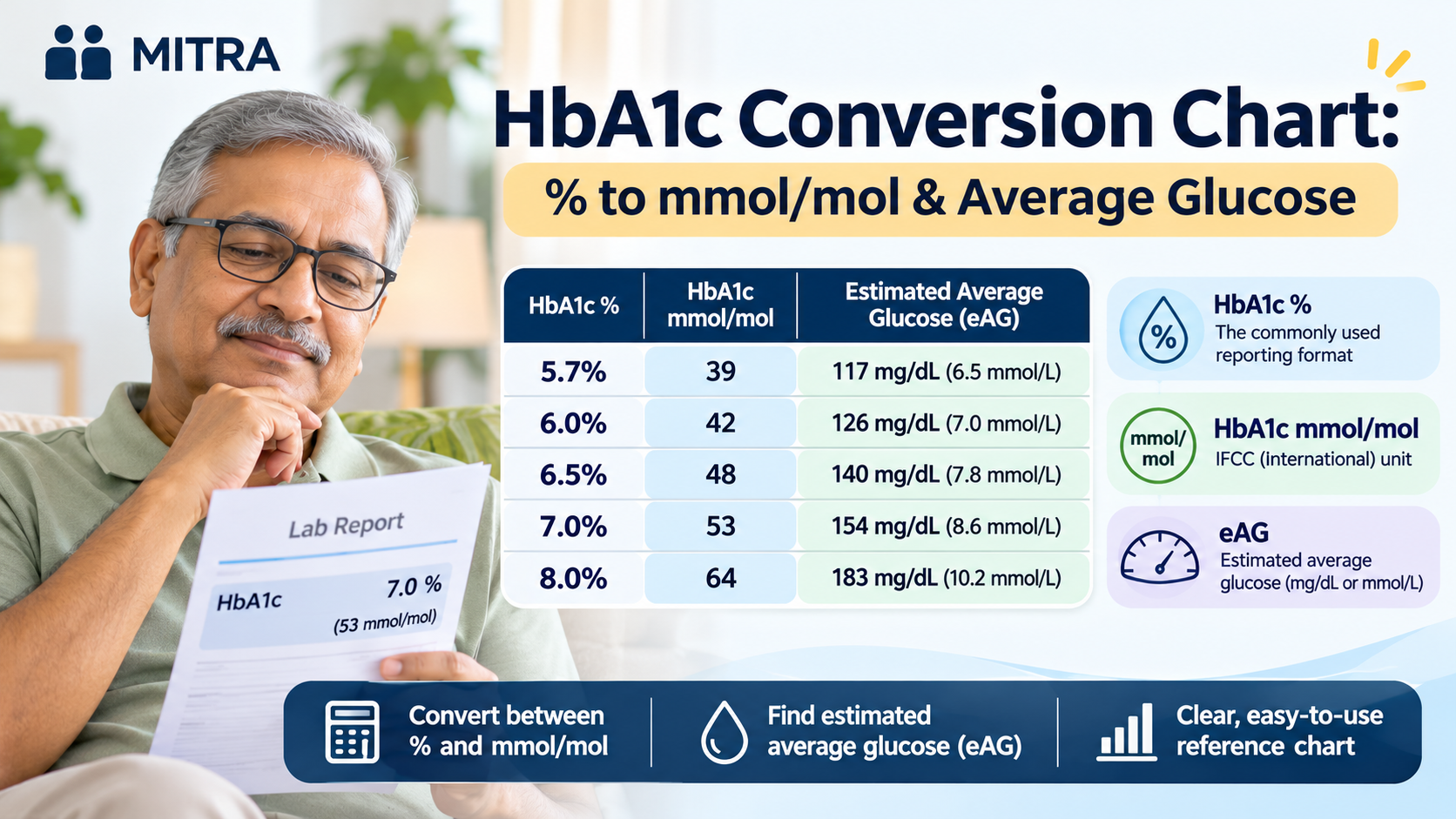
HbA1c Conversion Chart: % to mmol/mol & Average Glucose
Convert HbA1c between percentage and mmol/mol, and estimate the corresponding average glucose in mg/dL or mmol/L. Includes common values from HbA1c 5% to 12%, IFCC conversions and eAG calculations.
Wed, 4 Nov 2026