HbA1c Conversion Chart: % to mmol/mol & Average Glucose
Convert HbA1c between percentage and mmol/mol, and estimate the corresponding average glucose in mg/dL or mmol/L. Includes common values from HbA1c 5% to 12%, IFCC conversions and eAG calculations.
Written by Dr. Sanjay Kumar K A · Medically reviewed by Dr. Sanjay Kumar K A, MD Anaesthesiology (Wed, 4 Nov 2026)
Published Wed, 4 Nov 2026 · 9 min read
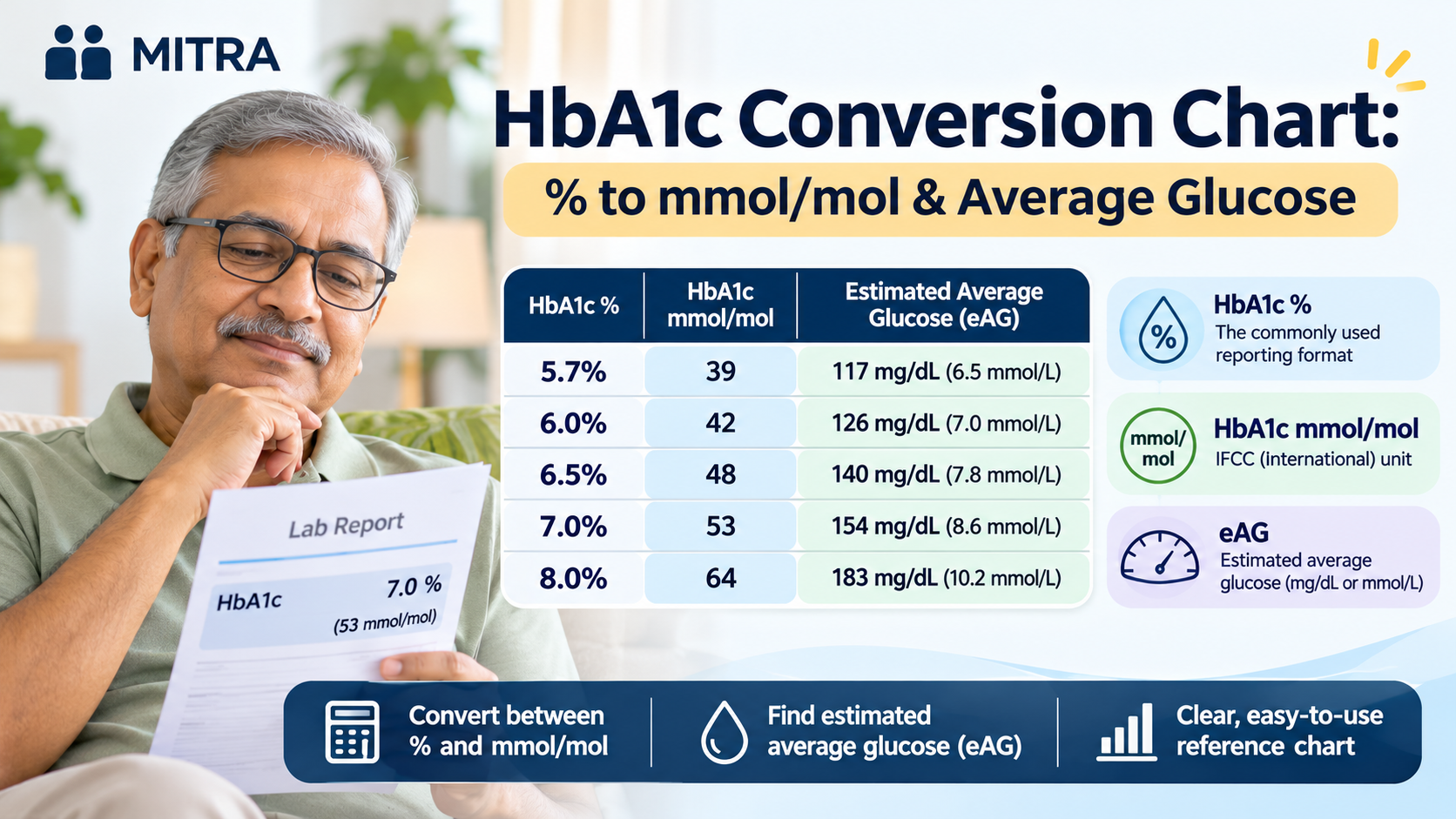
An HbA1c result can be written in different units depending on the laboratory or country. For example: HbA1c 7.0% = approximately 53 mmol/mol = estimated average glucose of 154 mg/dL. These numbers look very different, but they describe the same underlying HbA1c result. The NGSP publishes standard equations linking HbA1c percentage, IFCC mmol/mol and estimated average glucose (eAG).
HbA1c conversion chart: % to mmol/mol and average glucose
| HbA1c % | HbA1c mmol/mol | Estimated average glucose mg/dL | Estimated average glucose mmol/L | ||
| 5.0% | 31 | 97 | 5.4 | ||
| 5.5% | 37 | 111 | 6.2 | ||
| 5.7% | 39 | 117 | 6.5 | ||
| 6.0% | 42 | 126 | 7.0 | ||
| 6.4% | 46 | 137 | 7.6 | ||
| 6.5% | 48 | 140 | 7.8 | ||
| 7.0% | 53 | 154 | 8.6 | ||
| 7.5% | 58 | 169 | 9.4 | ||
| 8.0% | 64 | 183 | 10.2 | ||
| 8.5% | 69 | 197 | 11.0 | ||
| 9.0% | 75 | 212 | 11.8 | ||
| 9.5% | 80 | 226 | 12.6 | ||
| 10.0% | 86 | 240 | 13.4 | ||
| 11.0% | 97 | 269 | 14.9 | ||
| 12.0% | 108 | 298 | 16.5 |
See what your HbA1c number actually means
What does HbA1c percentage mean?
HbA1c measures the proportion of haemoglobin in red blood cells that has glucose attached to it. Because red blood cells remain in circulation for months, HbA1c provides an estimate of average blood glucose exposure over approximately the previous three months, rather than glucose at one moment in time.
When a report says: HbA1c = 7% it means approximately 7% of measured haemoglobin is glycated according to the NGSP/DCCT reporting system. It does not mean that blood glucose is 7%.
What does HbA1c mmol/mol mean?
The IFCC system reports HbA1c as millimoles of glycated haemoglobin per mole of total haemoglobin, written as: mmol/mol This produces numbers such as: 39 mmol/mol48 mmol/mol53 mmol/mol64 mmol/mol rather than percentages such as 5.7%, 6.5%, 7% or 8%. The IFCC recommends reporting HbA1c in mmol/mol.
HbA1c percentage to mmol/mol conversion
| HbA1c % | IFCC mmol/mol | ||
| 4.0% | 20 | ||
| 4.5% | 26 | ||
| 5.0% | 31 | ||
| 5.4% | 36 | ||
| 5.5% | 37 | ||
| 5.6% | 38 | ||
| 5.7% | 39 | ||
| 5.8% | 40 | ||
| 6.0% | 42 | ||
| 6.4% | 46 | ||
| 6.5% | 48 | ||
| 6.9% | 52 | ||
| 7.0% | 53 | ||
| 7.5% | 58 | ||
| 8.0% | 64 | ||
| 9.0% | 75 | ||
| 10.0% | 86 | ||
| 11.0% | 97 | ||
| 12.0% | 108 |
How do you convert HbA1c % to mmol/mol?
The NGSP publishes the master relationship: NGSP HbA1c (%) = 0.09148 × IFCC HbA1c (mmol/mol) + 2.152 Rearranging that equation gives an approximate conversion from percentage to mmol/mol: IFCC mmol/mol = (HbA1c % − 2.152) ÷ 0.09148 For everyday interpretation, using a validated conversion table is usually easier than calculating this manually.
What is 35 mmol/mol in HbA1c percentage?
An HbA1c of 35 mmol/mol is approximately 5.4%. This conversion describes the same HbA1c result in two different reporting systems. To understand whether 5.4% is considered normal or abnormal, use the main HbA1c interpretation article rather than treating the conversion itself as a diagnosis.
What is 39 mmol/mol in HbA1c percentage?
39 mmol/mol ≈ 5.7% HbA1c. The ADA's 2026 diagnostic criteria use 5.7–6.4%, corresponding to approximately 39–47 mmol/mol, as the HbA1c range defining prediabetes in nonpregnant individuals.
If your HbA1c is 39–47 mmol/mol, see the complete prediabetes guide
What is 48 mmol/mol in HbA1c percentage?
48 mmol/mol ≈ 6.5% HbA1c. The ADA currently uses HbA1c ≥6.5% or ≥48 mmol/mol as one diagnostic criterion for diabetes in nonpregnant individuals. In the absence of unequivocal hyperglycaemia, diagnosis generally requires confirmation with another abnormal result.
What is 53 mmol/mol in HbA1c percentage?
53 mmol/mol ≈ 7.0% HbA1c. A value of 7% has a different meaning depending on whether someone is being evaluated for diabetes or already has diagnosed diabetes. This conversion article does not set individual treatment targets.
What is 64 mmol/mol in HbA1c percentage?
64 mmol/mol ≈ 8.0% HbA1c. According to the NGSP conversion table, 8.0% also corresponds to an estimated average glucose of approximately 183 mg/dL or 10.2 mmol/L.
What is estimated average glucose or eAG?
Estimated average glucose (eAG) translates an HbA1c result into glucose units that may look more familiar from glucometer or laboratory results. For example: HbA1c 7% → eAG approximately 154 mg/dL The relationship comes from studies comparing HbA1c with repeated glucose measurements and continuous glucose monitoring.
HbA1c to average blood sugar chart
| HbA1c | Approx. average glucose | ||
| 5% | 97 mg/dL | ||
| 6% | 126 mg/dL | ||
| 7% | 154 mg/dL | ||
| 8% | 183 mg/dL | ||
| 9% | 212 mg/dL | ||
| 10% | 240 mg/dL | ||
| 11% | 269 mg/dL | ||
| 12% | 298 mg/dL |
How is estimated average glucose calculated?
The commonly used relationship is: eAG (mg/dL) = 28.7 × HbA1c (%) − 46.7 For example: HbA1c = 8% 28.7 × 8 − 46.7≈ 183 mg/dL The NGSP publishes this equation based on the relationship between HbA1c and repeated glucose measurements.
How do you convert eAG from mg/dL to mmol/L?
For glucose: mg/dL ÷ 18 ≈ mmol/L So an estimated average glucose of: 154 mg/dL ≈ 8.6 mmol/L This conversion applies to glucose concentration. It should not be confused with HbA1c mmol/mol, which is an entirely different unit.
HbA1c mmol/mol vs blood glucose mmol/L
| Unit | What it measures | Example | ||
| % | HbA1c | 7.0% | ||
| mmol/mol | HbA1c | 53 mmol/mol | ||
| mg/dL | Glucose concentration | 154 mg/dL | ||
| mmol/L | Glucose concentration | 8.6 mmol/L |
Is estimated average glucose the same as your glucometer average?
Not necessarily. eAG is an estimate derived mathematically from HbA1c. Your glucometer average depends on when you test. For example, if most measurements are taken before meals, it may miss higher post-meal glucose values. Continuous glucose monitoring can provide a much denser picture of glucose throughout the day.
Why can eAG and my glucose readings look different?
- Glucose varies throughout the day
- Finger-prick testing captures only selected moments
- Post-meal rises may not be measured
- Overnight values may be missed
- HbA1c reflects a longer period
- Some medical conditions affect HbA1c accuracy
- Laboratory and meter measurements have normal variation
HbA1c is not the same as fasting blood sugar
HbA1c estimates longer-term glucose exposure. A fasting blood sugar test measures glucose at the specific time the blood sample is taken after fasting. The two tests therefore answer different questions and may occasionally appear discordant. ADA guidance specifically notes that HbA1c and fasting glucose reflect different aspects of glucose metabolism.
See how fasting blood sugar differs from HbA1c
Can you convert HbA1c directly into fasting blood sugar?
No. An HbA1c conversion gives an estimated average glucose, not a predicted fasting glucose. Two people with the same HbA1c can have different combinations of:- Fasting glucose- Post-meal glucose- Overnight glucose- Glucose variabilitySo eAG should never be relabelled as “fasting blood sugar.”
Can you convert HbA1c into random blood sugar?
No. A random blood glucose result represents glucose at one particular moment. HbA1c reflects a much longer period. The estimated average glucose derived from HbA1c is therefore not a substitute for an actual random glucose measurement.
See the normal ranges for fasting, post-meal and random blood sugar tests
Why does my report show both % and mmol/mol?
Some laboratories provide both systems so results can be interpreted internationally. For example: HbA1c 6.5% (48 mmol/mol) represents one laboratory result expressed in two standardised formats. It does not mean two separate tests were performed.
NGSP vs IFCC: what is the difference?
NGSP standardisation links HbA1c measurements to the Diabetes Control and Complications Trial reference system and commonly expresses results as a percentage. The IFCC developed a reference measurement system and reports HbA1c in mmol/mol. A validated master equation links the two systems.
Does converting HbA1c change the result?
No. Changing: 7.0% → 53 mmol/mol does not change the patient's glucose control. It is similar to converting a temperature between Celsius and Fahrenheit: the numeric value changes because the unit changes, not because the underlying measurement changed.
Can HbA1c conversion tables diagnose diabetes?
A conversion table can show what one unit equals in another, but diagnosis requires appropriate clinical interpretation. Current ADA criteria include HbA1c ≥6.5% (≥48 mmol/mol) as a diabetes criterion, but in someone without unequivocal hyperglycaemia, confirmation is generally required. For detailed interpretation, use the main HbA1c article.
When might an HbA1c conversion be misleading?
The mathematical conversion may be correct while the underlying HbA1c itself is less reliable. Conditions that can affect HbA1c interpretation include:- Significant anaemia- Altered red-cell lifespan- Kidney failure- Some haemoglobin disorders- Recent blood loss- Blood transfusion- PregnancyThe CDC and NGSP both caution that these factors can cause falsely high or low HbA1c results.
A dedicated MITRA article will cover when HbA1c can be inaccurate in detail. If an HbA1c result is unexpectedly different from glucose readings, clinical review may be more useful than repeatedly converting the number. ADA recommends further evaluation when there is consistent and substantial discordance between HbA1c and measured glucose.
Frequently asked questions
What is HbA1c 6% in mmol/mol?
HbA1c 6.0% ≈ 42 mmol/mol. It corresponds to an estimated average glucose of approximately 126 mg/dL or 7.0 mmol/L.
What is HbA1c 7% in mmol/mol?
HbA1c 7.0% ≈ 53 mmol/mol. Its estimated average glucose is approximately 154 mg/dL or 8.6 mmol/L.
What is HbA1c 8% in mmol/mol?
HbA1c 8.0% ≈ 64 mmol/mol. Its estimated average glucose is approximately 183 mg/dL or 10.2 mmol/L.
What HbA1c is 64 mmol/mol?
64 mmol/mol ≈ 8.0% HbA1c. This is one of the standard conversions published by NGSP.
What HbA1c is 35 mmol/mol?
35 mmol/mol ≈ 5.4% HbA1c. Small rounding differences can occur between calculators, so a laboratory's reported value should remain the primary result.
What is a good HbA1c?
That question requires interpretation rather than conversion. The meaning differs depending on whether the person is being screened for diabetes or already has diabetes with an individual treatment target. Use MITRA's HbA1c Test Normal Range guide for that question rather than relying on this conversion table.
Need an HbA1c test at home in Bengaluru?
HbA1c itself does not require fasting, although fasting may be needed if it is ordered together with tests such as fasting blood sugar. MITRA offers home diagnostic sample collection in Bengaluru, including HbA1c and diabetes-related testing.
Check HbA1c at home in Bengaluru
References
This article is for general health education and does not replace advice from your doctor. Please consult a qualified professional about your specific situation.
Need care at home in Bengaluru? See MITRA services.
Related articles
Diabetes · 13 min read
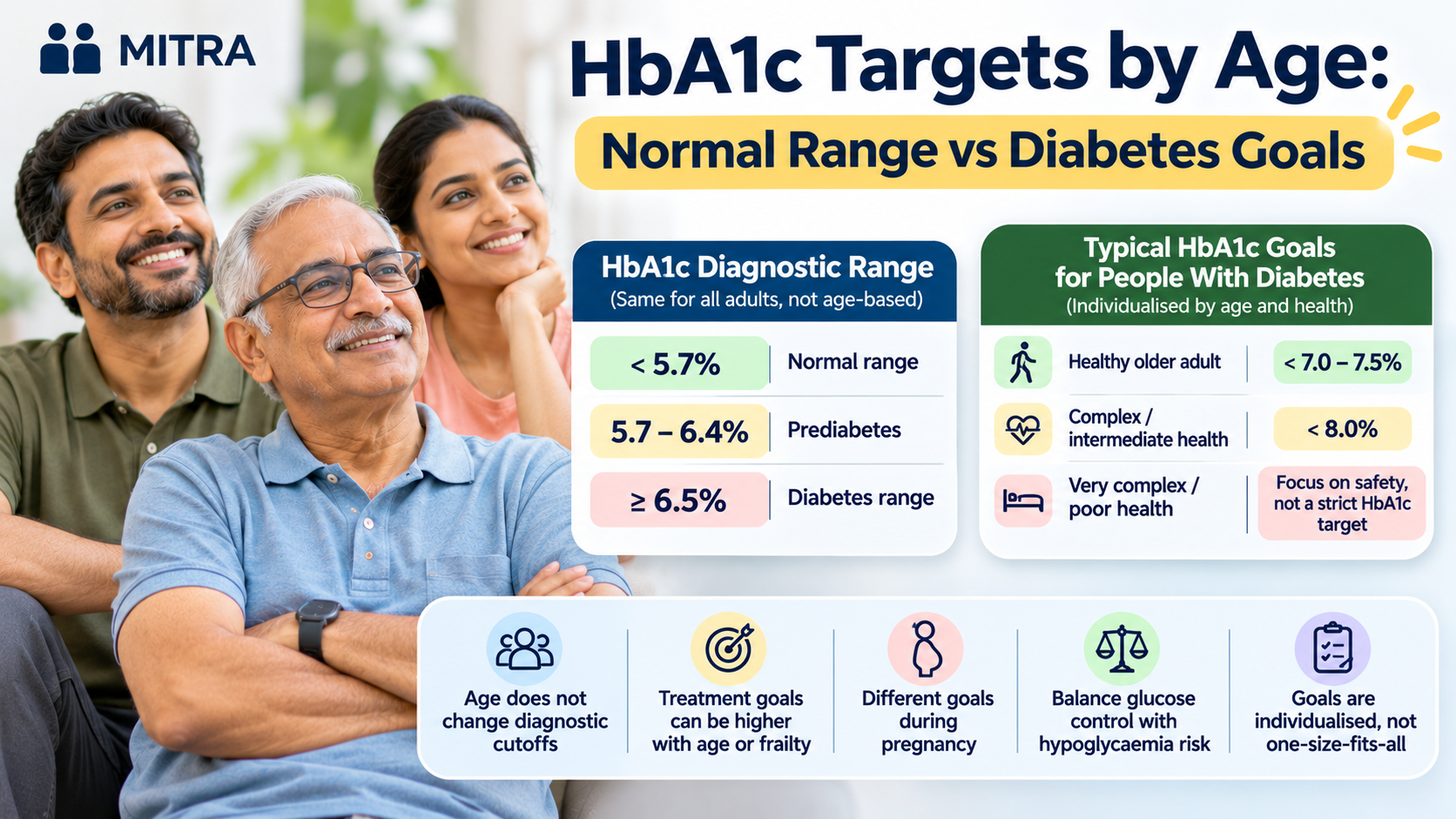
HbA1c Targets by Age: Normal Range vs Diabetes Goals
Does the normal HbA1c range change with age? Learn the difference between HbA1c diagnostic cutoffs and personal diabetes treatment targets, including goals for healthy adults, older adults, frailty and pregnancy.
Wed, 4 Nov 2026
Diabetes · 12 min read
When HbA1c Can Be Wrong: Anaemia, Kidney Disease & Other Causes
HbA1c is useful for estimating long-term glucose levels, but certain conditions can make the result falsely high, falsely low or difficult to interpret. Learn how anaemia, blood loss, transfusion, kidney disease, haemoglobin variants, pregnancy and altered red-cell turnover can affect HbA1c.
Wed, 4 Nov 2026
Diabetes · 11 min read
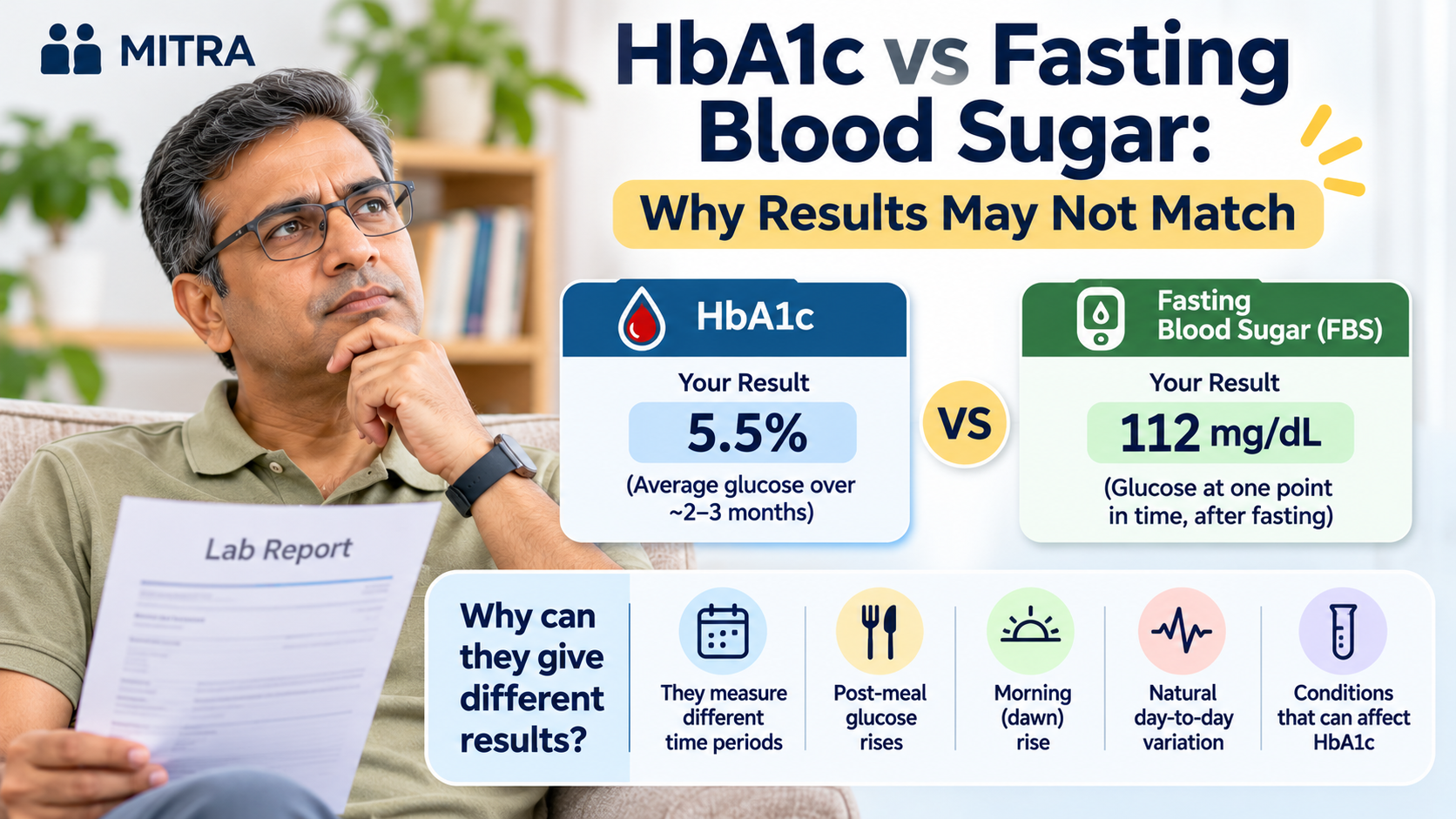
HbA1c vs Fasting Blood Sugar: Why Results May Not Match
Is your fasting blood sugar high but HbA1c normal — or HbA1c high despite a normal fasting glucose? Learn why these diabetes tests can disagree, which result matters, when testing should be repeated and when HbA1c may be unreliable.
Wed, 4 Nov 2026