How to Prepare Your Home Before a Caregiver Starts
A caregiver is about to start at home. Use this practical checklist to prepare the patient's routine, medicines, room, bathroom, emergency information and live-in arrangements before day one.
Written by Mr. Rahul B S
Published Sat, 17 Oct 2026 · 10 min read

Choosing a caregiver is only part of getting home care right. The first few days are much easier when the family has already organised the patient's routine, medicines, mobility equipment, bathroom, emergency information and household expectations. You do not need to turn your home into a hospital. The goal is simply to make the environment safe, give the caregiver clear information and remove avoidable confusion before the first shift begins.
What should you prepare before the caregiver arrives?
- Write down the patient's normal daily routine.
- Organise prescribed medicines in one clearly identified place.
- Keep recent prescriptions and important medical documents accessible.
- Clear the space used for walking and transfers.
- Prepare the bathroom for safe assistance.
- Keep commonly used care supplies together.
- Write down emergency and family contact numbers.
- Explain household rules and caregiver responsibilities.
- Decide who in the family will be the main point of contact.
- For 24-hour care, prepare suitable accommodation, meals, bathroom access and storage for the caregiver.
Make a simple daily routine sheet
Do not expect a new caregiver to learn the patient's entire routine through verbal instructions on the first morning. A simple written schedule can prevent repeated misunderstandings. Include the patient's usual wake-up time, bathing preference, meals, medicines, toileting pattern, mobility assistance, prescribed exercises, rest periods and bedtime routine. Also identify what the patient normally does independently. Good home care should support independence where possible rather than automatically doing everything for the person. NICE home-care guidance similarly recommends care based on the individual's goals, abilities and preferences.
| Information | Example | ||
| Wake-up | Usually 7:00 AM | ||
| Morning care | Toilet, brushing, assisted bath | ||
| Breakfast | 8:30 AM | ||
| Medicines | As per current prescription | ||
| Mobility | Walker with one-person supervision | ||
| Exercise | Physiotherapist's prescribed routine | ||
| Lunch | 1:00 PM | ||
| Rest | 2:00–3:00 PM | ||
| Evening routine | Walk / sitting outside if able | ||
| Dinner | 8:00 PM | ||
| Bedtime | Around 10:00 PM | ||
| Important preference | Prefers bathing before breakfast |
Organise medicines before day one
Keep the patient's current prescription and medicines together in a clearly identified, safe location. The caregiver should know which medicine-related responsibilities are included in the care plan. For routine caregiving, that may mean reminding a patient to take prescribed medicines or helping maintain the agreed schedule. It does not mean independently diagnosing symptoms, changing doses, stopping medicines or deciding to give extra medication. If the patient's medicines have recently changed after hospital discharge, make sure outdated prescriptions are not being used accidentally.
Create a safe space around the patient
- Clear walking routes
- Adequate lighting
- Frequently used items within reach
- Stable furniture
- Enough space for mobility aids
- Suitable footwear readily available
- A safe route between bed and bathroom
- Necessary glasses or hearing aids accessible
- A working phone, bell or other method of calling for assistance where appropriate
Think about how transfers actually happen
If the patient requires help moving from bed to chair, chair to toilet or sitting to standing, make sure there is enough physical space for the movement to be performed safely. Do not position heavy furniture or equipment where it forces the caregiver to twist, reach awkwardly or lift the patient through a narrow gap. If transfers require a particular technique or mobility device, that technique should be established by the relevant healthcare or rehabilitation professional rather than improvised by the family.
Preparing the home for someone who is largely confined to bed
Prepare the bathroom
- Removing slippery or loose floor mats
- Keeping the floor dry
- Providing good lighting
- Making the route to the toilet clear
- Keeping toiletries within easy reach
- Providing a suitable chair or bathing aid if recommended
- Installing appropriate grab support when professionally advised
- Keeping clean clothes, diapers or continence supplies nearby
- Ensuring the door arrangement still allows assistance in an emergency
For 24-hour care, prepare for someone living in your home
A 24-hour caregiver is not simply a 12-hour worker who stays awake for twice as long. For a live-in arrangement, the family needs to provide a reasonable living environment in addition to the patient's care setup. For MITRA's 24-hour caregiving arrangements, the household should plan for the caregiver's meals, accommodation, mattress or suitable sleeping arrangement, bathroom access, storage space, privacy and a safe environment. Adequate sleep and rest remain important. If the patient requires frequent active care throughout the night, the family should discuss whether a different staffing arrangement is more appropriate.
| Family should prepare | Why | ||
| Suitable sleeping space | The live-in caregiver requires rest | ||
| Mattress / appropriate bed arrangement | Safe and reasonable accommodation | ||
| Three meals | Caregiver is staying in the household | ||
| Bathroom access | Basic living requirement | ||
| Small storage area | Clothing and personal belongings | ||
| Privacy | Respectful live-in arrangement | ||
| Safe household environment | Important for both patient and caregiver | ||
| Clear nighttime expectations | Prevents confusion about active night duties |
Understand how a 24-hour live-in caregiving arrangement actually works
Agree on the caregiver's duties before the first shift
Many home-care disputes begin because responsibilities were never clearly defined. The caregiver should know what is expected for the patient, and the family should know what is outside the agreed role. Do not gradually convert a patient-care role into general domestic employment simply because the caregiver is already present in the house.Clear expectations protect the patient, caregiver and family. NICE home-care guidance similarly emphasises agreeing mutual expectations and making sure everyone involved understands what care they should provide and when.
| Typical patient-care responsibility | Not routine general household work | ||
| Personal hygiene assistance | Cleaning the entire house | ||
| Toileting support | Washing the family's clothes | ||
| Dressing and grooming | Cooking for the whole household | ||
| Mobility and positioning | Childcare | ||
| Patient meals/feeding assistance as agreed | Pet care | ||
| Medication reminders | Family errands and shopping | ||
| Basic observations in the care plan | Driving family members | ||
| Companionship | Handling unrelated household tasks | ||
| CareTrack / care documentation where applicable | Managing family finances |
See what is — and is not — normally part of a caregiver's role
Decide how food will be handled
Clarify the patient's meal routine before the caregiver arrives. Write down any prescribed dietary instructions, meal timings, foods the patient dislikes and whether they need assistance eating. If simple patient-specific food preparation is part of the agreed care plan, make sure the caregiver knows what is expected. For a 24-hour live-in caregiver, the family should also make arrangements for the caregiver's own meals rather than expecting them to independently manage their food while continuously responsible for the patient.
Set boundaries around valuables and privacy
Before home care starts, store unnecessary cash, jewellery, financial documents, passwords and other valuables securely. This is good practice regardless of who the caregiver is and avoids misunderstandings later. At the same time, the caregiver should respect the family's privacy and access only the areas of the home required for their work and living arrangement. The patient also deserves privacy. Assistance with bathing, toileting and dressing should be handled respectfully rather than turning personal care into an open family activity.
Create an emergency plan
- Primary family contact
- Backup family contact
- Treating doctor's details where relevant
- Preferred hospital
- Known major medical conditions
- Important allergies
- Current prescription
- Relevant recent discharge summary
- Ambulance/emergency instructions
- Instructions on whom the caregiver should contact first for non-emergency concerns
Use the first day for a proper handover
- Introduce them properly to the patient.
- Walk through the patient's normal routine.
- Demonstrate where medicines and supplies are kept.
- Explain mobility assistance already advised by professionals.
- Show the bathroom and patient-care areas.
- Review meals and fluid routines.
- Explain any communication, hearing or cognitive difficulties.
- Review emergency contacts.
- Clarify what should be documented or reported.
- Confirm which family member is the main contact.
- For live-in care, show the caregiver their sleeping, storage and bathroom arrangements.
- Allow the patient and caregiver time to become comfortable with one another.
Tell the caregiver about the person, not just the diagnosis
Good caregiving becomes easier when the provider understands the patient's preferences. Tell them how the patient likes to be addressed, their preferred language, normal sleep routine, favourite foods, usual television programmes, bathing preferences, religious or cultural practices, communication style and anything that commonly causes distress. This can be particularly valuable for someone with dementia or communication difficulty. Person-centred home care should reflect the individual's priorities and preferences rather than treating everyone with the same standard routine.
What should families avoid doing?
- Giving multiple contradictory instructions from different relatives
- Asking the caregiver to change prescribed treatment
- Expecting nursing procedures from a caregiver not authorised or trained to perform them
- Adding unrelated household duties after joining
- Leaving unsafe lifting or transfer arrangements unresolved
- Keeping emergency contacts only in one person's phone
- Leaving valuables casually around the house
- Expecting a 24-hour caregiver to remain awake throughout every night
- Changing the patient's routine unnecessarily on the caregiver's first day
- Assuming problems will resolve themselves instead of reporting them
- Discussing complaints about the caregiver in front of the patient rather than through the proper support channel
- Treating the patient as though they have no say in their own care
| Common question | Practical answer | ||
| Do we need a separate room for a 24-hour caregiver? | A reasonable private sleeping arrangement is needed. The exact setup depends on the home, but the caregiver must have adequate rest, privacy and a suitable mattress or bed arrangement. | ||
| Should we buy a hospital bed before care starts? | Not automatically. Equipment should be based on the patient's actual mobility and clinical needs. | ||
| Should the caregiver keep the patient's medicines? | Medicines should be stored safely according to the agreed care plan. The caregiver should not independently alter prescribed treatment. | ||
| Do we need CCTV? | CCTV is not a substitute for provider screening, communication or care oversight. Any monitoring should also respect privacy and applicable law. | ||
| What if the caregiver and patient do not get along? | Raise the issue early. Sometimes expectations or routines can be corrected; where the placement is genuinely unsuitable, MITRA's replacement process can be used. | ||
| Who should give instructions to the caregiver? | Ideally, nominate one primary family contact so instructions remain consistent. |
Need care at home in Bengaluru? See MITRA services.
Related articles
Home Care Guides · 19 min read
Personalised Home Care Plans: How MITRA Decides What Care a Patient Actually Needs
A home care plan should be based on what a person actually needs help with — not simply their age or diagnosis. See how MITRA assesses daily activities, mobility, nursing requirements, night needs, family support and preferences before structuring personalised home care.
Fri, 6 Nov 2026
Home Care Guides · 15 min read
Doctor-Guided Home Care at MITRA: What Doctor Check-Ins Actually Include
MITRA caregiving plans include doctor check-ins as part of ongoing home care. See what the doctor reviews, how CareTrack and LabTrack support the review, when the care plan may change, and what doctor oversight does not replace.
Thu, 5 Nov 2026
Home Care Guides · 12 min read
MITRA CareTrack Explained: How Families Receive Daily Care Updates
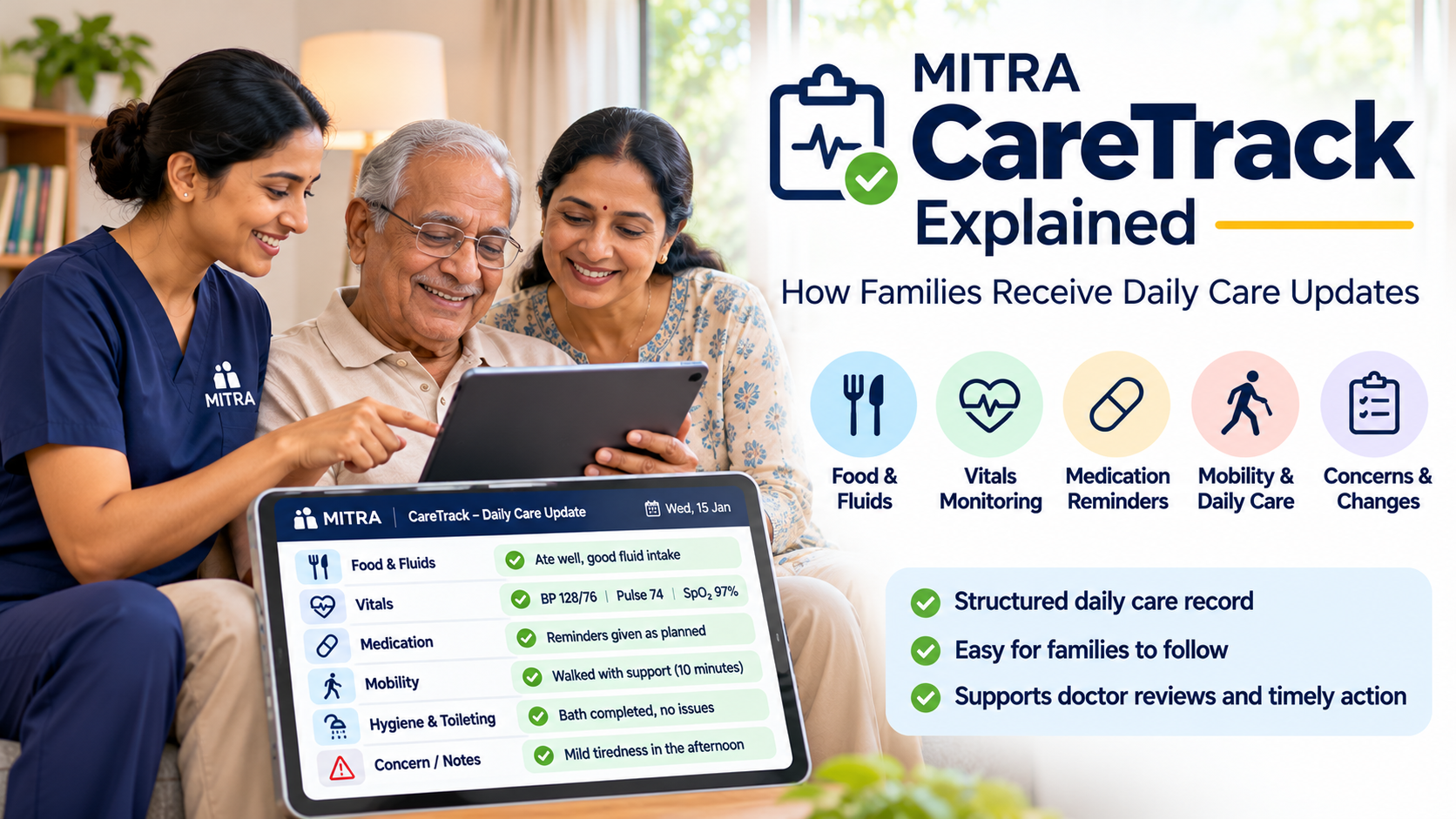
CareTrack is MITRA's structured daily care record for home caregiving. See what caregivers document, how families can follow day-to-day care, how vitals and concerns are tracked, and how CareTrack supports doctor reviews, escalation and continuity when caregivers change.
Wed, 4 Nov 2026