Stroke Patient Care at Home: Caregiver, Nurse or Physiotherapist?
Recovering from a stroke at home may require caregiving, nursing and rehabilitation. Learn what each professional does, how to plan daily care and when extra support may be needed.
Written by Dr. Sanjay Kumar K A
Published Fri, 16 Oct 2026 · 11 min read
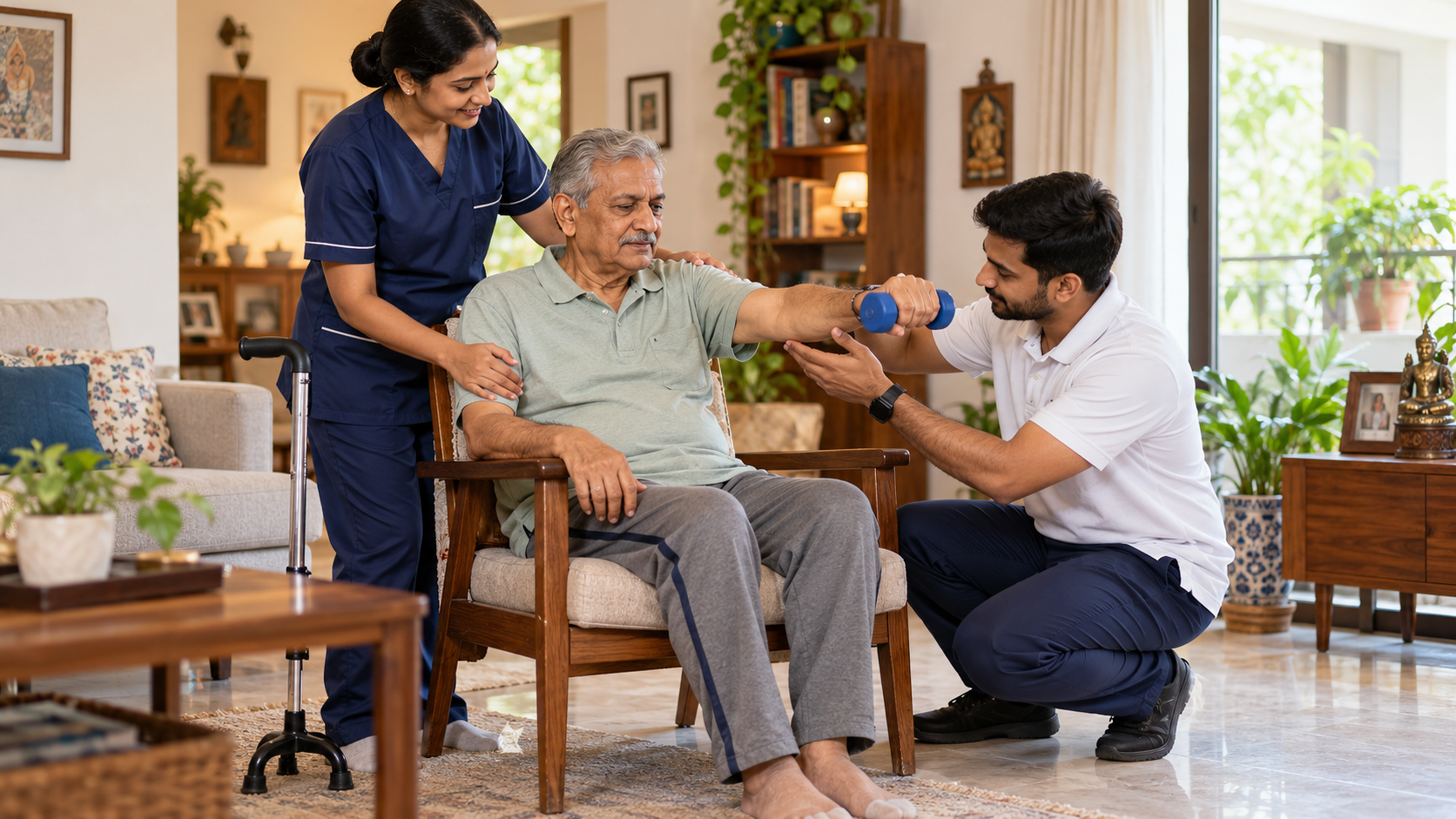
Coming home after a stroke can be confusing for families. One person may need help only with bathing and walking. Another may have paralysis, swallowing difficulty, a feeding tube, communication problems or significant nursing needs. That is why asking “Do we need a caregiver or a nurse?” is often too simple.Stroke recovery at home may involve a caregiver, nurse, physiotherapist and sometimes a speech or occupational therapist — each for a different reason. The right combination depends on what the person can safely do after the stroke.
What can change after a stroke?
A stroke can affect much more than one arm or leg. Depending on the area of the brain involved, a person may develop problems with:
- Weakness or paralysis on one side
- Balance and walking
- Transfers from bed to chair
- Hand function
- Speech
- Understanding language
- Swallowing
- Vision
- Attention or memory
- Continence
- Mood or behaviour
- Performing everyday activities independently
Caregiver, nurse or physiotherapist: who does what?
| Need after stroke | Usually most relevant | ||
| Bathing, grooming and dressing | Caregiver | ||
| Toileting and continence assistance | Caregiver | ||
| Meal and fluid assistance | Caregiver | ||
| Medication reminders | Caregiver | ||
| Supervision and companionship | Caregiver | ||
| Safe mobility assistance after training | Caregiver | ||
| Prescribed injections or IV medicines | Nurse | ||
| Feeding-tube nursing care | Nurse | ||
| Catheter-related nursing care | Nurse | ||
| Wound or complex dressing care | Nurse | ||
| Clinical monitoring requiring nursing skill | Nurse | ||
| Strength and movement rehabilitation | Physiotherapist | ||
| Balance and gait training | Physiotherapist | ||
| Transfer training | Physiotherapist | ||
| Prescribed mobility exercises | Physiotherapist | ||
| Swallowing assessment/therapy | Speech and language professional | ||
| Aphasia/communication rehabilitation | Speech and language professional | ||
| Relearning daily activities/adapting tasks | Occupational therapist |
What does a caregiver do after a stroke?
A caregiver is often most useful when the main problem is loss of independence in everyday activities. Depending on the care plan, this may include assistance with bathing, grooming, dressing, toileting, meals, changing position, getting in and out of bed, walking with an advised mobility aid and completing exercises already prescribed by the rehabilitation team. The caregiver can also observe how the person manages throughout the day and escalate meaningful changes to the family or clinical team.
The caregiver should support recovery, not replace it
Helping too much can sometimes be as unhelpful as helping too little. If a patient can safely perform part of an activity themselves, rehabilitation generally aims to preserve and improve that ability rather than making the person completely dependent. For example, a caregiver may supervise a transfer or assist with dressing while allowing the patient to perform the parts they can manage safely. The exact level of assistance should follow the rehabilitation plan.
When does a stroke patient need a nurse at home?
A stroke does not automatically mean a nurse is required around the clock. Nursing becomes important when the patient has clinical procedures or monitoring needs that go beyond ordinary caregiving. Examples may include prescribed injections, IV medicines through suitable existing access, complex wound care, feeding-tube care, catheter-related nursing, suctioning or other skilled procedures included in the patient's treatment plan.
See which clinical procedures require a home nurse
If the person mainly needs help with bathing, toileting, meals, mobility and supervision, using a nurse solely because they have had a stroke may provide a higher level of clinical care than the patient actually needs.Conversely, asking a non-nursing caregiver to perform nursing procedures is inappropriate.
Why physiotherapy matters after stroke
Physiotherapy is not simply “exercise after discharge.” A physiotherapist can assess how the stroke has affected strength, movement, balance, posture, walking and transfers, then build rehabilitation around those impairments. Stroke rehabilitation may include repeated practice of meaningful movements, balance work, mobility training and progressively challenging activities as appropriate. NICE recommends rehabilitation that is goal-based and tailored to the person's needs and ability.
Examples of physiotherapy goals
- Rolling and moving safely in bed
- Sitting without losing balance
- Moving from bed to chair
- Standing safely
- Improving affected-limb movement
- Building strength and endurance
- Improving balance
- Learning to use an appropriate walking aid
- Walking safely inside the home
- Progressing toward stairs or outdoor mobility when appropriate
Do not overlook swallowing after stroke
Some stroke survivors develop dysphagia — difficulty swallowing. This matters because swallowing problems can affect nutrition, hydration and the risk of food or liquid entering the airway.Warning signs can include:
- Coughing during or after meals
- Choking
- A wet or gurgling voice after swallowing
- Food remaining inside the mouth
- Difficulty controlling food or liquid
- Taking unusually long to eat
- Recurrent chest infections
- Unexplained weight loss
Speech difficulty and swallowing difficulty are different
Families sometimes assume that someone who cannot speak normally also cannot understand them. That is not necessarily true. A stroke can cause aphasia, affecting the ability to speak, understand, read or write to varying degrees. Speech may also be unclear because of weakness or poor coordination of the muscles used for speaking. Communication rehabilitation is therefore different from swallowing rehabilitation, although both may involve a speech and language professional. Give the person time to communicate rather than speaking about them as though they are not present.
Make mobility safer at home
Weakness, poor balance, altered sensation and reduced awareness of one side can make seemingly simple activities much more difficult after stroke. The home environment may need changes such as:
- Clear walking routes
- Removing loose rugs and unnecessary clutter
- Good lighting
- Appropriate footwear
- Grab bars where recommended
- A suitable chair height
- Safe bathroom access
- Mobility aids prescribed for the patient
- Enough room for assisted transfers
What if the patient is mostly bedridden?
A severe stroke may leave someone unable to sit, stand or change position independently. At that point, the care plan must also address the consequences of prolonged immobility, including skin protection, positioning, hygiene, bowel and bladder care and maintaining appropriate movement. Rather than repeating those steps here, use our dedicated guide for bed-bound patients.
See our complete guide to caring for a bedridden patient at home
Medicines after stroke need a reliable system
Many stroke survivors leave hospital with medicines intended to reduce the risk of another vascular event or control underlying conditions such as blood pressure, diabetes or abnormal cholesterol. The exact prescription depends on the type and cause of the stroke and the patient's medical history. At home, the important practical step is to make sure the prescribed plan is followed reliably. A caregiver can remind or assist according to the care plan, but should not independently change doses, stop medicines or add medicines because a blood-pressure or glucose reading looks unusual.
Know the warning signs of another stroke
A person who has previously had a stroke can have another one. Families and caregivers should therefore know the warning signs rather than assuming new weakness or speech difficulty is simply part of the old stroke. Think B.E. F.A.S.T.:
- B — Balance: sudden loss of balance or coordination
- E — Eyes: sudden new visual difficulty
- F — Face: new facial drooping
- A — Arm: new weakness or numbness
- S — Speech: new speech difficulty
- T — Time: seek emergency medical help immediately
How much supervision is needed after stroke?
There is no rule that every stroke survivor needs a 12-hour or 24-hour caregiver. Ask practical questions instead:
- Can the person get out of bed safely?
- Can they use the toilet safely?
- Can they eat and drink safely?
- Can they call for help?
- Can they manage medicines reliably?
- Is there significant fall risk?
- Are they confused or impulsive?
- Do they require help during the night?
- Is another responsible adult available when the caregiver leaves?
Compare 12-hour and 24-hour support based on the patient's actual dependency
A stroke care plan should change with recovery
Stroke care should not remain frozen at whatever level was required on the day of hospital discharge. A patient who initially needs help with almost everything may gradually become able to dress, transfer or walk with less assistance. Others may develop complications or reveal needs that were not obvious initially. Regular reassessment helps determine whether to increase, reduce or change the type of support rather than automatically continuing the same arrangement month after month.
How MITRA approaches stroke care at home
MITRA assesses what the stroke has actually changed in the person's everyday life rather than assigning care based only on the diagnosis.That can include:
- Mobility and transfers
- Bathing and dressing
- Toileting
- Feeding
- Swallowing concerns
- Communication
- Cognition
- Skin risk
- Medical devices
- Nursing procedures
- Daytime and nighttime supervision
- Rehabilitation requirements
Provider matching should reflect the patient's actual needs
For ongoing caregiving or nursing, MITRA can shortlist trained and verified providers based on the required level of care and relevant family preferences. The family can speak with shortlisted providers before selecting whom they are comfortable proceeding with. After joining, MITRA's managed-care pathway continues through care tracking, communication with the family and provider, clinical escalation pathways and reassessment when needs change.
Frequently asked questions
Does every stroke patient need a caregiver at home?
No. Some people regain enough independence to manage safely with family support and outpatient rehabilitation. Others need assistance because weakness, balance problems, communication difficulty or reduced independence make daily activities unsafe. The need for caregiving should be based on function rather than the diagnosis alone.
Does a stroke patient need a nurse or a caregiver?
If the main requirements are bathing, toileting, meals, mobility assistance and supervision, an appropriately trained caregiver may be sufficient. A nurse is needed when the care plan includes skilled clinical procedures or nursing-level monitoring.
Can a caregiver do physiotherapy exercises with a stroke patient?
A caregiver can help the patient practise movements or exercises that have been prescribed and taught by the rehabilitation team. The caregiver should not independently create exercises, aggressively stretch an affected limb or alter the rehabilitation programme.
How long does stroke rehabilitation take?
There is no fixed recovery timeline. Improvement varies according to the severity and location of the stroke, complications, previous health, rehabilitation needs and individual response. Goals should therefore be reviewed over time instead of promising recovery within a particular number of weeks or months.
Can stroke rehabilitation happen at home?
Yes, appropriate rehabilitation can continue at home for selected patients. NICE specifically includes specialist community rehabilitation and early supported discharge pathways for suitable stroke survivors. The programme should still be structured around professional assessment and individual goals.
Need care at home in Bengaluru? See MITRA services.
Related articles
Home Care Guides · 19 min read
Personalised Home Care Plans: How MITRA Decides What Care a Patient Actually Needs
A home care plan should be based on what a person actually needs help with — not simply their age or diagnosis. See how MITRA assesses daily activities, mobility, nursing requirements, night needs, family support and preferences before structuring personalised home care.
Fri, 6 Nov 2026
Home Care Guides · 15 min read
Doctor-Guided Home Care at MITRA: What Doctor Check-Ins Actually Include
MITRA caregiving plans include doctor check-ins as part of ongoing home care. See what the doctor reviews, how CareTrack and LabTrack support the review, when the care plan may change, and what doctor oversight does not replace.
Thu, 5 Nov 2026
Home Care Guides · 12 min read
MITRA CareTrack Explained: How Families Receive Daily Care Updates
CareTrack is MITRA's structured daily care record for home caregiving. See what caregivers document, how families can follow day-to-day care, how vitals and concerns are tracked, and how CareTrack supports doctor reviews, escalation and continuity when caregivers change.
Wed, 4 Nov 2026