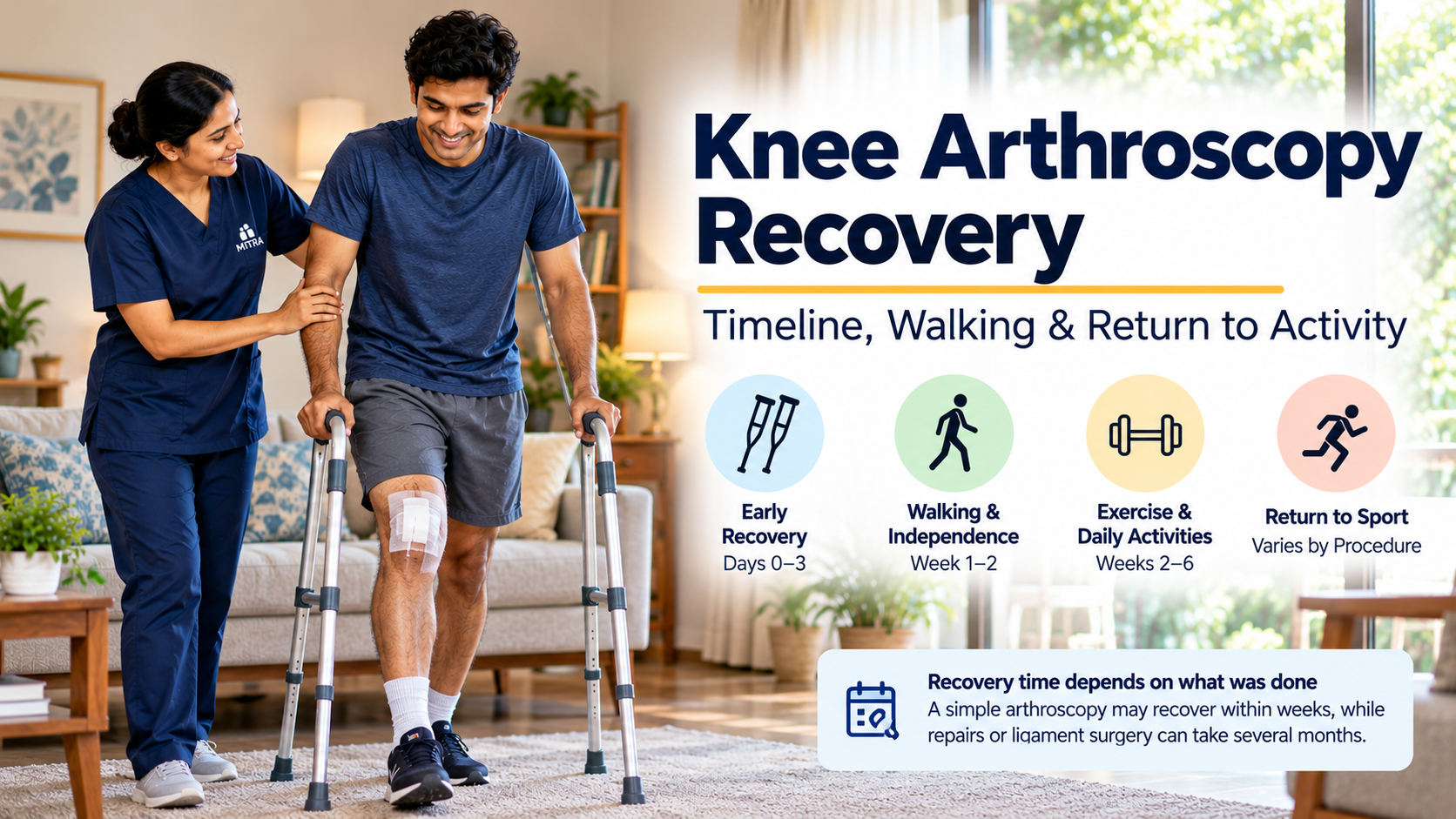
ACL Reconstruction Recovery: Timeline, Walking & Return to Sport
Recovering from ACL reconstruction takes months. Learn what to expect after ACL surgery, including walking, crutches, swelling, wound care, driving, work and the gradual return to sport.
Written by Dr. Sanjay Kumar K A · Medically reviewed by Dr. Sanjay Kumar K A, MD Anaesthesiology (Wed, 28 Oct 2026)
Published Thu, 29 Oct 2026 · 11 min read
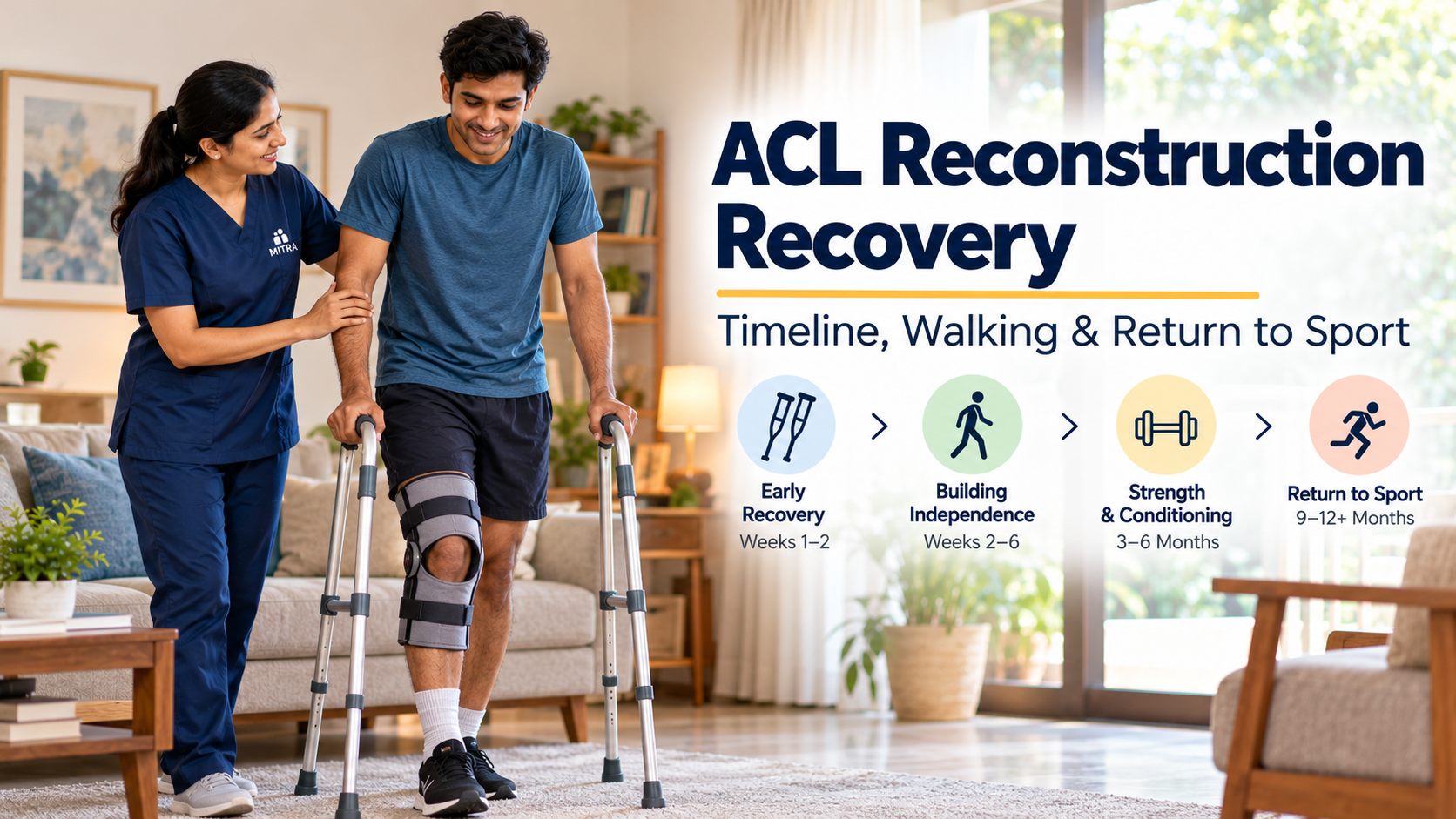
ACL reconstruction recovery is a long rehabilitation process, even though many patients go home on the day of surgery. Walking usually begins early with crutches, everyday activities gradually return over the following weeks and months, and a safe return to pivoting or contact sports may take 9–12 months or longer. The important distinction is that feeling better is not the same as the reconstructed ACL being ready for sport.
How long does ACL reconstruction recovery take?
Most patients can return to many normal daily activities within a few months, but full recovery from ACL reconstruction surgery commonly takes 6–12 months. For athletes returning to football, basketball, badminton or other pivoting sports, clearance may take around a year or longer depending on strength, stability, movement quality and reinjury risk.
| Stage | General ACL recovery focus | ||
| First few days | Pain, swelling, wound, safe walking | ||
| Weeks 1–2 | Crutches, movement, early daily activities | ||
| Weeks 2–6 | Improving gait and independence | ||
| 6–12 weeks | Strength and normal daily function | ||
| 3–6 months | More advanced conditioning | ||
| 6–9 months | Higher-level sports preparation | ||
| 9–12+ months | Return to sport if criteria are met |
What happens immediately after ACL surgery?
ACL reconstruction is frequently performed as a day-case procedure. After recovery from anaesthesia, patients usually begin walking with help from the clinical and physiotherapy team. Most people can go home the same day once they are medically stable and able to move safely.
The first 24–72 hours after ACL reconstruction
- Controlling pain
- Reducing swelling
- Protecting the surgical wound
- Using crutches correctly
- Following weight-bearing instructions
- Taking prescribed medicines
- Beginning the prescribed rehabilitation programme
- Moving around safely
- Watching for complications
ACL surgery recovery at home
Before surgery, it helps to prepare the home for temporary mobility limitations. NHS guidance recommends clearing floors and trip hazards, keeping frequently used objects within easy reach, arranging transport and planning for help with everyday activities if needed.
Useful home preparations
- Removing loose rugs
- Clearing cables
- Keeping frequently used items at waist height
- Preparing meals
- Making space for crutches
- Keeping medicines accessible
- Using a stable chair
- Reducing unnecessary stair trips
- Arranging help with shopping or cooking
Walking after ACL surgery
Walking generally begins very early after ACL reconstruction. However, walking normally matters more than walking far. Crutches may initially help the patient avoid limping and control how much weight goes through the operated leg. Follow the weight-bearing instructions given by the surgeon or physiotherapist.
How long do you need crutches after ACL surgery?
There is no universal crutch duration. Some patients need them for only a short period, while others may use them for several weeks. NHS guidance specifically recommends stopping crutches when the physiotherapist considers it appropriate rather than at a fixed postoperative date.
Can you put weight on the leg after ACL reconstruction?
Many isolated ACL reconstruction protocols allow early weight-bearing with crutches. However, restrictions can differ significantly when the operation also includes:- Meniscus repair- Cartilage procedures- Other ligament reconstruction- Surgeon-specific graft considerations The operation note and discharge instructions therefore take priority over generic ACL advice.
ACL reconstruction with meniscus repair is different
If a meniscus repair was performed during the same operation, the recovery plan may include additional restrictions on weight-bearing, knee bending or brace use. Do not assume an isolated ACL recovery timeline applies. Our next dedicated article will cover meniscus repair versus meniscectomy recovery separately.
Do you need a knee brace after ACL surgery?
Some surgeons prescribe a brace, while others do not routinely use one after isolated ACL reconstruction. If a brace has been prescribed, wear it according to the surgeon's or physiotherapist's instructions and do not independently change its range-of-motion settings. NHS guidance specifically advises using a brace only as directed and stopping it when the clinical team advises.
Swelling after ACL reconstruction
Knee swelling is expected after ACL surgery and may take time to settle. Swelling often increases after prolonged standing or excessive activity. Common measures include:- Appropriate rest- Elevation- Cold therapy if advised- Compression where prescribed- Gradual movement NHS guidance recommends elevation and short periods of protected icing to help control pain and swelling.
How should you use ice after ACL surgery?
If cold therapy is recommended, wrap the ice pack rather than placing it directly on the skin. Current NHS guidance suggests approximately 15–20 minutes at a time, repeated every few hours when appropriate, and advises stopping if numbness or loss of sensation develops.
Pain after ACL reconstruction
Pain is expected during the early recovery period. Take prescribed pain medicines as directed so that pain does not unnecessarily prevent:- Walking- Sleeping- Daily activities- Participation in rehabilitationPain should generally become more manageable over time.
Wound care after ACL surgery
ACL reconstruction usually leaves several small arthroscopy wounds plus an incision related to graft harvesting or fixation. Keep dressings and the wound managed according to the hospital's instructions. Do not assume the wound is safe to submerge because the incisions appear small.
When can you shower after ACL surgery?
This depends on the dressing and surgeon's instructions. NHS guidance advises keeping the wound dry until the hospital tells you that showering or bathing is appropriate. Avoid swimming or soaking the wounds until they are appropriately healed and cleared.
Bruising and numbness after ACL surgery
Bruising around the thigh, knee, shin or calf can occur after surgery. Some patients also notice a patch of numbness around the front of the knee or shin because small skin nerves can be affected during surgery. Persistent or newly worsening numbness, especially when associated with foot colour changes or severe swelling, requires clinical review.
How much help do you need at home after ACL surgery?
Many ACL patients are young and otherwise healthy, so full-time caregiving is often unnecessary. Temporary help can still be useful for:- Meals- Shopping- Transport- Bathing- Stairs- Carrying items while using crutches- Household workThe greatest need is usually during the earliest period while mobility is limited.
Physiotherapy after ACL reconstruction
Rehabilitation is essential after ACL reconstruction. It progressively works on:- Knee movement- Strength- Walking pattern- Balance- Neuromuscular control- Running- Jumping and landing- Sport-specific movementRegular physiotherapy commonly continues for several months. Detailed ACL exercise programmes will belong in MITRA's future Physiotherapy topic rather than being duplicated here. Understand why structured rehabilitation is essential after ACL reconstruction
When can you return to work after ACL surgery?
Return to work depends more on the type of job than the ACL operation alone. NHS general ACL guidance says return to work is often around 4–6 weeks, but hospital protocols show that desk-based workers may sometimes return earlier while heavy manual jobs can take considerably longer.
| Work type | General consideration | ||
| Work from home | May return relatively early if comfortable | ||
| Desk job | Often earlier than physical work | ||
| Job requiring prolonged standing | May need additional recovery | ||
| Frequent stairs | Requires safer mobility | ||
| Heavy manual work | May require several months | ||
| Pivoting / physically demanding work | Requires functional clearance |
When can you drive after ACL reconstruction?
There is no single universal driving date. Published hospital guidance ranges from around a few weeks to six weeks, depending on surgery, operated side and local protocol. The patient must be able to enter and exit the car safely, control the leg and perform an emergency stop. They should also be off medicines that impair driving. Follow the surgeon's clearance and relevant driving/insurance requirements.
When can you return to the gym after ACL surgery?
Gym training is reintroduced progressively. Do not return simply because the wounds look healed. Rehabilitation must protect the graft while gradually restoring strength and control. Some hospital protocols allow selected gym-based activities relatively early, but progression should be directed by the rehabilitation team.
When can you start running after ACL reconstruction?
Running is a rehabilitation milestone, not simply something that starts at a particular week. Before progressing, clinicians may consider:- Swelling- Knee movement- Strength- Single-leg control- Walking quality- Functional testingDetailed running criteria belong in the future ACL physiotherapy guide.
When can you return to sport after ACL surgery?
Returning to sport is one of the longest parts of ACL recovery. NHS guidance states that playing sport again can take up to a year, while multiple specialist programmes commonly place return to high-risk or contact sport around 9–12 months, provided functional criteria have also been achieved.
Why not return to sport as soon as the knee feels strong?
The reconstructed ligament and the athlete's movement system need time to recover. Return-to-sport assessment may consider:- Knee stability- Strength- Power- Balance- Agility- Landing mechanics- Movement symmetry- Psychological readinessMayo Clinic notes that return-to-play timing should be based on these functional factors, not time alone.
When can you return to football after ACL reconstruction?
Football places substantial cutting, pivoting, acceleration and contact demands on the knee. Return is commonly 9–12 months or later, but clearance should depend on objective functional testing and the rehabilitation team's assessment rather than the athlete choosing a date.
When can you return to badminton, tennis or squash?
These sports also involve rapid direction changes and therefore place high demands on ACL function. One recent NHS hospital pathway places racquet-sport return around the later stages of recovery rather than early rehabilitation. Individual clearance should still be based on function.
Why does ACL recovery take so long?
The operation replaces the torn ACL with a graft, usually tendon tissue. Recovery involves more than wound healing. The graft must integrate biologically while the patient also rebuilds:- Muscle strength- Coordination- Balance- Movement control- Sport-specific confidence AAOS notes that graft healing and neuromuscular recovery contribute to the 6–12 month recovery period.
Can you tear the reconstructed ACL again?
Yes. A reconstructed ACL can fail, particularly with another significant injury or premature return to high-risk sport. Mayo Clinic notes that athletes can also injure the opposite knee after returning to sport, which is one reason return-to-sport testing and adequate rehabilitation matter.
Warning signs after ACL reconstruction
| Symptom | Possible concern | ||
| Increasing wound redness | Infection | ||
| Pus or wound discharge | Infection | ||
| High temperature / feeling unwell | Infection | ||
| Increasing calf pain | Possible DVT | ||
| New one-sided leg swelling | Possible DVT | ||
| Hot, painful swollen calf | Possible DVT | ||
| Sudden breathlessness | Possible pulmonary embolism | ||
| Chest pain | Possible pulmonary embolism | ||
| New foot numbness or colour change | Neurovascular problem | ||
| Sudden major knee deterioration | Requires assessment |
Know which symptoms after ACL surgery need urgent assessment
Is swelling and stiffness normal after ACL surgery?
Yes, both are common during early recovery. However, the overall trend should gradually improve. A knee becoming increasingly hot, red, painful or swollen — particularly with fever or feeling unwell — should not simply be labelled normal postoperative inflammation.
Frequently asked questions
How long does ACL surgery recovery take?
Many normal activities return within a few months, but full ACL reconstruction recovery commonly takes 6–12 months. Returning to competitive pivoting sport may require approximately a year or longer depending on testing and individual progress.
Can you walk immediately after ACL surgery?
Many patients begin walking soon after surgery with help and crutches. The amount of weight allowed through the operated leg depends on the procedure and whether additional surgery such as meniscus repair was performed.
How long do you use crutches after ACL reconstruction?
There is no universal duration. Use them until walking is safe and the physiotherapist advises progression. Some patients progress quickly while others need crutches for several weeks.
Do you need someone at home after ACL surgery?
It is useful to have help during the early period, particularly while using crutches or recovering from anaesthesia. Assistance may be needed with meals, transport, household tasks, bathing or carrying objects. Most otherwise healthy ACL patients do not require long-term professional caregiving.
How soon can you play sport after ACL reconstruction?
Return to high-risk sport commonly takes 9–12 months or longer. Do not return solely because running feels comfortable. Strength, stability, power, movement quality and sport-specific readiness should also be assessed.
References
This article is for general health education and does not replace advice from your doctor. Please consult a qualified professional about your specific situation.
Need care at home in Bengaluru? See MITRA services.
Related articles
Post-Surgery & Recovery · 11 min read
Knee Arthroscopy Recovery: Timeline, Walking & Return to Activity
How long does knee arthroscopy recovery take? Learn what to expect after keyhole knee surgery, including walking, crutches, swelling, wound care, driving, work and return to sport.
Thu, 29 Oct 2026
Post-Surgery & Recovery · 12 min read
Meniscus Surgery Recovery: Repair vs Meniscectomy
Meniscus repair and partial meniscectomy have very different recovery timelines. Learn what to expect after meniscus surgery, including walking, crutches, swelling, driving, work and return to sport.
Thu, 29 Oct 2026
Post-Surgery & Recovery · 14 min read
Knee Replacement Recovery Timeline: Week-by-Week Milestones
How long does knee replacement recovery take? See a practical week-by-week timeline covering walking, walker use, swelling, pain, stairs, driving, work and return to normal activities after knee replacement.
Tue, 27 Oct 2026