Post-Surgery Physiotherapy at Home: When to Start and What It Helps With
Physiotherapy can help patients regain movement, strength and independence after surgery, but the right timing depends on the operation. Learn when post-surgery physiotherapy may begin, what it includes, when home physiotherapy makes sense and which warning signs need medical review first.
Written by Dr. Sanjay Kumar K A
Published Sun, 25 Oct 2026 · 20 min read
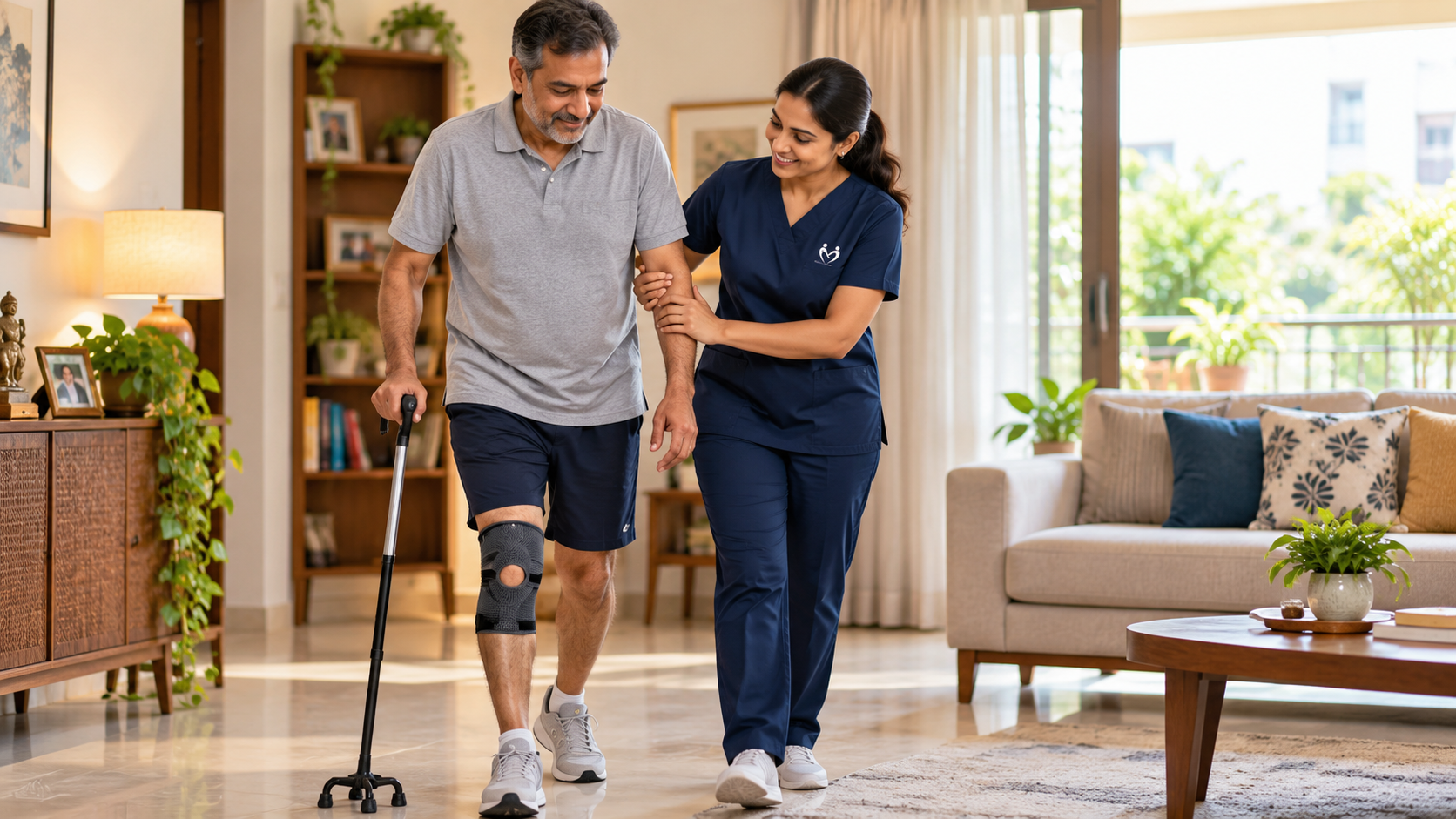
After surgery, many families are told: “Physiotherapy is important.” That advice is often correct — but it leaves several questions unanswered. When should physiotherapy start? Should the patient exercise despite pain? Is walking enough? Does the physiotherapist need to come home? And how do you know whether a patient is ready to progress? The answer depends on the type of surgery, surgeon's instructions, medical stability and the patient's current level of function.
What is post-surgery physiotherapy?
Post-surgery physiotherapy is rehabilitation designed to help a person recover movement, strength, balance, walking ability, endurance and independence after an operation. Depending on the procedure, physiotherapy may begin in the hospital and continue at home or in an outpatient clinic. The goal is not simply to “do exercises.” It is to help the patient return safely toward normal function.
What does physiotherapy help with after surgery?
- Getting out of bed safely
- Standing
- Walking
- Using a walker or crutches
- Improving balance
- Regaining joint movement
- Rebuilding muscle strength
- Reducing stiffness
- Improving endurance
- Practising stairs
- Improving transfers
- Returning to daily activities
- Breathing exercises after selected operations
- Preventing deconditioning from prolonged inactivity
- Building confidence with movement
When should physiotherapy start after surgery?
For many operations, movement begins earlier than families expect. After suitable procedures, the physiotherapy team may assess the patient in hospital on the day of surgery or the following day and begin with:- Sitting up- Standing- Transfers- Short walks- Basic circulation exercises- Breathing exercises where appropriateThe exact timing depends on the patient's stability and the operation.
Why is early movement encouraged after surgery?
Prolonged inactivity can lead to:- Muscle weakness- Loss of endurance- Reduced confidence- Stiffness- Difficulty walking- Greater dependence- Increased blood-clot risk- Chest complications in some patients NHS guidance encourages patients to start moving as soon as appropriate after surgery, while enhanced recovery programmes use early activity as a core part of postoperative recovery.
Does early physiotherapy mean exercising hard immediately?
No. Early physiotherapy is usually about safe movement, not intense training. The first session may involve only:- Sitting at the edge of the bed- Standing with assistance- Transferring into a chair- Taking a few steps- Learning how to use a walker- Simple breathing or circulation exercisesIntensity increases gradually as recovery progresses.
What happens during the first physiotherapy assessment?
A physiotherapist may assess: - Current pain- Medical stability- Surgical restrictions- Strength- Joint movement- Balance- Ability to sit and stand- Transfers- Walking ability- Need for a mobility aid- Ability to manage stairs- Home environment- Pre-surgery level of independence The rehabilitation plan should then reflect what the patient can safely do now, not only what they could do before surgery.
What does a home physiotherapist do after surgery?
- Assess mobility in the actual home
- Review the discharge rehabilitation plan
- Check use of walking aids
- Teach safe bed transfers
- Teach chair and toilet transfers
- Practise walking
- Practise stairs where relevant
- Prescribe exercises
- Adjust exercise difficulty
- Work on strength and balance
- Monitor progress
- Review functional goals
- Identify barriers to independence
- Escalate concerns when recovery is not progressing appropriately
Home physiotherapy vs hospital or clinic physiotherapy
| Home physiotherapy | Clinic physiotherapy | ||
| Patient does not need to travel | Requires travel | ||
| Exercises can be adapted to actual home | More equipment may be available | ||
| Can assess real stairs, bed and bathroom | Controlled therapy environment | ||
| Helpful for lower mobility | Useful once mobility improves | ||
| Good immediately after discharge for selected patients | Often suitable later in recovery | ||
| Family/caregiver can learn techniques | May offer broader rehabilitation equipment |
When does physiotherapy at home make the most sense?
- Has just returned from hospital
- Has difficulty travelling
- Uses a walker or crutches
- Cannot safely manage stairs outside the home
- Is elderly or frail
- Needs transfer training
- Needs family/caregiver education
- Has significant mobility restrictions
- Needs the home environment assessed
- Is not yet ready for outpatient rehabilitation
Who may not need home physiotherapy?
Not everyone needs a physiotherapist to visit their home. Some patients may be independent enough to attend outpatient physiotherapy, while others may be given a simple home exercise programme and require only periodic review. The decision should depend on the rehabilitation need, not on the assumption that every postoperative patient requires daily physiotherapy.
Do you need physiotherapy after every surgery?
No. Physiotherapy is particularly relevant when surgery affects:- Walking- Joint movement- Strength- Balance- Transfers- Endurance- Breathing- Functional independenceA patient after a small procedure who is already walking normally may not require formal physiotherapy.
Which surgeries commonly need physiotherapy?
- Knee replacement
- Hip replacement
- Shoulder surgery
- Spine surgery
- Fracture fixation
- ACL and other ligament surgery
- Major abdominal surgery in selected patients
- Cardiac surgery
- Thoracic surgery
- Neurosurgery
- Prolonged hospitalisation
- Surgery in frail or older adults
Physiotherapy after knee replacement
Knee replacement rehabilitation usually focuses heavily on: - Walking- Knee movement- Quadriceps strength- Transfers- Balance- Swelling management- Progressing walking aids- Returning to functional activities NHS guidance notes that physiotherapists help patients begin walking soon after knee replacement and provide home exercise programmes to improve long-term strength and movement.
Physiotherapy after hip replacement
Hip replacement physiotherapy commonly includes: - Walking with a frame or crutches- Transfers- Hip strengthening- Balance- Functional movement- Stairs- Progressing mobility aids NHS guidance similarly recommends early walking and continued prescribed exercises after hip replacement.
Physiotherapy after spine surgery
Spine surgery requires a more procedure-specific rehabilitation plan. The physiotherapist may work on:- Safe transfers- Walking- Posture- Strength- Functional movementHowever, restrictions on bending, lifting, twisting, bracing or activity progression may come from the surgeon and vary according to the operation. Do not use a generic spine exercise programme after surgery without clearance.
Physiotherapy after abdominal surgery
After abdominal surgery, physiotherapy may focus more on: - Getting out of bed- Walking- Breathing exercises- Regaining general strength- Returning to normal daily activityThe rehabilitation goal is usually not to aggressively strengthen the abdomen immediately. Lifting and abdominal exercise restrictions should follow the surgeon's instructions.
Physiotherapy after cardiac or chest surgery
After cardiac or thoracic surgery, rehabilitation may include: - Early mobilisation- Walking progression- Breathing exercises- Coughing techniques where appropriate- Endurance building- Functional activity progression Physiotherapy services after chest surgery commonly emphasise breathing techniques, positioning and early mobility to reduce pulmonary complications.
Is walking considered physiotherapy?
Walking is often an important part of postoperative rehabilitation, but it is not the whole of physiotherapy. A physiotherapist may need to assess:- Whether the patient is walking correctly- Whether an aid is needed- Whether the aid is the right height- How much weight can be placed on the operated limb- Whether balance is safe- Whether gait compensations are developing- When the walking programme should progressSimply telling a patient to “walk more” is not always enough.
How much should a patient walk after surgery?
There is no universal walking target that applies to every operation. The correct amount depends on:- Procedure- Pain- Weight-bearing status- Cardiovascular condition- Balance- Pre-surgery fitness- Surgeon restrictions- Physiotherapist assessment A common principle is to begin with manageable activity and increase gradually rather than suddenly.
Should you exercise if it hurts after surgery?
Some discomfort during rehabilitation can be expected, especially after orthopaedic procedures. But pain should not be ignored indiscriminately. The physiotherapist may distinguish between:- Expected stiffness or muscle discomfort- Pain that improves with adjustment- Excessive pain indicating overloading- Pain suggesting a complicationSevere, sudden or rapidly worsening pain should be assessed rather than pushed through.
“No pain, no gain” is not a good postoperative rule
Postoperative rehabilitation is not a gym challenge. Forcing movement aggressively despite severe pain can:- Increase swelling- Reduce confidence- Affect exercise quality- Potentially violate surgical restrictionsThe aim is progressive loading within the permitted recovery plan.
How should pain medicine and physiotherapy work together?
Adequate pain control can make movement easier. Some patients are advised to time prescribed pain medication so that rehabilitation is more comfortable. Do not independently increase medication before physiotherapy. Follow the pain-management plan given at discharge.
What are postoperative breathing exercises?
After selected major operations, especially abdominal or chest procedures, physiotherapists may teach breathing exercises designed to: - Encourage deeper breathing- Improve lung expansion- Help clear secretions- Reduce the effects of prolonged immobilityCambridge University Hospitals notes that breathing exercises and early mobilisation can contribute to reduced chest complications and improved physical function after surgery.
Does every patient need an incentive spirometer?
No. An incentive spirometer or specific breathing programme should be used when recommended by the surgical or rehabilitation team. Do not assume that every patient who has surgery needs respiratory equipment.
What is gait training?
Gait training means teaching or retraining a patient to walk safely and efficiently. It can include:- Step pattern- Weight distribution- Walking-aid use- Balance- Turning- Speed- Posture- Progressing from walker to crutches or stick where appropriateThis is one reason physiotherapy is different from simply having someone accompany the patient while walking.
How do physiotherapists decide which walking aid to use?
The choice can depend on: - Balance- Strength- Weight-bearing restrictions- Pain- Upper-body strength- Confidence- Home environmentPossible aids include:- Walker- Crutches- Walking stickThe physiotherapist can also adjust the height and teach correct use.
Who decides when the walker can be stopped?
Do not stop a walker simply because the patient feels better. The decision should usually be guided by the physiotherapist or treating team after considering:- Balance- Gait quality- Strength- Pain- Weight-bearing restrictions- Fall riskPremature removal of an aid may increase fall risk.
What is transfer training?
Transfer training teaches the patient how to safely move between positions such as: - Lying to sitting- Bed to standing- Chair to standing- Toilet transfers- Car transfersFor many patients, these everyday movements are more important for independence than performing complex exercises.
Can physiotherapy help with stairs after surgery?
Yes. If stairs are required at home, the physiotherapist may teach:- Which leg moves first- How to use the railing- How to use crutches or a stick- How much assistance is required- Whether stair use is currently safe Hospital physiotherapy teams may practise stairs before discharge when relevant.
What is a home exercise programme?
A home exercise programme is a set of exercises prescribed for the patient to perform between physiotherapy sessions. It may include:- Range-of-motion exercises- Strength exercises- Balance activities- Walking targets- Breathing exercises- Transfer practiceThe programme should be specific to the patient and operation.
How often should postoperative exercises be done?
Frequency varies according to the operation and exercise. Some movements may be prescribed several times each day, while others may be performed less frequently. Follow the physiotherapist's instructions rather than assuming that “more is better.”
Can the family help with physiotherapy exercises?
Yes, where appropriate. A family member or trained caregiver can:- Remind the patient- Help set up the exercise safely- Supervise- Record completion- Encourage regular practiceThey should not independently:- Add exercises- Increase weights- Increase repetitions substantially- Change movement restrictions- Force painful movement See how a caregiver can support physiotherapy without replacing the physiotherapist
Does physiotherapy need to happen every day?
Not necessarily. The physiotherapist may attend intermittently while the patient performs prescribed exercises and walking between visits. CUH postoperative guidance notes that physiotherapy attendance is based on need and may not occur every day, while patients continue prescribed activity between sessions.
How many physiotherapy sessions are needed after surgery?
There is no fixed number. The duration depends on:- Surgery- Pre-surgery strength- Age- Complications- Pain- Progress- Rehabilitation goals- Independence- Ability to exercise between sessionsSome patients require only a few sessions. Others need rehabilitation over several weeks or months.
How do you know physiotherapy is working?
- Walking farther
- Needing less assistance
- Improved joint movement
- Better strength
- Safer transfers
- Better balance
- Progressing to a simpler walking aid
- Managing stairs
- Reduced fear of movement
- Greater independence in daily activities
Should progress be measured only by pain?
No. Pain is only one part of recovery. A patient may still have discomfort while function is improving. Useful outcomes include:- Distance walked- Ability to stand- Transfer independence- Joint range- Strength- Balance- Stair ability- Need for assistance
What can slow post-surgery rehabilitation?
- Severe pain
- Infection
- Excessive swelling
- Poor nutrition
- Anaemia
- Poor sleep
- Fear of movement
- Long hospitalisation
- Frailty
- Pre-existing weakness
- Diabetes
- Cardiovascular or respiratory disease
- Inconsistent exercise
- New complications
What is deconditioning after surgery?
Deconditioning means losing strength, endurance and function because of inactivity. It can happen quickly after prolonged bed rest or a lengthy hospital stay. Postoperative physiotherapy attempts to reverse this gradually through safe mobilisation and progressive activity.
Can too much physiotherapy slow recovery?
Potentially. Overloading can cause:- Excessive pain- Increased swelling- Fatigue- Poor exercise technique- Reduced willingness to continue rehabilitationProgression should therefore be based on response, function and surgical restrictions.
When should physiotherapy be paused and the doctor contacted?
- Sudden severe pain
- New wound bleeding
- Increasing wound redness or discharge
- Fever with deterioration
- New one-sided leg swelling
- New severe calf pain
- New neurological weakness
- New numbness
- Sudden loss of balance not previously present
- Persistent dizziness
- Significant breathlessness
- Chest pain
- Collapse
Know when post-surgery symptoms need medical attention instead of more exercise
Can physiotherapy cause a blood clot to move?
Routine prescribed mobilisation is generally used as part of postoperative recovery and can help reduce problems associated with immobility. However, if a patient develops signs suggesting a possible DVT — such as new one-sided leg swelling or calf pain — do not massage or aggressively exercise the leg while waiting to see what happens. Seek appropriate medical assessment.
See when leg pain or swelling after surgery could be a blood clot
Can physiotherapy help prevent blood clots?
Early mobilisation can contribute to reducing the risks associated with prolonged immobility, but it is only one part of clot prevention. Some patients also require:- Anticoagulant medication- Compression stockings- Mechanical devices- Specific mobilisation plansThese measures should follow the hospital's clot-prevention plan.
Physiotherapy after surgery for elderly patients
Older patients may need rehabilitation not only for the operated body part but also for the overall loss of function caused by hospitalisation. Goals may include:- Standing safely- Preventing falls- Walking to the bathroom- Regaining endurance- Managing stairs- Returning to previous daily activitiesThe programme should consider the patient's pre-surgery baseline rather than age alone.
What if the patient was already weak before surgery?
Pre-existing weakness can make recovery slower. The rehabilitation plan may need to start at a lower level and focus on basic function before progressing to more demanding exercises. This is especially relevant after prolonged illness or major surgery.
What if the patient is afraid to walk?
Fear is common after surgery. Patients may worry that walking will:- Damage the operation- Cause the wound to open- Increase pain- Cause a fallA physiotherapist can explain what movement is permitted and gradually rebuild confidence through supervised practice.
What if the patient refuses physiotherapy because it hurts?
First understand why. Possible reasons include:- Poor pain control- Fear- Fatigue- Confusion- Excessive exercise intensity- A genuine complicationDo not simply force the patient. The physiotherapist and medical team may need to adjust pain management or the rehabilitation plan.
Physiotherapy after a long hospital stay
Someone may be medically ready for discharge but substantially weaker than before hospitalisation. Home physiotherapy can help rebuild:- Standing tolerance- Walking- Endurance- Transfers- Balance- ConfidenceThis can be especially important after prolonged bed rest, ICU admission or major illness.
Can physiotherapy reduce the need for a caregiver?
Potentially, over time. As strength, balance and mobility improve, the patient may require less help with:- Transfers- Walking- Toileting- Stairs- Daily movementThe goal of rehabilitation is generally to increase independence, not create permanent reliance on support.
When should the caregiver step back?
A caregiver should provide enough assistance to keep the patient safe, but not automatically perform tasks the patient can safely practise independently. For example, if the physiotherapist has cleared the patient to stand with supervision, the caregiver should not continue lifting them unnecessarily. Recovery requires opportunities to regain function.
What equipment may be needed for home physiotherapy?
- Depending on the rehabilitation plan:
- - Walker
- - Crutches
- - Walking stick
- - Stable chair
- - Exercise band
- - Step
- - Light weights where prescribed
- - Raised toilet seat
- - Shower chair
- Many postoperative exercises require little or no specialised equipment.
Do you need expensive rehabilitation equipment at home?
Usually not. The most important tools may simply be:- A safe walking route- A suitable chair- Prescribed walking aid- Enough space for exercisesDo not buy rehabilitation equipment until the physiotherapist identifies a reason for it.
How should the home be prepared for physiotherapy?
- Clear walking paths
- Remove loose rugs
- Keep prescribed walking aids nearby
- Use suitable footwear
- Keep discharge documents available
- Keep surgical restrictions available
- Ensure a stable chair is accessible
- Keep relevant reports and prescriptions ready
What should you tell the physiotherapist at the first home visit?
- Surgery performed
- Date of surgery
- Discharge summary
- Surgeon restrictions
- Weight-bearing status
- Current pain level
- Current walking ability
- Previous mobility level
- Falls history
- Walking aid used
- Wound concerns
- Medicines affecting mobility
- Existing medical conditions
- Rehabilitation goals
What is weight-bearing status?
After some orthopaedic procedures, the surgeon may restrict how much body weight the patient can place through the operated limb. Common instructions may include:- Non-weight bearing- Toe-touch weight bearing- Partial weight bearing- Weight bearing as tolerated- Full weight bearingThe patient should understand exactly what their instruction means before practising walking.
Can physiotherapy be done through video consultation?
Some follow-up, exercise review and education may be possible remotely for selected patients. However, in-person assessment can be more useful when the therapist needs to evaluate:- Balance- Transfers- Walking- Falls risk- Joint movement- Home barriers- Safe use of equipmentA newly discharged high-dependency patient may benefit more from initial in-person assessment.
Home physiotherapy vs doing YouTube exercises
Generic online exercise videos do not know:- Which surgery you had- Your surgeon's restrictions- Your weight-bearing status- Your balance- Your wound status- Your pain- Your medical conditionsPostoperative exercise should therefore be based on individual clearance and assessment, particularly early in recovery.
How long does physiotherapy continue after surgery?
The duration can range from days to several months. For example, NHS guidance notes that recovery after knee and hip replacement can take several months, with continued exercises contributing to longer-term strength and movement.The appropriate end point is based more on functional goals than a fixed number of weeks.
When can physiotherapy stop?
Formal therapy may reduce or stop when the patient:- Has achieved agreed functional goals- Can safely continue exercises independently- Walks safely- Manages transfers- Has acceptable strength and movement- Can manage stairs if required- No longer needs skilled progressionThe patient may still continue a home exercise programme afterward.
How often should progress be reviewed?
Progress should be reassessed whenever:- Mobility improves- A walking aid changes- Pain changes significantly- The surgeon changes restrictions- The patient becomes more independent- Recovery plateaus- New symptoms developThe rehabilitation programme should evolve rather than remain identical for weeks.
Physiotherapy should become harder only when the patient is ready
Progression may involve:- More repetitions- Greater walking distance- Less support- More challenging balance activities- Increased resistance- More complex functional tasksThe therapist should progress the programme according to healing, symptoms and functional ability.
Frequently asked questions
When should physiotherapy start after surgery?
It depends on the operation. After some surgeries, rehabilitation begins on the same day or within 24 hours. After others, particular movements may be restricted. Follow the surgeon and physiotherapist's plan rather than using one fixed start date.
Can physiotherapy start the day after surgery?
Yes, for many procedures. For example, NICE recommends rehabilitation on the day of surgery if possible and no later than 24 hours after elective hip, knee or shoulder replacement. This does not mean the same timing applies to every operation.
Can physiotherapy be done at home after surgery?
Yes. Home physiotherapy can be useful for patients who have limited mobility, difficulty travelling or need rehabilitation in their actual living environment. The physiotherapist can assess walking, transfers, stairs and home barriers.
Is physiotherapy painful after surgery?
Some discomfort can occur, especially with movement after orthopaedic surgery. Severe or rapidly increasing pain should not simply be pushed through. Tell the physiotherapist how the patient responds during and after exercise.
How many days a week should I do physiotherapy?
The therapist's visit frequency and the patient's exercise frequency are different. A physiotherapist may visit only periodically while prescribed exercises and walking are performed more frequently between visits. The exact schedule depends on the operation and rehabilitation programme.
Can walking replace physiotherapy?
Not always. Walking is an important part of recovery, but some patients also need joint-movement work, strength training, balance training, gait correction or transfer practice.
Can physiotherapy reduce swelling after surgery?
Appropriate movement can support circulation and function, and certain rehabilitation strategies may help manage postoperative swelling depending on the procedure. However, new or rapidly increasing swelling should be medically assessed rather than treated automatically as a physiotherapy issue.
Should elderly patients do physiotherapy after surgery?
Age alone is not a reason to avoid rehabilitation. Older adults may benefit significantly from therapy aimed at restoring walking, balance and independence. The programme should be adapted to their medical condition, frailty and pre-surgery function.
Can the caregiver do the exercises instead of having a physiotherapist?
A caregiver can help the patient perform a programme that has already been prescribed. The caregiver does not replace the physiotherapist's role in assessment, exercise selection, progression and rehabilitation planning.
Can physiotherapy be stopped once the patient can walk?
Not necessarily. Walking is only one rehabilitation goal. Depending on the surgery, the patient may still need improvement in:- Strength- Joint movement- Balance- Endurance- Stairs- Functional activities
How MITRA approaches post-surgery physiotherapy at home
Post-surgery rehabilitation should begin with understanding:- What operation was performed- What the surgeon has permitted- Current mobility- Weight-bearing restrictions- Walking aid use- Pain- Home environment- Functional goalsMITRA can coordinate home physiotherapy in Bengaluru alongside caregiving or nursing when the patient needs more than one type of support during recovery.
Physiotherapy and caregiving can work together
For a patient who needs assistance throughout the day, the physiotherapist may establish the rehabilitation plan while the caregiver helps the patient follow that plan between sessions. That can create a more practical recovery routine than relying only on short physiotherapy visits.
Need care at home in Bengaluru? See MITRA services.
Related articles
Post-Surgery & Recovery · 11 min read
Knee Arthroscopy Recovery: Timeline, Walking & Return to Activity
How long does knee arthroscopy recovery take? Learn what to expect after keyhole knee surgery, including walking, crutches, swelling, wound care, driving, work and return to sport.
Thu, 29 Oct 2026
Post-Surgery & Recovery · 12 min read
Meniscus Surgery Recovery: Repair vs Meniscectomy
Meniscus repair and partial meniscectomy have very different recovery timelines. Learn what to expect after meniscus surgery, including walking, crutches, swelling, driving, work and return to sport.
Thu, 29 Oct 2026
Post-Surgery & Recovery · 11 min read
ACL Reconstruction Recovery: Timeline, Walking & Return to Sport
Recovering from ACL reconstruction takes months. Learn what to expect after ACL surgery, including walking, crutches, swelling, wound care, driving, work and the gradual return to sport.
Thu, 29 Oct 2026