Post-Surgery Warning Signs: Infection, Blood Clots and When to Seek Help
Some pain, swelling and tiredness can be expected after surgery, but certain changes need medical attention. Learn the warning signs of wound infection, blood clots, bleeding, dehydration and other post-operative complications — and when to seek emergency help.
Written by Dr. Sanjay Kumar K A
Published Sun, 25 Oct 2026 · 19 min read

Some pain, tiredness, bruising and swelling can be normal after surgery. The difficulty for families is knowing when recovery has stopped looking normal. A useful rule is to pay attention to the direction of change. Symptoms that are gradually improving are different from symptoms that suddenly appear, become significantly worse or are accompanied by fever, breathlessness, bleeding, confusion or other new problems.
Post-surgery warning signs: quick guide
| Symptom | What to do | ||
| Mild pain that gradually improves | Usually monitor and follow pain plan | ||
| Mild bruising or local swelling that improves | Usually monitor | ||
| Increasing wound redness, heat or swelling | Contact surgical/medical team | ||
| Pus or cloudy wound drainage | Contact surgical/medical team promptly | ||
| Wound opening | Contact surgical/medical team promptly | ||
| New fever or chills with worsening symptoms | Seek medical advice | ||
| Pain becoming significantly worse | Seek medical advice | ||
| Persistent vomiting or inability to drink | Seek urgent medical advice | ||
| Unable to pass urine with discomfort/swelling | Urgent assessment | ||
| New one-sided leg pain or swelling | Urgent assessment for possible DVT | ||
| Sudden breathlessness or chest pain | Emergency | ||
| Coughing up blood | Emergency | ||
| Collapse or loss of consciousness | Emergency | ||
| Sudden facial weakness, arm weakness or speech difficulty | Emergency | ||
| Heavy or uncontrolled bleeding | Emergency |
What symptoms are normal after surgery?
Depending on the operation, it can be normal to experience some:- Pain or tenderness- Mild swelling- Bruising- Fatigue- Reduced appetite- Temporary constipation- Limited mobility- Mild discomfort around the incisionThe important question is whether these symptoms are within the expected pattern for that particular procedure and gradually improving.
When should you worry after surgery?
Concern should increase when a symptom is:- Completely new- Rapidly worsening- More severe than expected- Preventing eating, drinking or movement- Associated with fever or chills- Associated with breathing difficulty- Associated with bleeding- Associated with confusion- Associated with one-sided leg swelling- Not responding to the prescribed treatment planA complication may be identified less by one isolated symptom and more by a change in the patient's trajectory.
Signs of infection after surgery
A surgical site infection is an infection involving the area where an operation was performed. The CDC lists redness and pain around the surgical area, cloudy wound drainage and fever among common signs of surgical-site infection. CDC
Warning signs around the surgical wound
- Redness that is increasing
- Increasing warmth around the wound
- Increasing swelling
- Pain or tenderness getting worse
- Yellow, green or cloudy discharge
- Pus
- Unpleasant smell
- Wound edges separating
- New bleeding or persistent oozing
- Fever or feeling increasingly unwell
How can you tell normal redness from possible infection?
Some redness immediately around an incision can occur during normal healing. What is more concerning is redness that:- Spreads outward- Becomes more intense- Is accompanied by increasing warmth- Is associated with increasing swelling- Becomes more painful- Occurs with pus, fever or feeling unwellDo not judge infection from colour alone — particularly on darker skin tones, where redness may be less obvious.
What if the wound feels warm?
Some local warmth can occur during healing. Increasing warmth together with worsening redness, swelling, tenderness, discharge or fever is more concerning for infection than warmth alone. Compare the wound with how it looked and felt the previous day rather than checking it in isolation.
Is pus from a surgical wound normal?
No. Thick yellow, green, milky or cloudy drainage can indicate infection and should be medically reviewed. The CDC specifically identifies cloudy drainage from the surgical wound as a possible surgical-site infection symptom.
What if the surgical wound opens?
Separation of the wound edges should be reported promptly. Do not attempt to close the wound yourself using household tape, glue or other improvised methods. Cover it appropriately if instructed, avoid unnecessary handling and contact the surgical team or an appropriate healthcare professional.
Fever after surgery: when should you call the doctor?
A fever after surgery can have several causes and should be interpreted together with the timing, procedure and other symptoms. Many postoperative discharge instructions use 38°C or higher as a threshold for seeking medical advice, particularly when fever occurs with worsening pain, chills, wound changes or feeling unwell. However, the threshold given by your surgical team should take priority.
Could an infection become sepsis?
Yes. Most wound infections do not become sepsis, but infection after surgery can occasionally progress into a serious systemic response. The CDC advises people recovering from recent surgery to act quickly if infection symptoms are accompanied by concerning features such as confusion, shortness of breath, extreme discomfort, fever or shivering.
Possible severe infection or sepsis warning signs
- New or increasing confusion
- Severe breathlessness
- Extreme shivering
- Feeling profoundly unwell
- Severe or rapidly increasing pain
- Fever with deterioration
- Very low blood pressure if measured
- Very fast heartbeat
- Markedly reduced urine output
- Pale, mottled or unusually clammy skin
Pain after surgery: what is expected?
Pain is expected after many operations. Pain should generally become more manageable as recovery progresses, particularly with the prescribed pain-control plan. The pattern matters more than whether pain exists at all.
When is post-surgery pain a warning sign?
- Suddenly becomes much worse
- Continues increasing instead of improving
- Is severe despite prescribed medication
- Occurs with increasing swelling
- Occurs with wound redness or discharge
- Is accompanied by fever
- Is accompanied by vomiting
- Is associated with new weakness or numbness
- Prevents a previously possible activity such as walking
- Is severe in the chest or abdomen
Severe abdominal pain after surgery
Some abdominal discomfort can be expected after abdominal surgery and even after certain operations elsewhere. However, severe, worsening or persistent abdominal pain, particularly with vomiting, increasing abdominal swelling, fever or inability to pass stool or gas, should be assessed. Some procedure-specific complications can present primarily as worsening abdominal pain, so the relevant surgical discharge instructions matter.
Persistent nausea or vomiting after surgery
Nausea can occur after anaesthesia or as a side effect of medicines. It becomes more concerning when vomiting:- Continues- Prevents the patient from keeping fluids down- Prevents medicines from being taken- Is associated with severe abdominal pain- Is associated with increasing abdominal swelling- Leads to signs of dehydration Recent enhanced-recovery discharge guidance advises urgent assessment when nausea and vomiting prevent eating or drinking.
Signs of dehydration to watch for
- Possible signs include:
- - Very dry mouth
- - Marked thirst
- - Dizziness
- - Weakness
- - Reduced urine output
- - Dark urine
- - Difficulty standing because of light-headedness
- - Increasing drowsiness
- Older adults may deteriorate relatively quickly when fluid intake becomes inadequate.
Not being able to pass urine after surgery
Temporary difficulty urinating can occur after surgery because of anaesthesia, pain, medicines or bladder-related factors. However, inability to pass urine, particularly with increasing lower-abdominal pain or swelling, requires prompt assessment. Recent postoperative guidance recommends seeking help when a patient cannot pass urine for several hours or develops bladder discomfort or swelling. geh.nhs.uk
What if the patient has a urinary catheter?
Seek advice if: - Urine suddenly stops draining- The catheter falls out- Significant leakage develops- There is increasing lower abdominal pain- Urine becomes markedly cloudy or foul smelling- Fever or chills develop- Bleeding becomes significant Do not attempt to reinsert a catheter at home unless you are an appropriately trained healthcare professional.
Blood clots after surgery
Surgery and reduced mobility can increase the risk of venous thromboembolism, which includes deep vein thrombosis (DVT) and pulmonary embolism (PE). The level of risk differs according to the operation, duration of immobility and the patient's other risk factors. Patients may be prescribed blood-thinning medication, compression measures or early mobilisation as part of prevention.
Possible DVT symptoms after surgery
- Swelling mainly affecting one leg
- Calf or leg pain
- Tenderness
- Warmth
- Skin colour change
- Throbbing or cramping pain
See the detailed signs of DVT and when leg swelling needs urgent assessment
What is a pulmonary embolism?
A pulmonary embolism can occur when a blood clot travels to the lungs. It can be life-threatening and requires urgent medical assessment. Postoperative patients should not wait at home to see whether severe breathing symptoms settle spontaneously.
Possible pulmonary embolism warning signs
- Sudden shortness of breath
- Severe difficulty breathing
- Chest pain
- Coughing up blood
- Collapse or fainting
- Sudden major deterioration
Chest pain after surgery
Chest pain after recent surgery should not automatically be attributed to gas, muscle pain or anxiety. Possible causes range from relatively minor problems to pulmonary embolism, heart disease or other serious complications. New severe chest pain, particularly with breathlessness, sweating, fainting or deterioration, needs emergency assessment.
Shortness of breath after surgery
Breathing difficulty can occur for several reasons after surgery, including lung complications, infection, pulmonary embolism or cardiac problems. Mild breathlessness during early exertion may have a different significance from sudden severe breathlessness at rest. Sudden, severe or rapidly worsening breathlessness is an emergency warning sign.
Bleeding after surgery
A small amount of staining on a dressing can occur after some procedures. More concerning patterns include:- Dressing rapidly soaking with blood- Bleeding that does not stop- Large-volume bleeding- Vomiting blood- Significant blood in urine or stool where not expected- Dizziness or fainting with bleeding- Rapidly increasing swelling near the operation siteHeavy bleeding warrants urgent medical assessment.
What if the dressing has a small blood stain?
Follow the instructions given for that specific operation. Do not repeatedly remove the dressing simply to inspect a small stain unless instructed. If bleeding is actively continuing, increasing or soaking through the dressing, contact the surgical team or seek urgent care according to the severity.
New confusion after surgery
New confusion should not simply be dismissed as “old age,” particularly in an older adult who was previously alert. Possible causes include:- Infection- Dehydration- Medication effects- Low oxygen- Metabolic problems- Urinary retention- Delirium- Neurological complicationsThe CDC includes new or increased confusion among possible serious infection/sepsis warning signs after recent surgery or hospital care.
Seek urgent help if confusion occurs with
- Severe drowsiness
- Difficulty waking
- Breathlessness
- Fever
- Collapse
- New weakness
- Speech difficulty
- Seizure
- Severe headache
- Major behaviour change
- Very low urine output
Stroke symptoms after surgery
Sudden neurological changes require emergency assessment. Watch for: - Facial drooping- Weakness or numbness on one side- New difficulty speaking- New inability to understand speech- Sudden severe imbalance- Sudden vision change- Sudden severe neurological deterioration Do not wait for a routine follow-up appointment.
Severe drowsiness or difficulty waking
Some sleepiness can occur after anaesthesia and pain medication. What is concerning is a person who is:- Increasingly difficult to wake- Breathing unusually slowly- Confused when previously alert- Unable to stay awake- Showing blue or grey lips- Becoming progressively less responsiveSeek emergency assessment when consciousness or breathing is significantly affected.
Falls after surgery
Weakness, pain medicines, unfamiliar walking aids and reduced mobility can increase fall risk after surgery. A fall deserves particular attention if:- The patient hit their head- The patient takes blood-thinning medication- New pain or inability to walk develops- There is obvious deformity- The patient becomes confused- Loss of consciousness occurredA head injury after a fall may warrant urgent assessment, especially in someone taking anticoagulants.
What if swelling is getting worse?
Some swelling around an operated area may be expected. Concern rises when swelling:- Increases rapidly- Becomes very painful- Becomes tense- Is accompanied by redness or heat- Occurs mainly in one leg- Is associated with breathlessness- Appears with significant wound bleedingThe cause depends on the operation, so follow procedure-specific advice.
When should constipation become concerning?
Constipation is common after surgery because of reduced activity, dietary changes and some pain medicines. Seek medical advice if constipation occurs with:- Severe abdominal pain- Progressive abdominal swelling- Persistent vomiting- Inability to pass gas- Significant deterioration- Other symptoms specifically highlighted by the surgical teamDo not repeatedly take additional laxatives without advice when symptoms suggest something more than ordinary constipation.
What if the patient suddenly cannot walk?
A patient who was able to stand or walk and then suddenly loses that ability needs evaluation. Possible reasons include:- Severe pain- New weakness- Neurological problems- Fall or injury- Significant dizziness- Infection- Other acute complicationsUnexpected loss of function is different from the gradual weakness commonly experienced during recovery.
What should you do when something feels wrong but you cannot identify the problem?
Families often recognise deterioration before they can name the cause. Examples include:- “He looks completely different today.”- “She is much sleepier.”- “He cannot walk like yesterday.”- “She isn't eating or drinking.”- “Something about the breathing looks wrong.”Do not ignore a significant change simply because it does not fit a neat symptom category. Contact the appropriate medical team and describe what has changed and when it changed.
Call the doctor vs go to emergency: how do you decide?
| Contact the surgical/medical team promptly | Seek emergency help now | ||
| Increasing wound redness | Severe breathlessness | ||
| Pus or cloudy wound drainage | Severe chest pain | ||
| Worsening but stable pain | Collapse | ||
| New fever without severe deterioration | Loss of consciousness | ||
| Wound edges opening | Major uncontrolled bleeding | ||
| Persistent nausea | Coughing significant blood | ||
| New urinary problems | Sudden stroke symptoms | ||
| Increasing but non-severe swelling | Severe difficulty waking | ||
| Concern about catheter/drain | Rapid life-threatening deterioration |
When should you seek emergency help in India?
Call for emergency medical assistance for symptoms such as:- Severe breathing difficulty- Severe chest pain- Collapse- Loss of consciousness- Major uncontrolled bleeding- Suspected stroke- Another immediately life-threatening deterioration India's Emergency Response Support System uses the pan-India emergency number 112, including for medical emergencies.
Do not drive a severely unwell patient yourself if ambulance support is needed
If the patient is unconscious, severely breathless, actively deteriorating or has another life-threatening problem, emergency transport may be safer than attempting to move the person in a private vehicle. The priority is rapid access to appropriate emergency care.
What information should you have when calling the doctor?
- What surgery was performed.
- When the surgery happened.
- When the patient was discharged.
- What has changed.
- When the symptom started.
- Whether it is improving or worsening.
- Current temperature if relevant.
- Current medicines.
- Whether blood thinners are being taken.
- Whether a catheter, drain or other device is present.
- Any recent fall or injury.
- Relevant measurements the clinical team specifically asked you to monitor.
Take a wound photo if the medical team asks
A clear photograph can sometimes help the treating team compare changes over time, especially when teleconsultation is being used. Do not use photos as a substitute for examination when the patient is significantly unwell, and do not delay emergency care while trying to document symptoms.
Keep discharge instructions accessible
Generic internet guidance cannot account for every operation. Your discharge instructions may specify:- Different fever thresholds- Different wound expectations- Different bleeding limits- Procedure-specific pain patterns- Diet restrictions- Drain instructions- Weight-bearing restrictions- Specific reasons to return to hospitalKeep those instructions available to the patient, family and home-care professionals.
Make sure warning signs and emergency contacts are clear before hospital discharge
Do not stop blood-thinning medicine because of bruising without advice
Some post-operative patients are prescribed anticoagulants to reduce blood-clot risk. Bruising can occur with these medicines, but independently stopping them can increase clot risk. If bleeding or bruising is concerning, contact the prescribing team for guidance rather than changing the medication yourself. Major or uncontrolled bleeding requires urgent assessment.
Do not start antibiotics yourself for a suspected wound infection
A suspected surgical infection should be clinically assessed. Using leftover antibiotics can:- Use the wrong medicine- Use the wrong dose- Delay appropriate treatment- Make subsequent assessment more difficultSome surgical infections require more than oral antibiotics, including drainage or other procedural treatment. The CDC notes that some surgical-site infections require additional medical care or further surgery.
Do not remove drains or stitches yourself
A drain, staple or suture should be removed according to the surgical team's plan. If something appears loose, blocked, displaced or unexpectedly painful, contact the appropriate healthcare professional rather than attempting to correct it without training.
What should a caregiver watch for after surgery?
- Reduced alertness
- Increasing pain
- Fever
- Wound changes
- Reduced eating or drinking
- Vomiting
- Reduced urine output
- New swelling
- Breathing changes
- Reduced mobility
- New confusion
- Difficulty taking medicines
What should a nurse monitor after surgery?
Where nursing care has been prescribed, a qualified nurse may additionally perform clinical assessment or monitoring appropriate to the patient's care plan, including wound-related care, prescribed procedures and escalation of concerning clinical findings. A nurse at home still does not replace hospital-level emergency care when a serious complication is suspected. See who should handle different parts of post-surgery recovery at home
Who is at higher risk of complications after surgery?
Risk varies considerably between patients and operations. Factors that can affect complication risk include:- Type and complexity of surgery- Older age- Frailty- Diabetes- Smoking- Obesity- Poor nutrition- Reduced mobility- Previous blood clots- Heart or lung disease- Immune suppression- Long hospital stay- Emergency rather than planned surgeryThe surgical team's individual risk assessment matters more than any generic risk list.
Warning signs may differ after different operations
The broad warning signs in this guide apply across many types of surgery, but certain operations have additional risks. For example:- Joint replacement → infection, clot and mobility concerns- Abdominal surgery → worsening abdominal pain, vomiting or distension- Spine surgery → new neurological symptoms- Brain surgery → seizures or neurological deterioration- Prostate surgery → catheter and urinary problems- Bariatric surgery → hydration and gastrointestinal complications- Cardiac surgery → chest, breathing and wound-related concernsThose surgery-specific patterns will be covered in the dedicated recovery guides.
Frequently asked questions
What are the most common warning signs after surgery?
Important warning signs include increasing wound redness or discharge, worsening pain, fever or chills, persistent vomiting, inability to urinate, new one-sided leg swelling, chest pain, breathlessness, major bleeding, confusion and sudden loss of function. Which symptoms are most important depends on the operation.
How do I know if my surgical wound is infected?
Increasing redness, heat, swelling, pain, pus or cloudy drainage, wound opening and fever are important warning signs. The CDC recommends contacting a healthcare professional if symptoms such as increasing pain/redness, drainage or fever occur after surgery.
Is fever normal after surgery?
A temperature rise can occur for different reasons after surgery, and the significance depends on the operation, timing and other symptoms. A temperature around 38°C or higher is commonly used in postoperative instructions as a reason to contact the healthcare team, especially when accompanied by chills, wound changes, worsening pain or feeling unwell. Follow the threshold provided at discharge.
How many days after surgery can an infection develop?
Surgical wound infections often appear during the days after surgery but can develop later, depending on the operation and whether implanted material is present. Do not assume the risk is over simply because the first few days went well. UCLH notes that surgical wound infections can develop from a few days after surgery until the wound has healed, and some implant-related infections may present later.
Is swelling normal after surgery?
Some local swelling can be normal after many procedures. Seek advice if swelling is rapidly increasing, very painful, associated with wound redness or fever, or occurs mainly in one leg. One-sided leg swelling after surgery can indicate DVT and needs assessment.
When is pain too much after surgery?
Pain is concerning when it becomes substantially worse rather than gradually improving, remains severe despite prescribed medication, or occurs with fever, wound changes, swelling, vomiting, neurological symptoms or another significant change.
When should I worry about shortness of breath after surgery?
Sudden, severe or rapidly worsening breathlessness requires urgent assessment. If breathlessness occurs with chest pain, coughing blood, collapse or one-sided leg swelling, seek emergency medical help because pulmonary embolism is one possible cause.
Can a blood clot happen after leaving hospital?
Yes. Blood-clot risk does not necessarily end when the patient is discharged. Continue prescribed clot-prevention measures for the instructed duration and seek assessment for new one-sided leg pain/swelling or symptoms suggesting pulmonary embolism.
Should every new symptom mean going to the emergency department?
No. Many postoperative questions can be handled by the surgical team, treating doctor or another appropriate clinician. Emergency assessment is most important when symptoms suggest immediate danger — for example severe breathing difficulty, major chest pain, collapse, major bleeding or sudden neurological deterioration.
What if I cannot reach the surgeon?
Use the alternative contact information provided at discharge, such as the hospital, emergency department or another designated clinician. For an immediately life-threatening emergency in India, call 112.
The safest rule after surgery
See the complete guide to safe recovery at home after surgery
Need care at home in Bengaluru? See MITRA services.
Related articles
Post-Surgery & Recovery · 11 min read
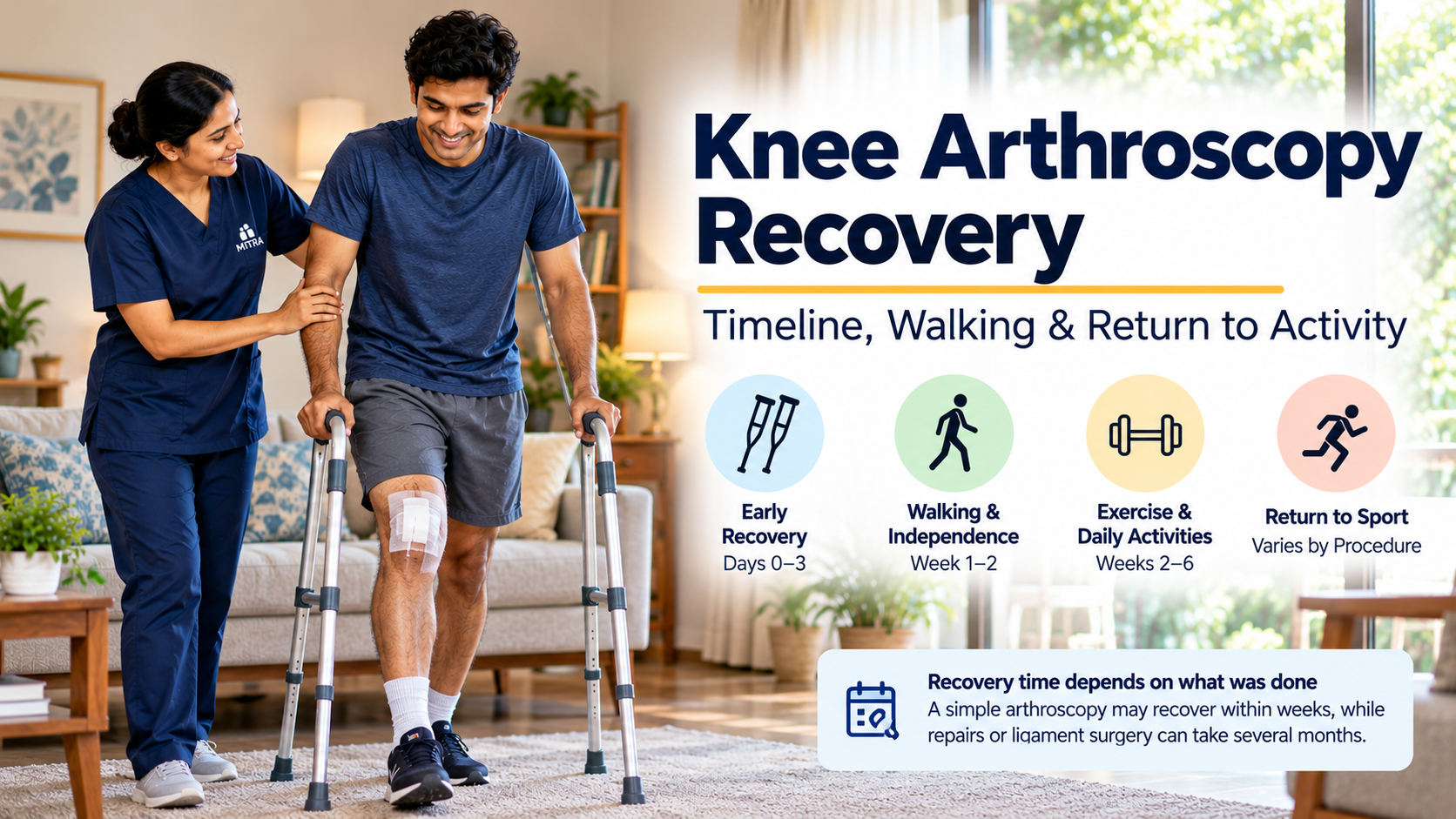
Knee Arthroscopy Recovery: Timeline, Walking & Return to Activity
How long does knee arthroscopy recovery take? Learn what to expect after keyhole knee surgery, including walking, crutches, swelling, wound care, driving, work and return to sport.
Thu, 29 Oct 2026
Post-Surgery & Recovery · 12 min read
Meniscus Surgery Recovery: Repair vs Meniscectomy
Meniscus repair and partial meniscectomy have very different recovery timelines. Learn what to expect after meniscus surgery, including walking, crutches, swelling, driving, work and return to sport.
Thu, 29 Oct 2026
Post-Surgery & Recovery · 11 min read
ACL Reconstruction Recovery: Timeline, Walking & Return to Sport
Recovering from ACL reconstruction takes months. Learn what to expect after ACL surgery, including walking, crutches, swelling, wound care, driving, work and the gradual return to sport.
Thu, 29 Oct 2026