Caregiver vs Nurse vs Physiotherapist After Surgery
Not every patient needs a nurse after surgery. Learn when a caregiver, home nurse or physiotherapist is appropriate, what each professional can do, when you may need more than one, and how support can change as recovery progresses.
Written by Dr. Sanjay Kumar K A
Published Fri, 23 Oct 2026 · 19 min read

After surgery, families are often told: “Arrange someone at home.” But who exactly? A caregiver, nurse and physiotherapist perform very different roles. Choosing the wrong type of support can mean paying for clinical skills the patient does not need — or expecting a non-clinical caregiver to perform tasks that require a healthcare professional. The correct choice depends on what the patient actually needs help with after discharge.
Caregiver vs nurse vs physiotherapist after surgery: quick answer
| Post-surgery need | Caregiver | Nurse | Physiotherapist | ||
| Bathing | ✓ | Can assist | — | ||
| Grooming | ✓ | Can assist | — | ||
| Dressing | ✓ | Can assist | — | ||
| Toileting | ✓ | Can assist | — | ||
| Meals | ✓ | — | — | ||
| Hydration support | ✓ | Can monitor if clinically relevant | — | ||
| Medication reminders | ✓ | ✓ | — | ||
| Administer prescribed injections | — | ✓ | — | ||
| Skilled wound dressing | — | ✓ | — | ||
| Catheter-related nursing | — | ✓ | — | ||
| Drain/tube nursing | — | ✓ | — | ||
| Clinical observations | Limited to care plan | ✓ | — | ||
| Walking supervision | ✓ after instruction | Sometimes | ✓ assessment/training | ||
| Getting in/out of bed | ✓ after instruction | Can assist | ✓ teaches technique | ||
| Gait training | — | — | ✓ | ||
| Balance training | — | — | ✓ | ||
| Strength rehabilitation | Assist prescribed programme | — | ✓ | ||
| Exercise progression | — | — | ✓ | ||
| Functional rehabilitation | Assist daily practice | Sometimes | ✓ | ||
| Companionship/supervision | ✓ | — | — |
What does a caregiver do after surgery?
A post-surgery caregiver primarily helps the patient manage daily life safely while independence is temporarily reduced. The caregiver is usually most useful when the patient is medically stable but cannot yet comfortably or safely manage normal activities alone. This can include assistance with personal hygiene, mobility, meals, toileting and supervision.
Typical caregiver duties after surgery
- Bathing
- Grooming
- Dressing
- Toileting
- Continence assistance
- Meals
- Hydration
- Getting in and out of bed
- Moving between bed and chair
- Walking with a prescribed aid
- Fall-prevention supervision
- Medication reminders
- Positioning
- Companionship
- Accompanying the patient to appointments
- Helping with already-prescribed exercises
- Observing changes and escalating concerns
What should a caregiver not be expected to do?
- Prescribe or change medicines
- Decide medication doses
- Give injections unless appropriately qualified and authorised
- Perform complex wound assessment
- Decide whether a wound is infected
- Start or alter an IV
- Change a clinical treatment plan
- Insert urinary catheters
- Manage complex medical devices without appropriate training
- Diagnose a blood clot
- Design a physiotherapy programme
- Progress weight-bearing restrictions
- Decide when surgical restrictions can be stopped
When is a caregiver enough after surgery?
A caregiver may be sufficient when the patient is clinically stable and the main limitations are functional rather than medical. For example, the patient may need help bathing, using the toilet, preparing food or walking safely but have no ongoing skilled nursing procedures.
- Can take oral medicines but needs reminders
- Needs help bathing
- Needs help dressing
- Needs toileting assistance
- Needs meals prepared or served
- Needs someone nearby while walking
- Uses a walker or walking stick
- Needs help getting out of bed
- Cannot safely remain alone
- Needs daytime or nighttime supervision
- Has a prescribed exercise plan that requires assistance
Example: caregiver after knee replacement
After an uncomplicated knee replacement, the physiotherapist may teach the patient how to walk with a walker, transfer safely and perform prescribed exercises. The caregiver can then help with the daily repetition of those activities, assist with bathing and toileting, make sure the walker is available and reduce fall risk. The caregiver is supporting the rehabilitation plan, not designing it.
What does a nurse do after surgery?
A nurse becomes important when the patient has clinical procedures or nursing-level monitoring requirements that cannot appropriately be handled by a general caregiver. MedlinePlus lists examples of home healthcare needs after illness or surgery including wound dressing, IV medicines or fluids, urinary catheter care and monitoring relevant clinical parameters.
Typical home nursing needs after surgery
- Surgical wound assessment
- Skilled dressing changes
- Prescribed injections
- IV medicines where appropriate
- IV line care
- Catheter-related nursing
- Drain care
- Feeding-tube-related nursing
- Tracheostomy care
- Stoma-related clinical care
- Monitoring specifically ordered by the treating team
- Identifying changes that require clinical escalation
- Patient/family education around clinical procedures
Does every patient need a nurse after surgery?
No. Having undergone surgery does not automatically create a need for nursing care. A patient who has a simple dressing, can take oral medicines, is medically stable and mainly needs help with mobility or daily activities may be better supported by a caregiver plus physiotherapy where required. This distinction can substantially affect both care quality and cost.
When might a nurse be clearly preferable to a caregiver?
| Situation | Why nursing may be appropriate | ||
| Complex surgical wound | Requires skilled assessment/dressing | ||
| Prescribed injections | Medication administration | ||
| IV medicines | Requires clinical skill and monitoring | ||
| Urinary catheter complication | Nursing assessment/care | ||
| Surgical drain | Clinical monitoring and care | ||
| Tracheostomy | Skilled airway-related care | ||
| Feeding tube requiring nursing management | Clinical procedure | ||
| Unstable observations | Requires clinical assessment/escalation | ||
| Multiple complex medical needs | Greater clinical supervision |
See when hospital discharge actually requires nursing support at home
See which clinical procedures can require a qualified home nurse
What does a physiotherapist do after surgery?
A physiotherapist focuses on movement and functional recovery. Depending on the surgery, rehabilitation may involve improving mobility, strength, balance, transfers, walking ability and confidence. NHS recovery guidance notes that physiotherapy may be part of postoperative recovery, while postoperative physiotherapy services commonly focus on early mobilisation, movement, breathing techniques and regaining independence
Typical physiotherapy goals after surgery
- Assessing movement
- Teaching safe transfers
- Teaching how to use a walker or crutches
- Gait training
- Balance training
- Improving joint movement
- Strengthening
- Prescribing exercises
- Progressing exercises
- Rebuilding endurance
- Stair training
- Functional mobility
- Breathing exercises after selected procedures
- Helping the patient return toward independence
Caregiver vs physiotherapist after surgery
| Caregiver | Physiotherapist | ||
| Supports everyday activities | Assesses movement and function | ||
| Helps with bathing/toileting | Designs rehabilitation | ||
| Supervises mobility after instruction | Teaches safe mobility | ||
| Helps patient practise prescribed exercises | Selects and progresses exercises | ||
| Can remain for long shifts | Usually attends scheduled therapy sessions | ||
| Focuses on daily support | Focuses on recovery of function |
Can a caregiver do physiotherapy exercises with the patient?
Yes, when those exercises have already been prescribed and demonstrated by the physiotherapist or treating team and the patient has been told they are safe to perform. The caregiver can help with reminders, positioning and supervision. The caregiver should not independently invent new exercises, increase resistance or change weight-bearing restrictions.
Can a nurse replace a physiotherapist?
Usually not. A nurse may help the patient mobilise as part of everyday care and may reinforce safety instructions, but rehabilitation assessment, gait retraining, exercise prescription and progression are physiotherapy functions. The professions overlap at certain practical points but have different core responsibilities.
Can a physiotherapist replace a caregiver?
Usually not when the patient needs help throughout the day. A physiotherapist may spend a defined period working on mobility and rehabilitation, while the patient may still need assistance with:- Toilet trips- Bathing- Meals- Transfers- Walking between therapy sessions- Nighttime needsThat ongoing support is more commonly a caregiving role.
Can a caregiver replace a nurse?
Not when skilled nursing procedures are required. A caregiver may help the patient remember oral medicines or observe the wound externally, but this is different from clinical wound assessment, injections, IV therapy or management of complex medical devices. Choosing a caregiver for a nursing task simply because it is cheaper can create safety problems.
Why do some post-surgery patients need all three?
A major operation can affect several areas at once. For example, an older patient after major orthopaedic surgery might need: Caregiver → bathing, toileting, meals and supervisionNurse → prescribed wound care or injectionsPhysiotherapist → walking and rehabilitation The three roles solve different problems.
Example care team after a major joint replacement
| Need | Professional | ||
| Bathing | Caregiver | ||
| Toilet assistance | Caregiver | ||
| Meals | Caregiver | ||
| Walking practice between therapy sessions | Caregiver after instruction | ||
| Surgical dressing if skilled care required | Nurse | ||
| Prescribed injection | Nurse | ||
| Assess gait | Physiotherapist | ||
| Teach walker technique | Physiotherapist | ||
| Prescribe exercises | Physiotherapist | ||
| Progress mobility | Physiotherapist |
Example care team after abdominal surgery
A patient after abdominal surgery may be able to walk but still feel weak and need temporary assistance with meals, bathing and household movement. If the wound requires skilled dressing, a nurse can attend for that specific procedure. A full-time nurse may not be necessary simply because the surgery involved the abdomen.
Example after spine surgery
Following spine surgery, the physiotherapist may teach safe transfers and mobility while the surgeon specifies restrictions such as limits on lifting, bending or twisting. A caregiver can help the patient follow these instructions during daily life. Any new weakness, numbness, bladder or bowel symptoms or other neurological changes should be escalated medically rather than treated as a routine rehabilitation problem.
Example after cardiac surgery
A patient recovering after cardiac surgery may need help with bathing, meals and daily activity while strength returns. Rehabilitation may involve structured activity progression or cardiac rehabilitation. If there are clinical procedures, wound issues or other nursing needs, nursing support may also be appropriate. The required combination depends on the discharge plan and the patient's stability.
How do you decide which professional is needed?
- Can the patient bathe independently?
- Can they use the toilet safely?
- Can they get in and out of bed?
- Can they walk safely?
- Can they manage medicines?
- Does the patient have a wound requiring skilled care?
- Are prescribed injections required?
- Is a catheter, drain or other device present?
- Has physiotherapy been prescribed?
- Is the patient safe alone?
- Are there nighttime care needs?
- Does the family know how to recognise deterioration?
A simple decision guide
| Main problem | Likely starting point | ||
| “She can't bathe or use the toilet alone.” | Caregiver | ||
| “He needs someone around because he may fall.” | Caregiver | ||
| “The wound needs professional dressing.” | Nurse | ||
| “She has prescribed injections.” | Nurse | ||
| “He has a catheter requiring nursing care.” | Nurse | ||
| “She cannot walk properly after surgery.” | Physiotherapist assessment | ||
| “He needs to learn to use a walker.” | Physiotherapist | ||
| “She needs help throughout the day AND rehabilitation.” | Caregiver + physiotherapist | ||
| “He needs dressing plus help with bathing and toileting.” | Caregiver + nurse | ||
| “She has clinical procedures, dependency and poor mobility.” | Caregiver + nurse + physiotherapist |
Does the patient need a full-time nurse or only nursing visits?
This is an important distinction. A patient may need one skilled dressing per day but otherwise require only routine assistance with meals, bathing and mobility. In that situation, a full-time nurse may not be necessary. A caregiver may provide ongoing daily support while a nurse attends for the clinical procedure. Conversely, complex or unstable patients may require much more continuous nursing input.
Does the patient need 12-hour or 24-hour caregiving?
That depends on whether the patient can safely manage when the caregiver is absent. Daytime support may be sufficient if the patient can manage nighttime toileting, medicines and mobility independently. Twenty-four-hour support becomes more relevant when assistance is needed across both day and night. Work out whether post-surgery support is needed for 12 or 24 hours
What about the first 24 hours after surgery?
For some procedures involving general anaesthesia or sedation, a responsible adult may need to remain with the patient during the early recovery period. NHS and MedlinePlus postoperative guidance advises arranging responsible adult support after certain surgical procedures and following the specific restrictions given by the surgical team. That does not automatically mean a professional nurse is necessary.
Does an elderly patient need more support after surgery?
Often, but not automatically. Age alone should not determine the staffing level. An older adult who was independent before surgery may recover with limited temporary assistance, while another patient may have substantial needs because of frailty, dementia, poor balance, weakness or pre-existing disability. Assess function, not age alone.
Questions that matter particularly in older adults
- Is the patient more confused than before admission?
- Can they remember medicines?
- Can they recognise the bathroom at night?
- Has walking deteriorated?
- Can they transfer independently?
- Are they eating and drinking?
- Is there a high fall risk?
- Can they use a walking aid correctly?
- Were they independent before surgery?
- Is the current decline expected to improve?
What if the patient lives alone?
Living alone does not automatically mean 24-hour professional care is required. But the discharge plan should realistically consider whether the patient can:- Get food- Reach the bathroom- Take medicines- Get out of bed- Manage stairs- Use the phone- Respond to an emergencyNHS discharge and recovery guidance emphasises assessing what a person can manage and tailoring short-term support toward recovery and independence.
What if family members are available?
Family support can reduce the amount of professional caregiving required when relatives are physically able, available and comfortable with the tasks involved. But family presence does not replace a nurse when skilled nursing procedures are required or a physiotherapist when specialised rehabilitation assessment is needed.
Should a family member perform wound dressing?
It depends on the wound and the discharge instructions. A simple dressing may sometimes be managed by a family member who has been specifically taught the procedure. Complex wounds, concerning changes or dressings requiring clinical assessment should be handled by an appropriately trained healthcare professional.
What if the patient has a urinary catheter?
A urinary catheter does not automatically mean a nurse must remain with the patient continuously. A caregiver may help with general positioning or practical daily support after appropriate instruction, while clinical catheter problems, insertion, replacement or nursing assessment require an appropriately qualified professional. The care plan should clearly separate routine support from nursing tasks.
What if injections are prescribed after surgery?
Some patients are discharged with prescribed injections, including anticoagulants in selected surgical situations. The patient may be taught to self-administer them, a trained family member may sometimes be instructed, or a nurse may be arranged depending on the medicine and local clinical plan. Do not delegate prescribed injections to an unqualified caregiver.
Who monitors the surgical wound?
Everyone involved can notice visible changes, but responsibilities differ. A caregiver may observe that a dressing is wet, blood-stained or that the patient reports more pain. A nurse may clinically assess and manage the wound where nursing input is required. The surgeon or treating clinician remains responsible for evaluating suspected surgical complications.
Who manages medication after surgery?
| Medication task | Appropriate support | ||
| Reminding patient to take tablets | Caregiver | ||
| Organising medicines according to existing prescription | Family/caregiver depending on care plan | ||
| Administering prescribed nursing medication | Nurse where required | ||
| Changing dose | Prescribing clinician | ||
| Starting a new medicine | Prescribing clinician | ||
| Stopping a medicine | Prescribing clinician | ||
| Managing adverse reaction | Clinical evaluation |
Who decides how much the patient should walk?
The postoperative mobility plan should come from the surgeon, physiotherapist or treating team. The caregiver helps implement that plan. NHS guidance encourages getting moving when appropriate after surgery but also stresses following the medical team's advice on activity. This is particularly important where weight-bearing or movement restrictions apply.
Who should help with stairs?
A physiotherapist should teach the safest technique when stair use is affected by surgery, weakness or a walking aid. Once the technique is established, a caregiver or family member may assist or supervise according to the rehabilitation plan. NHS recovery services explicitly include practising stairs and other daily activities as part of rehabilitation toward independence.
The goal should be decreasing dependence
Good recovery care should not unnecessarily make a patient dependent. Where medically appropriate, the aim is to progressively help the person regain the ability to:- Bathe- Dress- Toilet- Transfer- Walk- Eat- Manage daily routinesNHS intermediate-care guidance describes recovery support as helping patients regain independence rather than doing everything for them indefinitely.
How should the care team change as recovery improves?
The staffing needed on the first day home may not be appropriate three weeks later. A typical progression might look like: Higher dependencyCaregiver + nurse + physiotherapy ↓ Clinical needs reduceCaregiver + physiotherapy ↓ Daily independence improvesPart-day caregiving + physiotherapy ↓ Independent daily activityPhysiotherapy/follow-up only This is only an example — actual recovery varies significantly.
When should the plan be reassessed?
- The patient walks more independently
- Toileting improves
- Wound care ends
- Injections finish
- A catheter or drain is removed
- Physiotherapy goals change
- Nighttime needs decrease
- The patient becomes safe alone
- A complication develops
- New weakness or dependency appears
What if recovery is not progressing as expected?
Do not simply add more caregiving hours without understanding the reason. Slower recovery may reflect:- Pain- Infection- Anaemia- Poor nutrition- Medication effects- Fear of movement- Inadequate rehabilitation- New medical complications- Pre-existing frailtyUnexpected deterioration should be medically assessed rather than treated solely as a staffing problem.
When home care is not enough
A caregiver, nurse or physiotherapist at home is not a substitute for hospital-level assessment when the patient develops an acute complication. Urgent medical evaluation may be needed for symptoms such as:- Severe breathlessness- Chest pain- Collapse- Major bleeding- Sudden neurological symptoms- Rapidly worsening wound infection- Severe uncontrolled pain- Significant deterioration in consciousnessThe specific discharge instructions should guide escalation. See the complete guide to recovery and warning signs after surgery
How to choose post-surgery care before hospital discharge
- List every task they cannot currently perform.
- Separate daily-living tasks from clinical procedures.
- Identify rehabilitation requirements.
- Ask whether the patient is safe alone.
- Identify nighttime needs.
- Confirm who will perform wound care.
- Confirm who will administer injections if needed.
- Obtain mobility and weight-bearing instructions.
- Decide whether support is temporary or likely to continue.
- Reassess after recovery begins.
Use the complete discharge checklist before arranging home support
Frequently asked questions
Do I need a nurse at home after surgery?
Not necessarily. A nurse is most useful when the patient requires skilled clinical procedures or nursing assessment. If the main needs are bathing, meals, toileting, mobility and supervision, a trained caregiver may be more appropriate.
Is a caregiver enough after surgery?
A caregiver may be enough when the patient is medically stable and mainly needs assistance with daily activities. If wound care, injections, complex devices or other clinical tasks are required, additional nursing may be needed.
Do I need a physiotherapist after surgery?
Not after every operation. Physiotherapy becomes particularly useful when the surgery affects mobility, strength, balance, breathing, joint movement or the ability to perform normal activities. The surgeon or hospital team may recommend when rehabilitation should begin.
Can one person be both caregiver and nurse?
A qualified nurse can often assist with some basic daily-care tasks, but that does not necessarily make full-time nursing the most appropriate or cost-effective arrangement. The key question is how many hours of clinical nursing the patient actually requires versus how many hours of daily living assistance are needed.
Can a caregiver stay for 24 hours after surgery?
Yes, 24-hour caregiving may be appropriate when the patient needs assistance across both daytime and nighttime. However, one live-in caregiver also requires adequate rest. Patients needing frequent active overnight intervention may require a different staffing plan.
Can a caregiver help a patient walk after surgery?
Yes, once the treating team or physiotherapist has established how the patient should mobilise. The caregiver can supervise walking, make sure the prescribed walking aid is used and help reduce fall risk.
Who should decide when the walker can be stopped?
That decision should come from the physiotherapist, surgeon or treating clinical team, not from the caregiver or patient simply because walking feels easier. Stopping an aid prematurely may increase fall risk or violate procedure-specific restrictions.
Do I need a nurse just for wound dressing?
Potentially, but that does not necessarily mean you need a nurse for a full shift. If a skilled dressing is the only nursing requirement, a scheduled nursing visit may sometimes be sufficient while a caregiver or family provides the rest of the patient's daily support.
What if my parent needs both physiotherapy and a caregiver?
That is common. The physiotherapist can establish the mobility and exercise programme, while the caregiver helps the patient safely practise the prescribed activities between sessions and assists with everyday tasks.
How MITRA decides what kind of post-surgery support is needed
MITRA's starting point is the patient's actual functional and clinical needs after discharge. The assessment can consider:- Bathing- Toileting- Feeding- Mobility- Transfers- Cognition- Medication support- Wound requirements- Catheters or other devices- Nursing procedures- Rehabilitation requirements- Nighttime dependency- Whether the patient can remain safely aloneThe goal is to avoid both under-supporting and over-medicalising recovery.
The care plan should step down when possible
Post-surgery care is often temporary. As the patient regains function, the level of assistance can be reassessed. Someone who initially needs 24-hour support may later need daytime help only, and someone who needed a nurse for wound care may no longer require nursing once the wound-care phase ends. The objective is appropriate support for the current stage of recovery.
Need care at home in Bengaluru? See MITRA services.
Related articles
Post-Surgery & Recovery · 11 min read
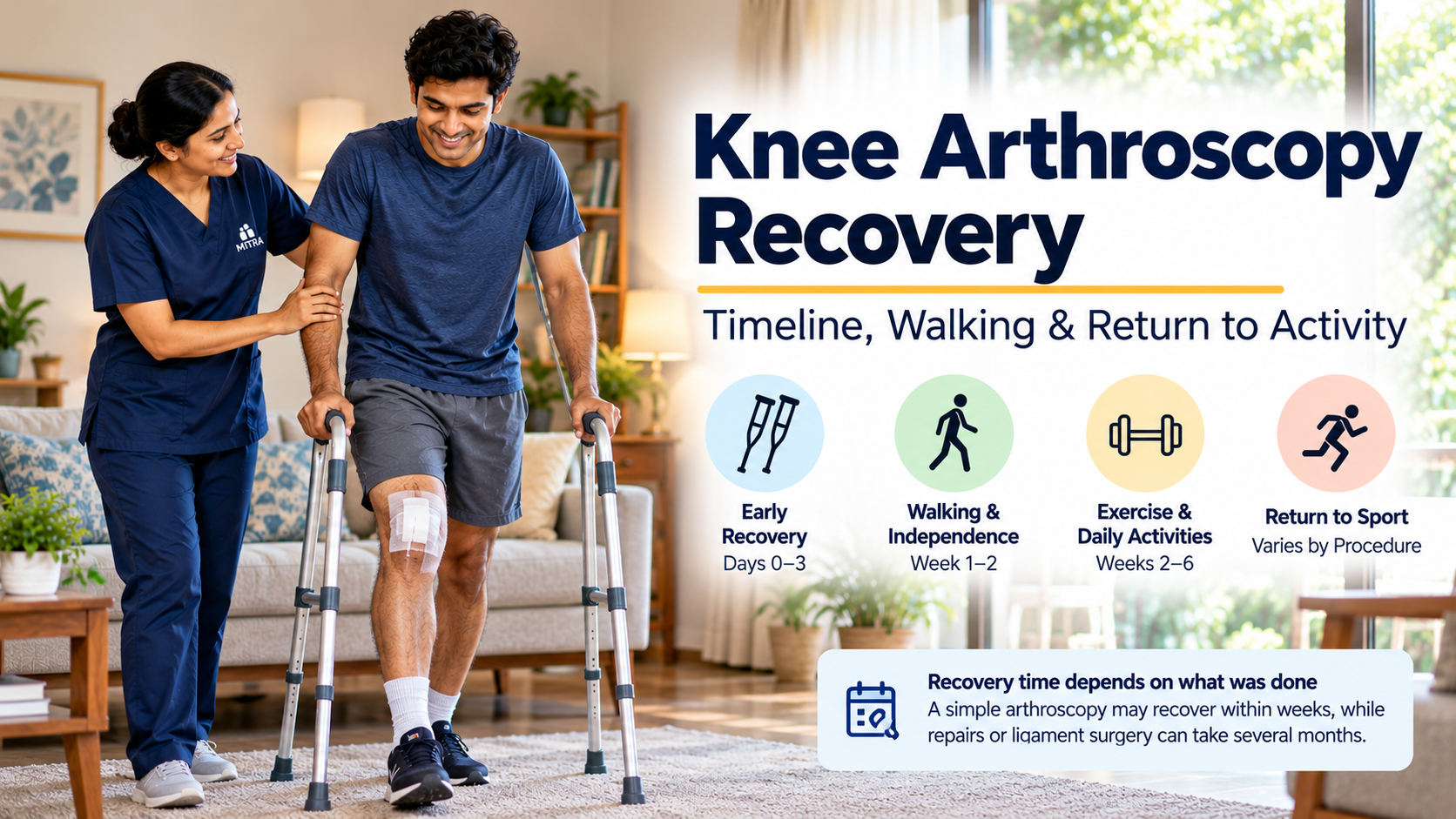
Knee Arthroscopy Recovery: Timeline, Walking & Return to Activity
How long does knee arthroscopy recovery take? Learn what to expect after keyhole knee surgery, including walking, crutches, swelling, wound care, driving, work and return to sport.
Thu, 29 Oct 2026
Post-Surgery & Recovery · 12 min read
Meniscus Surgery Recovery: Repair vs Meniscectomy
Meniscus repair and partial meniscectomy have very different recovery timelines. Learn what to expect after meniscus surgery, including walking, crutches, swelling, driving, work and return to sport.
Thu, 29 Oct 2026
Post-Surgery & Recovery · 11 min read
ACL Reconstruction Recovery: Timeline, Walking & Return to Sport
Recovering from ACL reconstruction takes months. Learn what to expect after ACL surgery, including walking, crutches, swelling, wound care, driving, work and the gradual return to sport.
Thu, 29 Oct 2026