Home Nursing After Hospital Discharge: What Families Should Arrange
Bringing a patient home after hospital discharge? Learn what families should arrange for medicines, nursing procedures, mobility, equipment, follow-up and safe recovery at home.
Written by Mr. Rahul B S
Published Tue, 13 Oct 2026 · 9 min read
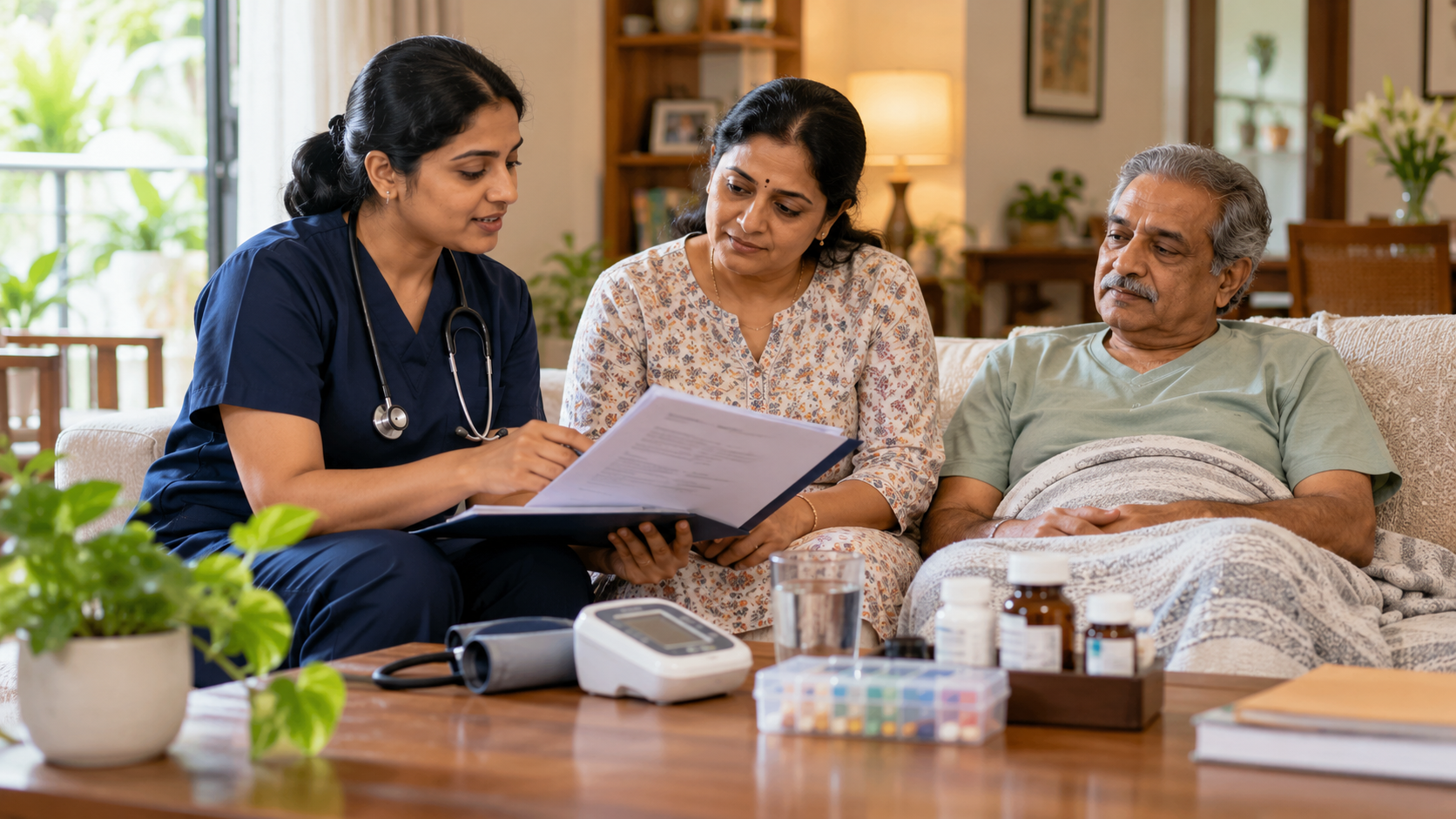
Hospital discharge can feel like the end of treatment, but for many patients it is really the start of the recovery phase at home. A patient may leave hospital medically stable and still need help with medicines, wound care, mobility, feeding, catheters, monitoring or everyday activities. The safest approach is to understand what must continue after discharge, who is qualified to provide it, and what changes should trigger medical review before the patient reaches home.
Does every patient need a nurse after discharge?
No. Some recovering patients mainly need help with bathing, toileting, feeding, walking, supervision or medication reminders. A trained caregiver may be sufficient for these needs. Home nursing becomes more relevant when the discharge plan includes skilled clinical care such as prescribed injections, IV medicines through appropriate existing access, wound care, feeding-tube care, catheter or line care, suctioning, tracheostomy care or other nursing procedures.
| Need after discharge | Caregiver may be enough | Nurse may be needed | ||
| Bathing and grooming | ✓ | |||
| Toileting and continence | ✓ | |||
| Feeding assistance | ✓ | |||
| Walking and transfers | ✓ | |||
| Medication reminders | ✓ | |||
| Basic routine observation | ✓ | |||
| Prescribed injections | ✓ | |||
| IV medicines through existing access | ✓ | |||
| Wound dressing | ✓ | |||
| Feeding-tube care | ✓ | |||
| Catheter/line care | ✓ | |||
| Suctioning or tracheostomy care | ✓ |
See how to decide between a caregiver and a home nurse
Who may need home nursing after discharge?
- Has a surgical or complex wound requiring prescribed dressings
- Needs prescribed injections
- Requires IV medication through appropriate existing access
- Has a urinary catheter requiring nursing care
- Has a Ryle's tube or PEG feeding requirement
- Needs suctioning or tracheostomy care
- Requires closer observation because of their clinical condition
- Has multiple clinical care requirements that the family cannot safely perform
- Has been discharged with specific nursing instructions
- Needs skilled support while transitioning from hospital care to recovery at home
What should families arrange before leaving hospital?
A good discharge plan should transfer essential information from the hospital team to the patient and family. AHRQ's discharge-planning framework specifically highlights medicines, warning signs, test results, follow-up appointments and what daily life at home is expected to look like. Before leaving, organise the following.
1. Keep the discharge summary and instructions
Obtain the final discharge summary and keep it easily accessible. It should help the next healthcare professional understand the diagnosis, treatment received, important investigations, procedures, ongoing medicines and planned follow-up. If something in the discharge instructions is unclear, ask before leaving the hospital.
2. Confirm the final medication list
Hospital admissions often result in medicines being started, stopped or changed. Do not assume that every medicine the patient took before admission should automatically continue after discharge. Compare the final discharge prescription with the previous medicine list and clarify discrepancies with the treating team. WHO identifies transitions such as hospital discharge as particularly important points for medication safety and recommends structured medication reconciliation and a clear final medication list.
3. Write down every nursing procedure required
Do not leave with vague instructions such as “continue dressing” or “manage the tube at home.” Ask for clarity about: - What procedure is required- How often it should be performed- How long it is expected to continue- What supplies are needed- Whether a trained nurse is required- What changes should be reported- When the procedure should be reviewed or stopped This information also helps a home-care provider match the correct level of nursing support.
4. Arrange the required equipment and supplies
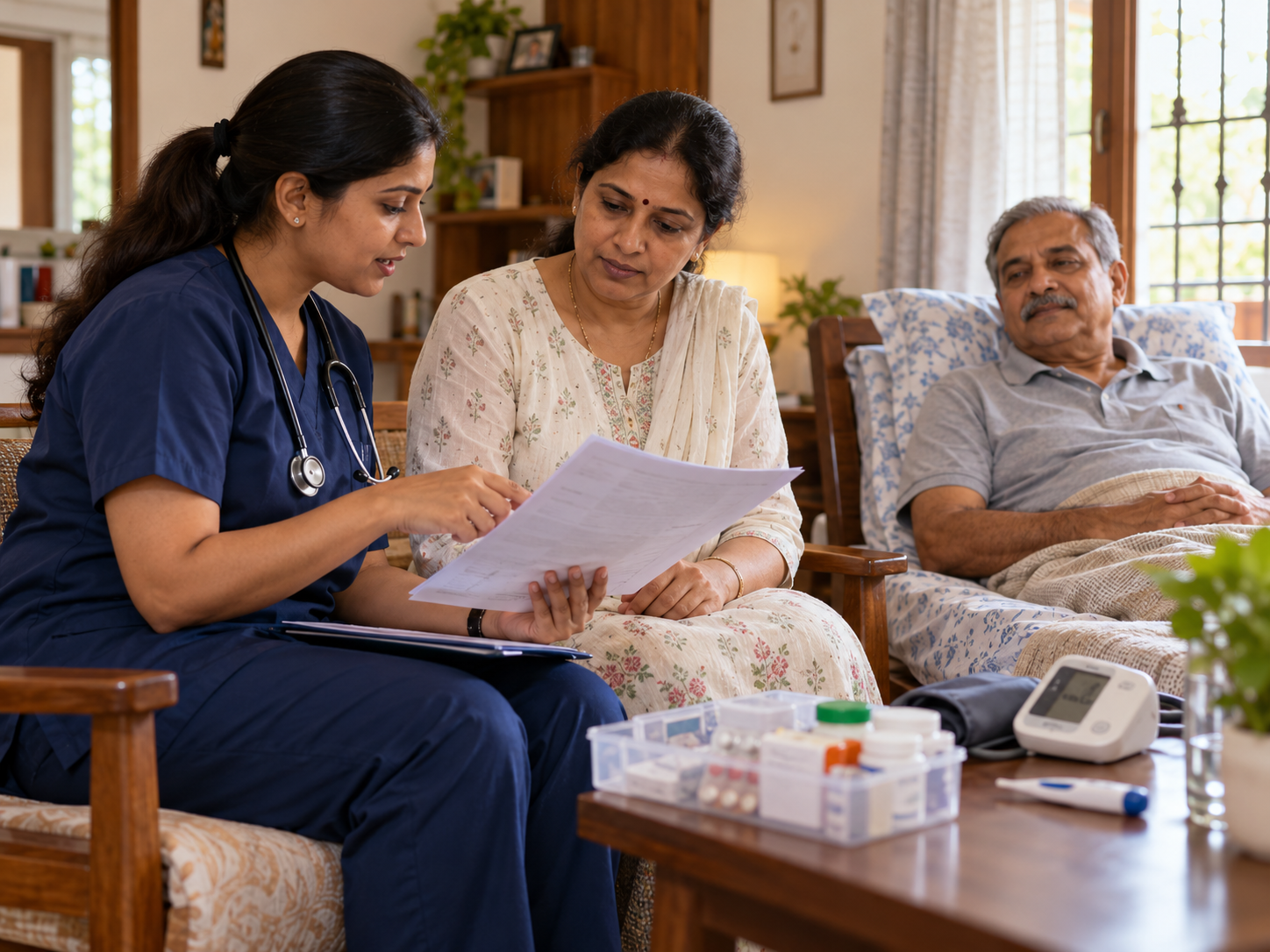
The required equipment depends entirely on the patient's condition. Examples may include: - Walker or wheelchair- Bedside commode- Hospital bed when appropriate- Pressure-relieving support- Prescribed wound-care materials- Feeding supplies- Catheter supplies- Monitoring equipment- Diapers or continence supplies- Other equipment specifically recommended by the treating team Avoid buying medical equipment simply because another recovering patient used it. The patient's actual discharge plan should guide what is required.
5. Plan mobility before the patient reaches home
Ask whether the patient can safely: - Get out of bed- Sit unsupported- Stand- Walk- Use stairs- Reach the bathroom- Transfer to a chair- Use a walker or other aid A patient who could walk independently before admission may be significantly weaker after illness or surgery. If mobility has changed, clarify whether physiotherapy, assistance during transfers or home modifications are needed.
6. Understand food, feeding and hydration instructions
Confirm whether there are specific instructions regarding diet, fluid intake, swallowing or feeding. Some patients can return to their usual diet. Others may have restrictions, altered textures or tube-feeding plans. Families should not independently change a prescribed feeding plan because the patient “seems better.”
7. Book follow-up before problems arise
Know: - Which doctor should review the patient- When the appointment is due- Whether stitches or staples need removal- Whether repeat blood tests are required- Whether imaging needs to be repeated- Whether any pending hospital test results still need review AHRQ recommends that follow-up requirements and outstanding test results be explicitly addressed during discharge planning.
The first few days at home matter
The first days after discharge are when the family learns whether the plan that looked manageable in hospital actually works at home. Pay attention to changes in: - Alertness- Breathing- Pain- Temperature- Eating and drinking- Urination- Bowel movements- Mobility- Wound appearance- Sleep- Behaviour- Ability to take medicines as prescribed A nurse or caregiver should observe and escalate changes, not independently diagnose the problem or alter medical treatment.
What does a home nurse actually do after discharge?
The exact duties depend on the patient's prescription and care plan. A qualified home nurse may provide appropriate clinical care such as:
- Prescribed injections
- Prescribed IV medicines through appropriate existing access
- Wound assessment and dressing
- Catheter and line care
- Ryle's/PEG feeding
- Suctioning
- Tracheostomy care
- Vital-sign monitoring according to the care plan
- Intake/output monitoring where required
- Observation for changes in condition
- Documentation
- Escalation to the medical team when concerns arise
Explore MITRA home caregiving and nursing options
What can the family do themselves?
Families remain an important part of recovery even when professional help is present. Depending on the patient's condition, family involvement may include providing meals and fluids, maintaining the home environment, attending follow-up appointments, keeping medicines and supplies available, offering emotional support and communicating changes to the care team. The objective is not necessarily to outsource every task. It is to make sure each task is performed by the right person.
What if the patient also needs everyday caregiving?
Clinical care is only one part of recovery. A patient may need a nurse for specific procedures while also requiring substantial help with: - Bathing- Toileting- Feeding- Positioning- Walking- Transfers- Continence- Supervision The care plan should therefore consider both clinical nursing needs and activities of daily living.
See what everyday support a home caregiver can provide
When home care is NOT enough
A home nurse is not a substitute for hospital care when a patient is becoming acutely unwell. Seek urgent medical assessment for significant deterioration such as:
- Severe or worsening breathlessness
- New chest pain
- New weakness of the face, arm or leg
- New difficulty speaking
- Loss of consciousness
- Seizure
- Major bleeding
- Marked reduction in responsiveness
- Rapidly worsening infection symptoms
- Severe uncontrolled pain
- Sudden significant deterioration in the patient's condition
A successful discharge is not simply getting the patient home. It is making sure the next phase of care can continue safely once they arrive.
How MITRA approaches post-discharge home care
MITRA first assesses the patient's requirements rather than automatically assigning a caregiver or nurse. The care requirement is reviewed in areas such as mobility, personal care, feeding, cognition, medical devices, nursing procedures, monitoring and nighttime support. Where appropriate, the family can then be matched with providers whose training and competencies fit those requirements. MITRA remains involved after placement through the agreed care-support pathway, including care tracking, communication with the family and provider, clinical escalation where required, and scheduled doctor oversight according to the selected care plan.
Post-discharge home checklist
- The final discharge summary.
- The latest medication list.
- Clear instructions for all nursing procedures.
- Required medicines and supplies.
- Necessary mobility or medical equipment.
- A safe place for the patient to sleep and move around.
- A plan for feeding and hydration.
- Follow-up appointments.
- Instructions for pending investigations.
- Warning signs and emergency instructions.
- Contact details for questions after discharge.
- The appropriate caregiver, nurse or physiotherapist arranged where required.
Frequently asked questions
How long is home nursing needed after hospital discharge?
There is no fixed duration. Some patients require nursing only for a short recovery period, while others have longer-term clinical needs. The need should be reviewed as wounds heal, mobility improves, devices are removed and the patient's condition changes.
Can a caregiver manage a patient after discharge?
Yes, when the patient's main needs are non-clinical activities such as bathing, toileting, feeding, mobility, supervision and medication reminders. If prescribed nursing procedures are required, an appropriately qualified provider should perform them.
Can a home nurse change medicines if the patient is unwell?
Not independently. A nurse can observe the patient, document relevant findings and escalate concerns, but prescribing medicines or changing prescribed treatment requires an appropriately authorised clinician.
Should home nursing be arranged before discharge?
Ideally, yes when ongoing nursing needs are already known. Arranging the provider, equipment, medicines and supplies before the patient reaches home reduces the chance of a gap between hospital care and home care.
Need care at home in Bengaluru? See MITRA services.
Related articles
Home Care Guides · 19 min read
Personalised Home Care Plans: How MITRA Decides What Care a Patient Actually Needs
A home care plan should be based on what a person actually needs help with — not simply their age or diagnosis. See how MITRA assesses daily activities, mobility, nursing requirements, night needs, family support and preferences before structuring personalised home care.
Fri, 6 Nov 2026
Home Care Guides · 15 min read
Doctor-Guided Home Care at MITRA: What Doctor Check-Ins Actually Include
MITRA caregiving plans include doctor check-ins as part of ongoing home care. See what the doctor reviews, how CareTrack and LabTrack support the review, when the care plan may change, and what doctor oversight does not replace.
Thu, 5 Nov 2026
Home Care Guides · 12 min read
MITRA CareTrack Explained: How Families Receive Daily Care Updates
CareTrack is MITRA's structured daily care record for home caregiving. See what caregivers document, how families can follow day-to-day care, how vitals and concerns are tracked, and how CareTrack supports doctor reviews, escalation and continuity when caregivers change.
Wed, 4 Nov 2026