Knee Replacement Recovery Timeline: Week-by-Week Milestones
How long does knee replacement recovery take? See a practical week-by-week timeline covering walking, walker use, swelling, pain, stairs, driving, work and return to normal activities after knee replacement.
Written by Dr. Sanjay Kumar K A · Medically reviewed by Dr. Sanjay Kumar K A, MD Anaesthesiology (Tue, 27 Oct 2026)
Published Tue, 27 Oct 2026 · 14 min read
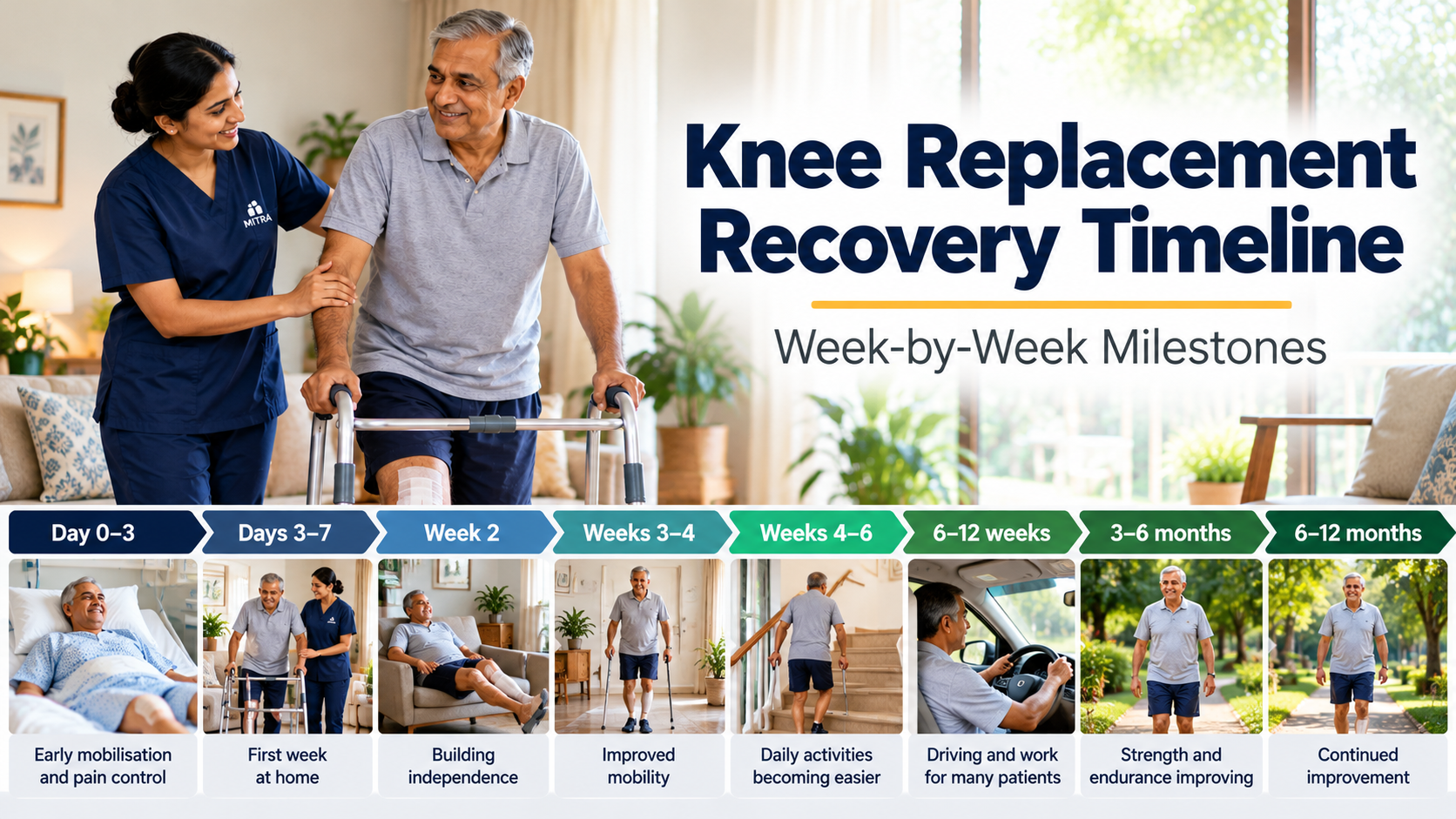
Knee replacement recovery usually takes months rather than days. Walking begins very early, many everyday activities return over the first several weeks, and strength, stamina and comfort can continue improving for 6–12 months. There is no single timeline that applies to everyone. Age, pre-surgery strength, general health, whether the operation was a total or partial knee replacement, and the pace of rehabilitation all affect recovery.
Knee replacement recovery timeline at a glance
| Recovery stage | Common milestones | ||
| Day 0–3 | Standing, walking with assistance, pain control | ||
| Days 3–7 | Early recovery at home, walker/crutches, swelling management | ||
| Week 2 | Increasing walking and independence | ||
| Weeks 3–4 | Better daily mobility, possible progression of walking aid | ||
| Weeks 4–6 | Many routine activities becoming easier | ||
| Weeks 6–12 | Greater independence, work/driving for many patients if cleared | ||
| 3–6 months | Strength and endurance continue improving | ||
| 6–12 months | Ongoing improvement toward maximum recovery |
Day 0: the day of knee replacement surgery
Recovery begins almost immediately. Modern knee-replacement pathways generally encourage patients to get out of bed and begin walking with assistance on the day of surgery or soon afterwards. A physiotherapist or clinical team member will usually help with:- Standing- Walker or crutch use- Short-distance walking- Transfers- Basic exercisesEarly mobilisation is part of standard recovery rather than waiting several days in bed.
Days 1–3 after knee replacement
During the first few days, priorities usually include: - Pain control- Safe walking- Getting in and out of bed- Toilet transfers- Wound observation- Blood-clot prevention- Beginning the prescribed rehabilitation programme Many patients are discharged once they are medically stable and can move around safely with an appropriate walking aid.
How long do you stay in hospital after knee replacement?
Hospital stays are increasingly short. NHS guidance says patients without complications commonly leave hospital around 1–4 days after surgery, while AAHKS describes a typical stay of around 1–3 days, depending on the patient and rehabilitation progress. Selected patients may even have same-day pathways.
Days 3–7: the first week at home
The first week at home is often one of the most support-intensive parts of recovery. The patient may still need help with:- Bathing- Dressing- Meals- Toileting- Bed transfers- Walking- Medicines- Ice or swelling-management routines- Getting to appointments The goal is not to stay in bed. It is to alternate appropriate movement with rest and swelling control.
What is normal during the first week?
- Knee pain
- Swelling
- Bruising
- Stiffness
- Reduced appetite
- Fatigue
- Difficulty sleeping
- Slow walking
- Dependence on walker or crutches
How much should you walk in the first week?
There is no universal step count. Walking usually starts with short, frequent periods using the prescribed aid and progresses according to:- Balance- Pain- Swelling- Strength- General health- Physiotherapist instructionsDo not copy another patient's distance or online step target.See how to manage the first days at home after knee replacement
Week 2 after knee replacement
By the second week, many patients notice that transfers and short-distance walking are becoming easier. However, it is still normal to have:- Swelling- Stiffness- Pain during activity- Fatigue- Difficulty sleepingThe skin incision itself may be approaching healing during this period; AAHKS notes that the incision commonly takes approximately 2–3 weeks to heal, even though deeper recovery continues for much longer.
Should you still need a walker at 2 weeks?
Possibly. AAHKS notes that some patients progress to a cane or no walking aid around 2–3 weeks, while NHS guidance is more conservative and suggests trying unaided walking around 6 weeks if ready. These differences show why walker use should be based on the individual's gait and safety rather than a calendar date.
Weeks 3–4 after knee replacement
During weeks three and four, many patients become more independent in daily activities. Depending on progress, this may include:- Longer walks- Easier toilet transfers- More independent dressing- Less reliance on family or caregiver support- Progression from walker to cane- Better confidence using stairsSwelling and stiffness can still be significant.
Is pain still normal after one month?
Some pain or discomfort with activity can still be expected. AAOS notes that pain during activity and at night can continue for several weeks after joint replacement. What matters is the overall direction: pain should generally become easier to manage rather than suddenly worsening.
Weeks 4–6 after knee replacement
The 4–6 week period is a major milestone for many patients. Walking may be easier, daily activities may require less assistance, and some people may begin returning to driving or sedentary work if their surgeon considers it safe. However, the knee is still recovering.
Can you walk without a walker at 6 weeks?
Many patients can, but not everyone should. NHS guidance suggests trying to walk without an aid around 6 weeks if the patient feels ready, while other orthopaedic guidance reports that some patients progress earlier. The safer milestone is: stable gait + adequate balance + appropriate strength + clinical clearance.
What happens at the 6-week follow-up?
Follow-up schedules vary by hospital and surgeon, but a postoperative review around this period is common. The team may assess:- Wound healing- Pain- Swelling- Knee movement- Walking- Medication needs- Rehabilitation progress- Return to activitiesNHS guidance notes that many patients have a follow-up appointment around 6 weeks after surgery.
Weeks 6–12 after knee replacement
Between six and twelve weeks, many patients move from basic recovery toward rebuilding normal daily function. Possible milestones include:- Walking more independently- Increasing endurance- Using stairs more confidently- Returning to work- Driving if medically cleared- Performing more household activities- Needing much less caregiver supportAAHKS notes that many patients return to most activities by around three months, although recovery varies.
3 months after knee replacement
Three months is an important milestone, but it is not the end of recovery. Many people are substantially more independent by this stage and can perform most normal daily activities. Strength, endurance, residual swelling and the sensation of the artificial knee can continue changing well beyond three months.
3–6 months after knee replacement
During this phase, improvement often becomes less dramatic than in the first few weeks, but recovery is still occurring. Patients may continue gaining:- Walking endurance- Strength- Confidence- Knee movement- Ability to manage longer outings- Comfort during normal daily lifeSome swelling or stiffness may still occur after increased activity.
6–12 months after knee replacement
Knee replacement recovery can continue for a full year. AAHKS states that it may take 6–12 months to reach maximal strength and endurance after total knee replacement, while its patient guidance notes that healing can continue for up to a year even though patients improve much earlier. Therefore, a knee that does not feel completely “normal” at three months is not automatically failing.
How long does swelling last after knee replacement?
Swelling commonly lasts much longer than the initial wound-healing period. It is often more noticeable:- At the end of the day- After longer walks- After rehabilitation- After prolonged standingImprovement is usually gradual. Suddenly increasing swelling, especially with calf pain, redness, warmth or breathlessness, needs medical assessment rather than being assumed to be normal postoperative swelling.
When does knee replacement pain go away?
Pain usually improves gradually rather than disappearing on a single date. Early surgical pain commonly gives way to discomfort associated with movement, stiffness and rehabilitation. Some patients still experience discomfort for weeks or months while strength and movement improve. A sudden increase in pain after previous improvement requires review.
When can you stop using a walker after knee replacement?
There is no fixed week. Transition should depend on whether the patient can:- Stand safely- Walk without significant instability- Maintain appropriate gait- Turn safely- Manage the distances required at homeThe surgeon or physiotherapist should guide progression from walker → crutch/cane → unaided walking.
When can you climb stairs after knee replacement?
Many patients practise stairs before leaving hospital when stairs are necessary at home. Being able to use stairs does not mean the patient should repeatedly climb them for exercise. During early recovery, minimise unnecessary stair trips and follow the technique taught by the rehabilitation team.
When can you drive after knee replacement?
Driving usually resumes only after several conditions are met:- Adequate knee control- Ability to enter and exit the vehicle- Ability to perform an emergency stop- No sedating opioid medication- Surgeon clearance where required NHS guidance advises waiting at least 6 weeks after total knee replacement and around 3 weeks after partial knee replacement, while AAHKS describes 4–6 weeks as common for total replacement.
When can you return to work after knee replacement?
The answer depends strongly on the job. NHS guidance places return to work commonly around 6–12 weeks, while AAHKS notes that sedentary jobs may sometimes resume around 4–6 weeks, with physically demanding work potentially requiring up to three months. Someone working from a computer does not have the same recovery requirements as someone whose job involves lifting, stairs or prolonged standing.
| Type of work | General recovery consideration | ||
| Work from home / desk work | May return earlier if comfortable | ||
| Office with commute | Walking, sitting and transport must be manageable | ||
| Prolonged standing | Usually requires more recovery | ||
| Frequent stairs | Requires adequate strength and control | ||
| Manual work | Often requires considerably longer | ||
| Heavy physical work | Must be specifically cleared by surgeon |
When can you do household work again?
Light tasks usually return before heavy household work. NHS guidance advises avoiding household activities involving significant lifting or moving heavy objects for approximately the first three months after knee replacement. During early recovery, family or caregiver support can reduce unnecessary strain.
When can you kneel after knee replacement?
Kneeling can remain uncomfortable even after otherwise successful knee replacement. NHS guidance advises waiting until the treating doctor says kneeling is appropriate, while AAHKS notes that some patients continue to perceive the artificial knee when kneeling even after recovery. Do not repeatedly force kneeling simply to “test” the new knee.
When can you travel after knee replacement?
Short trips and longer journeys are different questions. Long periods of sitting soon after surgery can be uncomfortable and raise concerns about blood-clot risk. AAHKS notes that many surgeons advise caution with prolonged seated travel or flying during approximately the first 4–6 weeks, particularly in patients with increased clot risk. Discuss unavoidable long-distance travel with the surgical team.
When does a knee replacement feel normal?
There is no guaranteed point when an artificial knee feels exactly like the natural knee did before arthritis. Patients often experience major improvements in pain and mobility while still noticing:- Mild stiffness- Awareness of the implant- Occasional swelling- Difficulty kneeling- Differences in sensationFunctional improvement matters more than expecting the knee to become completely unnoticeable.
Partial vs total knee replacement recovery
Partial knee replacement generally has a faster recovery than total knee replacement because less of the joint is replaced. NHS guidance specifically notes that recovery following partial knee replacement should generally be shorter. It also gives earlier example driving guidance for partial replacement than total replacement. Follow the timeline given for the operation actually performed.
What can slow knee replacement recovery?
- Frailty
- Poor mobility before surgery
- Significant muscle weakness
- Obesity
- Diabetes
- Anaemia
- Other joint problems
- Heart or lung disease
- Poor nutrition
- Fear of walking
- Inadequate rehabilitation
- Infection or another complication
- A prolonged hospital stay
What if recovery seems slower than expected?
A slower recovery does not automatically mean something has gone wrong. Look at whether the patient is making gradual progress in:- Walking- Transfers- Knee movement- Pain control- Daily independence- EnduranceHowever, new deterioration after previous improvement deserves more attention than simply recovering slowly from the beginning.
Warning signs that should not wait for the next milestone
- Increasing wound redness
- Pus or increasing wound drainage
- Fever or chills
- Wound opening
- Sudden major increase in pain
- New calf pain
- Markedly worsening one-sided leg swelling
- Sudden inability to walk after prior improvement
Know which symptoms are not part of a normal knee replacement timeline
Learn how possible DVT symptoms differ from ordinary postoperative swelling
When can caregiver support be reduced?
Caregiver support should usually step down according to function, not the postoperative week. Consider reducing assistance when the patient can consistently:- Get out of bed- Stand safely- Walk with the prescribed aid- Use the bathroom- Manage basic dressing- Obtain meals and water- Manage medicines- Remain safely aloneSome patients reach these milestones quickly; others need several weeks. Use functional milestones to decide when knee replacement caregiver support can reduce
Frequently asked questions
How long does it take to fully recover from knee replacement?
Many routine activities return within the first few months, but full recovery can take 6–12 months. NHS guidance says knee-replacement recovery may take several months or longer, while AAHKS notes that maximal strength and endurance may take up to a year.
What should I be able to do 2 weeks after knee replacement?
There is no mandatory two-week target. Many patients are walking with an aid, becoming more independent with transfers and continuing to work on mobility. Some remain significantly dependent. Progress should be compared with the patient's own previous week rather than another patient's recovery.
What should I be able to do 6 weeks after knee replacement?
By six weeks, many patients are considerably more independent and some can walk without an aid, drive or return to selected work. However, these are possible milestones rather than requirements. The patient may still have swelling, stiffness and ongoing rehabilitation needs.
Is it normal to still have swelling 3 months after knee replacement?
Some residual swelling can persist for months, particularly after increased activity. What matters is the pattern. Gradually improving swelling is different from sudden new swelling associated with calf pain, redness, fever, wound problems or breathlessness.
How long do you use a walker after total knee replacement?
There is no fixed duration. Some patients progress to a cane within a few weeks, while others need a walker longer. The safest time to stop depends on gait, strength, balance and the physiotherapist's assessment.
When can I drive after total knee replacement?
Approximately 4–6 weeks or later is commonly cited, with NHS guidance recommending at least six weeks after total knee replacement. The patient must also be off impairing pain medication and capable of performing an emergency stop safely.
Is 3 months enough to recover from knee replacement?
Three months is enough for substantial recovery in many patients, but it is not necessarily the end. Strength, endurance, stiffness, swelling and confidence may continue improving for another several months.
Why is my knee still stiff months after knee replacement?
Some stiffness can persist while tissues continue healing and rehabilitation progresses. Persistent or worsening stiffness should be discussed with the orthopaedic and rehabilitation team, particularly if knee movement is deteriorating rather than improving. Do not force aggressive exercises without professional guidance.
The most important rule: do not race another patient's recovery
One patient may stop using a walker at two weeks. Another may need one at six weeks. One may return to office work in a month. Another may not be ready for two months. Both can still have successful outcomes. The useful question is: Is this patient's pain, movement, walking and independence progressing safely over time?
References
- Recovering from a Knee Replacement — NHS · source
- Total Knee Replacement — American Association of Hip and Knee Surgeons
This article is for general health education and does not replace advice from your doctor. Please consult a qualified professional about your specific situation.
Need care at home in Bengaluru? See MITRA services.
Related articles
Post-Surgery & Recovery · 11 min read
Knee Arthroscopy Recovery: Timeline, Walking & Return to Activity
How long does knee arthroscopy recovery take? Learn what to expect after keyhole knee surgery, including walking, crutches, swelling, wound care, driving, work and return to sport.
Thu, 29 Oct 2026
Post-Surgery & Recovery · 12 min read
Meniscus Surgery Recovery: Repair vs Meniscectomy
Meniscus repair and partial meniscectomy have very different recovery timelines. Learn what to expect after meniscus surgery, including walking, crutches, swelling, driving, work and return to sport.
Thu, 29 Oct 2026
Post-Surgery & Recovery · 11 min read
ACL Reconstruction Recovery: Timeline, Walking & Return to Sport
Recovering from ACL reconstruction takes months. Learn what to expect after ACL surgery, including walking, crutches, swelling, wound care, driving, work and the gradual return to sport.
Thu, 29 Oct 2026