24-Hour Caregiver Cost in Bengaluru: Live-In Care Charges Explained
How much does a 24-hour caregiver cost in Bengaluru? Understand live-in caregiver charges, salary vs agency fees, what affects pricing and what families should compare before booking.
Written by Mr. Rahul B S
Published Wed, 14 Oct 2026 · 10 min read

A 24-hour live-in caregiver in Bengaluru can cost roughly ₹28,000 to ₹45,000 or more per month in currently published 2026 offerings, depending on the provider, caregiver experience, patient workload and what is included in the service. But this number can be misleading. Some companies quote an all-inclusive monthly package. Others separate the caregiver's salary from an agency or service fee. Some include replacements and care coordination; others mainly introduce the caregiver. Before comparing two prices, first understand what the number actually includes.
24-hour caregiver cost in Bengaluru: quick answer
| Arrangement | Published 2026 price examples | ||
| Lower-cost live-in caregiver arrangements | Around ₹22,000–₹30,000/month | ||
| Many professionally managed live-in caregiver arrangements | Around ₹28,000–₹45,000/month | ||
| Two caregivers covering separate shifts | Often ₹36,000–₹50,000+ | ||
| Nursing-level 24-hour care | Usually higher than ordinary caregiving |
Why do 24-hour caregiver prices vary so much?
The phrase “24-hour caregiver” describes the duration of the arrangement, but tells you very little about the actual workload. One patient may walk independently and mainly need supervision, meals and companionship. Another may need help with every transfer, bathing, feeding, diapers, repeated repositioning and nighttime toileting. The caregiver requirement — and therefore the cost — can be very different.
- Caregiver experience and training
- Patient mobility
- Bed-bound care requirements
- Toileting and continence assistance
- Feeding assistance
- Dementia or behavioural supervision
- Body weight and transfer difficulty
- Nighttime workload
- Language or gender preferences
- Length of booking
- Replacement arrangements
- Screening and background verification
- Monitoring and care coordination
- Whether nursing procedures are required
Live-in caregiver cost vs two 12-hour shifts
This distinction is particularly important. A live-in caregiver stays in the patient's home and is available across the daily routine, but still requires adequate sleep and rest. That is different from employing two separate caregivers on 12-hour shifts, where one provider takes over from another and active staffing can continue around the clock. Because two-shift care requires two providers, it will generally cost more.
| Live-in 24-hour caregiver | Two 12-hour shifts | |||
| Number of providers | Usually 1 primary caregiver | Usually 2 | ||
| Lives in the home | Yes | Usually no | ||
| Sleep/rest required | Yes | Off duty after shift | ||
| Suitable for occasional night assistance | Often | Yes | ||
| Suitable for repeated active night care | May not be ideal | Often more appropriate | ||
| Typical cost | Lower | Higher |
See when nighttime care may require a different staffing arrangement
Understand how live-in 24-hour caregiving actually works
What does “24-hour” actually mean?
A live-in caregiver being present for 24 hours does not mean one person works continuously for 24 hours without sleep. The caregiver stays at the patient's home and supports the agreed daily routine, including reasonable assistance during the night where required. If the patient routinely needs repeated active attention throughout the night, the family should disclose this during assessment because a different staffing arrangement may be necessary. This is one reason a very cheap “24×7 caregiver” quote should be examined carefully: ask what overnight duty is actually expected.
What are Bengaluru providers currently charging?
Published prices in 2026 show a fairly wide range. For example, one Bengaluru caregiver provider currently publishes ₹28,000–₹38,000 per month for 24×7 live-in placements, while another Bengaluru elder-care provider lists live-in caregiving at ₹1,500 per day, equivalent to roughly ₹45,000 over a 30-day month. Another published Bangalore guide places live-in caretaker arrangements around ₹22,000–₹30,000 per month.This does not mean one provider is necessarily expensive or cheap. You still need to compare what each price includes.
How MITRA prices 24-hour caregiving
MITRA uses a slightly different model from a conventional bundled home-care package. The family pays: 1. The caregiver's monthly salary directly to the caregiver, and2. A separate MITRA service fee for the booked care period. Nothing is payable simply to request the booking. MITRA first assesses the requirement, shares suitable provider profiles and allows the family to choose before payment and joining are finalised. MITRA's current public service pages confirm that caregiver salary is paid directly by the family and that suitable shortlisted providers can be interviewed before selection.
MITRA 24-hour caregiver pricing example
For Essential Daily Care, MITRA's current public listings show the following approximate effective costs for 24-hour caregiving:
| Booking duration | Approx. effective cost | ||
| 1 month | ₹40,000/month | ||
| 3 months | ₹31,667/month | ||
| 6 months | ₹29,167/month |
These figures reflect the effective cost across the selected booking duration under MITRA's current pricing model. Longer commitments reduce the monthly-equivalent cost because the service fee is spread over a longer period.
The exact cost should always be confirmed on the live service page or with the MITRA team before booking because pricing, provider category and patient requirements can change. The caregiver's exact monthly salary is also confirmed with the family before the caregiver joins.
What is the MITRA service fee paying for?
This distinction matters when comparing MITRA with an independent caregiver or a simple placement agency. MITRA's role continues after the caregiver is selected.Depending on the care plan, the managed service can include:
- Initial assessment of the patient's needs
- Provider screening
- Training before providers enter the active pool
- Background verification
- Matching based on care requirements
- Matching for relevant family preferences
- Shortlisting suitable providers
- Family interview and selection
- Joining coordination
- Personalised care planning
- CareTrack monitoring
- Communication with the caregiver
- Communication with the family
- Scheduled doctor oversight according to the care plan
- LabTrack access where applicable
- Complaints and escalation support
- Replacement coordination
- Discounted diagnostic tests
See what happens before a MITRA caregiver is offered to a family
What does the caregiver salary cover?
The caregiver's salary pays the provider for performing the agreed caregiving role. For routine 24-hour caregiving, that may include:- Personal hygiene- Bathing and grooming- Toileting and continence care- Feeding assistance- Mobility and transfers- Repositioning- Medication reminders- Basic observations according to the care plan- Companionship- Daily routine assistance- Reporting important changes Clinical nursing procedures are a separate level of care.
See what is normally included in a home caregiver's role
What extra costs should families budget for?
The quoted caregiving price may not represent every household expense associated with live-in care.For 24-hour arrangements, families should also consider practical requirements such as:
- Meals for the caregiver
- Suitable sleeping accommodation or mattress
- Bathroom access
- Basic storage space
- Patient diapers and personal-care products
- Medical consumables
- Mobility equipment
- Monitoring equipment when required
- Additional staffing if the patient needs continuous active nighttime care
MITRA's current 24-hour care information specifies that the family provides suitable meals, accommodation, washroom access, privacy and a safe working environment for the live-in provider.
Does a bedridden patient cost more?
Potentially, but being bedridden does not automatically mean the patient needs nursing-level care. A medically stable bed-bound person may primarily need intensive assistance with hygiene, feeding, diapers, repositioning and transfers. What can increase the cost is the workload or skill level required, particularly when substantial physical assistance, closer observation or clinical procedures are involved.
Does dementia increase caregiver cost?
It can. A physically independent person with dementia may still require considerable supervision because of wandering, unsafe behaviour, sleep disturbance or inability to remain alone. The relevant issue is therefore not only physical dependency, but how much supervision and caregiver involvement is actually required. Our dedicated dementia-care guide will cover this in more detail.
Caregiver cost vs home nurse cost
A qualified nurse generally costs more because nursing involves clinical competencies that ordinary caregiving does not require. If the patient only needs bathing, feeding, mobility, toileting and supervision, paying for nursing-level care may be unnecessary. Conversely, selecting a lower-cost caregiver when the patient actually requires skilled nursing can create a safety problem.
See when paying for nursing-level care is actually necessary
Why the cheapest 24-hour caregiver may cost more later
Price matters, but reliability has financial value too. A very low-cost arrangement can become expensive if: - The caregiver leaves without notice- Skills do not match the patient- Family members repeatedly miss work to cover absences- There is no replacement mechanism- The family has to pay another agency and restart the search- Care needs were underestimated- Poor role definition creates repeated conflicts A useful comparison therefore asks what happens when the placement stops working, not only what it costs when everything goes well.
What happens if the caregiver needs replacement?
MITRA's current managed-care model includes replacement support. If the family is dissatisfied with the caregiver, the current policy provides up to two free dissatisfaction replacements. If a provider unexpectedly abandons or stops reporting to the placement, MITRA coordinates replacement support without treating it as an ordinary family-requested change. Suitable alternatives are again shortlisted so the family can speak with potential replacements before choosing.
How to compare two caregiver quotes
- Is this for one live-in caregiver or two shifts?
- Is caregiver salary included in the quoted number?
- Is there a separate agency or service fee?
- Are taxes or payment charges additional?
- Who provides meals and accommodation?
- Is the provider trained?
- Has background verification been completed?
- What happens during leave?
- What happens if the caregiver abandons the placement?
- How many replacements are included?
- Is care monitored after placement?
- Is there a medical escalation pathway?
- What happens if the patient's needs become more complex?
- Is the quote for caregiving or nursing?
Is a longer booking cheaper per month?
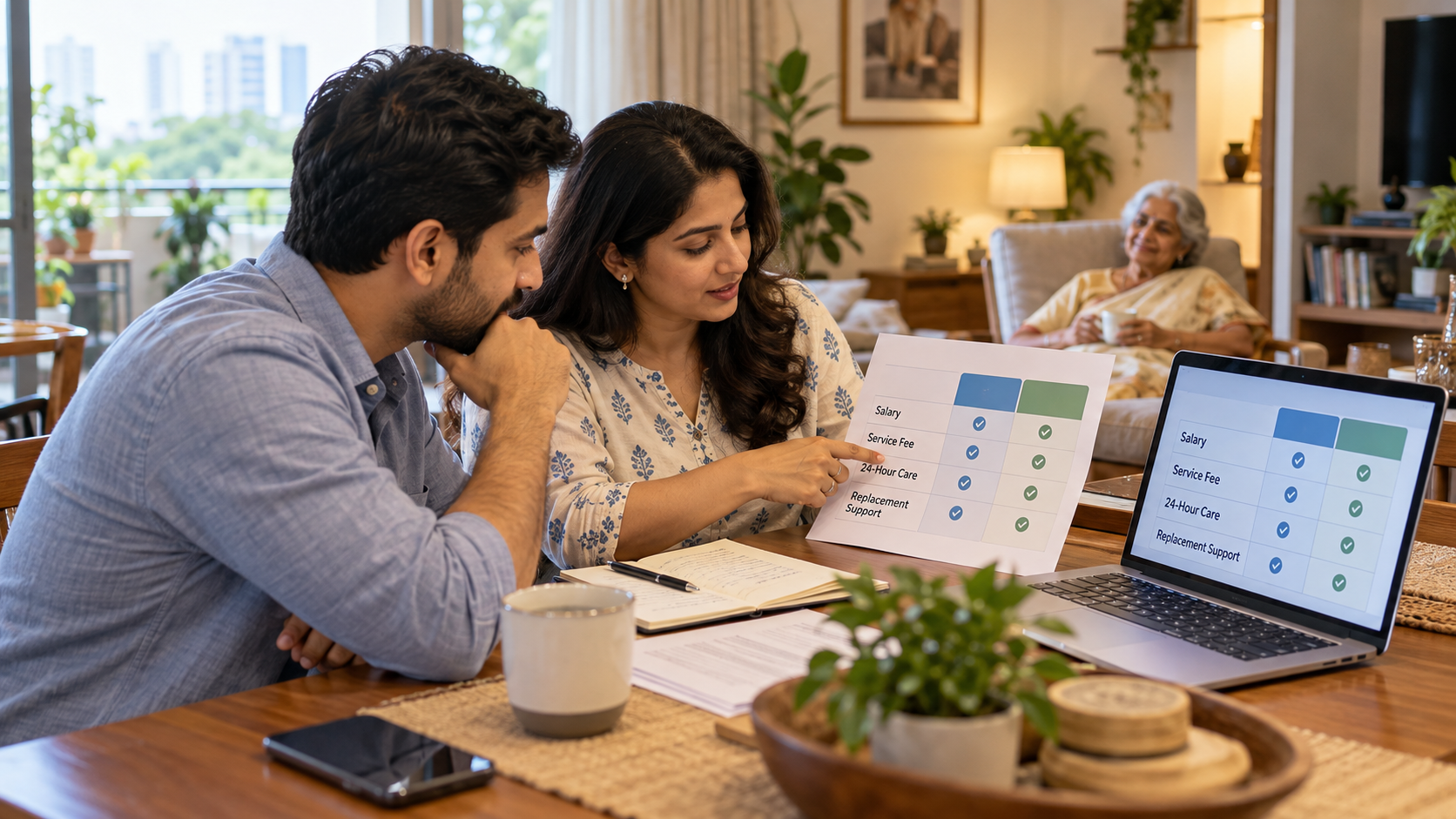
It can be. Under pricing models that include a one-time service or onboarding fee, that fee is spread across more months when the booking period is longer. MITRA's current Essential Daily Care listings illustrate this: the published monthly-equivalent cost decreases from approximately ₹40,000 for a one-month plan to ₹29,167 per month on a six-month plan.That does not mean every family should automatically choose six months. The expected duration of care should still make sense for the patient's situation.
Frequently asked questions
How much is a 24-hour caregiver in Bangalore per month?
Current published 2026 examples generally place live-in caregiving in roughly the ₹28,000–₹45,000+ monthly range, although lower and higher prices exist. The important distinction is whether the figure includes caregiver salary, agency fees, replacement support and ongoing care management.
How much does a live-in caretaker cost in Bengaluru?
“Live-in caretaker” and “24-hour caregiver” are often used for similar arrangements. Published Bengaluru prices currently vary from the high-₹20,000s into the ₹40,000-plus range depending on provider and service model. Always confirm whether the price represents the complete household cost or only one component.
Is food included for a 24-hour caregiver?
It depends on the provider. In MITRA's current 24-hour model, the family is expected to provide suitable meals and accommodation for the live-in caregiver. Other agencies may bundle food differently, so this should be confirmed before comparing prices.
Is a live-in caregiver cheaper than two 12-hour caregivers?
Usually, because only one primary provider is involved. However, one caregiver requires adequate sleep and cannot reasonably deliver continuous active care for 24 hours. If the patient regularly needs substantial nighttime assistance, two shifts may be the safer arrangement even if they cost more.
Is caregiver salary paid to MITRA?
Under MITRA's current model, the caregiver's monthly salary is paid directly by the family to the caregiver. MITRA's service fee is separate, and the exact salary is confirmed before the caregiver joins.
Need care at home in Bengaluru? See MITRA services.
Related articles
Home Care Guides · 19 min read
Personalised Home Care Plans: How MITRA Decides What Care a Patient Actually Needs
A home care plan should be based on what a person actually needs help with — not simply their age or diagnosis. See how MITRA assesses daily activities, mobility, nursing requirements, night needs, family support and preferences before structuring personalised home care.
Fri, 6 Nov 2026
Home Care Guides · 15 min read
Doctor-Guided Home Care at MITRA: What Doctor Check-Ins Actually Include
MITRA caregiving plans include doctor check-ins as part of ongoing home care. See what the doctor reviews, how CareTrack and LabTrack support the review, when the care plan may change, and what doctor oversight does not replace.
Thu, 5 Nov 2026
Home Care Guides · 12 min read
MITRA CareTrack Explained: How Families Receive Daily Care Updates
CareTrack is MITRA's structured daily care record for home caregiving. See what caregivers document, how families can follow day-to-day care, how vitals and concerns are tracked, and how CareTrack supports doctor reviews, escalation and continuity when caregivers change.
Wed, 4 Nov 2026