Elderly Care Services in Bengaluru: Complete Home Care Guide
Looking for elderly care at home in Bengaluru? Understand caregiver and nursing options, 12-hour vs 24-hour care, costs, provider selection and how to choose the right level of support.
Written by Mr. Rahul B S
Published Sun, 18 Oct 2026 · 8 min read
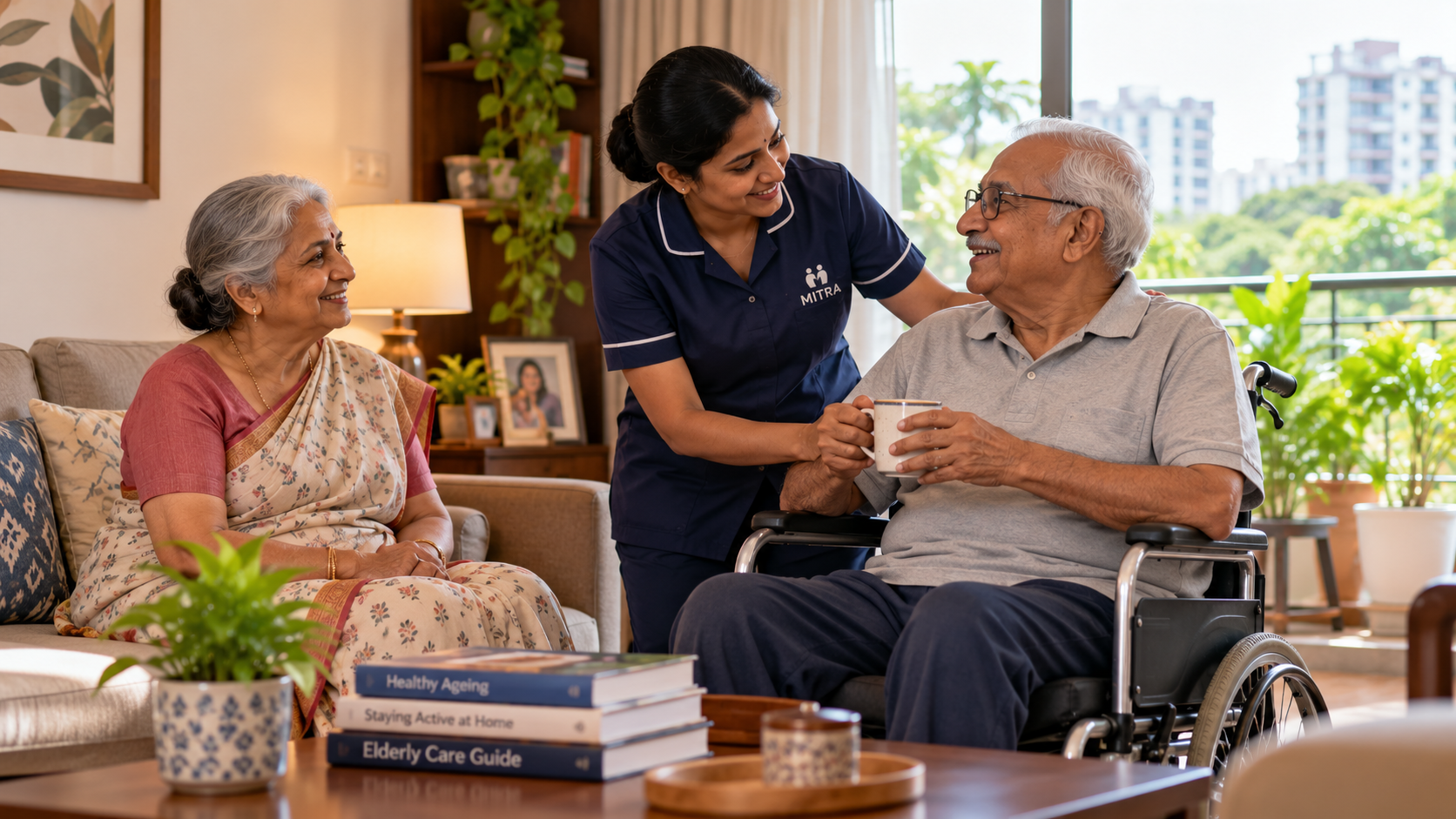
When an ageing parent begins needing help at home, families often start with one question: “What kind of care do we actually need?” The answer may be very different for someone who only needs help bathing and walking compared with someone who has dementia, is recovering from a stroke, is largely bedridden or requires nursing procedures. This guide explains the main elderly care services available at home in Bengaluru and helps families work out what level of support fits their situation.
Who is this guide for?
This guide is useful if your parent or older family member is beginning to need regular help with: - Bathing, grooming or dressing- Toileting- Walking or transfers- Meals and hydration- Medication routines- Supervision- Dementia-related safety- Recovery after hospitalisation- Nursing procedures- Rehabilitation You do not need to wait until someone becomes completely dependent before considering support.
What does elderly care at home include?
Home care is broader than simply placing someone in the house with an elderly person. Good care should be based on the person's abilities, health needs, preferences, routine and goals. WHO's current Integrated Care for Older People guidance promotes person-centred assessment and personalised care rather than treating all older adults as having the same needs. India's National Programme for the Health Care of the Elderly also recognises home-based care and rehabilitation within the broader continuum of geriatric services.
When might an elderly parent need help?
Look for changes such as: - Increasing difficulty bathing or dressing- Falls or near-falls- Difficulty getting out of bed or a chair- Forgetting medicines- Missing meals or drinking too little- New toileting difficulties- Increasing weakness after hospitalisation- Wandering or unsafe behaviour- Being unable to remain alone safely- Increasing nighttime supervision- Family members struggling to provide the required care consistently The important question is not merely whether the person is “old enough” for care, but whether everyday activities are becoming unsafe, unreliable or exhausting for the family to manage alone.
See the warning signs that an elderly parent may need additional help at home
What level of home care does your parent need?
| Level of support | Best suited for | Typical requirement | ||
| Essential Daily Care | Older adults needing routine assistance | Personal hygiene, meals, mobility, toileting, companionship and daily support | ||
| Enhanced Daily Care | People needing greater observation | Daily care plus closer monitoring, I/O awareness, pressure-area support and observation of existing devices | ||
| Comprehensive Nursing Care | Patients with regular nursing requirements | Prescribed injections/IV medicines through existing access, tube feeding, catheter care, dressings, suctioning and other nursing procedures | ||
| Advanced Nursing Care | Higher-dependency patients requiring senior nursing skills | More complex nursing care, including selected peripheral IV, Ryle's tube or urinary catheter procedures when appropriate and prescribed |
These levels should not be chosen simply according to a diagnosis. Two people who have both had a stroke, for example, may need completely different care. One may mainly need help bathing and walking, while another may require feeding-tube care and skilled nursing. The correct starting point is therefore a care-needs assessment.
Caregiver or nurse: which one do you need?
A caregiver primarily helps the person function safely through everyday life — including hygiene, toileting, meals, mobility, positioning, supervision and companionship. A nurse becomes necessary when the patient's care plan includes skilled clinical procedures or nursing-level monitoring. Choosing a nurse when caregiving is sufficient can unnecessarily increase the level and cost of care. Asking a caregiver to perform nursing procedures they are not qualified to perform creates the opposite problem.
Compare caregiver and nursing responsibilities before choosing a service
12-hour or 24-hour elderly care?
| Consider 12-hour care when… | Consider 24-hour care when… | ||
| Help is mainly needed during a defined part of the day | The person cannot safely remain alone across day and night | ||
| Family can reliably cover the remaining hours | Family cannot provide consistent supervision outside the shift | ||
| Most bathing, meals and mobility happen during one shift | Assistance is required throughout the full daily routine | ||
| Nighttime is generally safe and manageable | Nighttime supervision may also be required | ||
| The patient's dependency is predictable | Dependency is high or supervision needs are continuous |
Use our detailed 12-hour vs 24-hour caregiving comparison
Different problems need different care plans
“Elderly care” can mean very different things depending on what has changed. Rather than putting every condition into one generic package, use the relevant guide below for the problem your family is dealing with.
For a person who spends most or all of the day in bed
How MITRA elderly care works
- 1. Understand the patient's needs — daily activities, mobility, toileting, feeding, cognition, monitoring, clinical requirements and nighttime needs are reviewed.
- 2. Understand family preferences — including relevant language, gender and other practical preferences.
- 3. Match from the active provider pool — suitable trained and verified providers are identified.
- 4. Share matching options — families are typically given around four appropriate provider options.
- 5. Talk to the providers — the family can directly speak with or interview the shortlisted candidates.
- 6. Choose the preferred provider — the caregiver or nurse also agrees to the placement.
- 7. Coordinate joining — MITRA helps organise the start of care.
- 8. Continue supporting the care plan — the relationship does not end once a provider joins.
Providers are prepared before placement
MITRA's provider pathway starts before the family receives a shortlist. Eligible caregivers and nurses undergo initial screening and MITRA training. Providers then undergo external verification processes that can include identity and document checks, educational qualification verification and background or police verification as applicable. Only suitable providers enter the active pool used for matching.
What happens after the caregiver joins?
MITRA operates as a managed home-care service, rather than ending involvement once the family selects a provider. Depending on the selected plan, ongoing support can include CareTrack monitoring, LabTrack where applicable, communication with the caregiver and family, scheduled clinical oversight, escalation support and reassessment when the patient's requirements change. If a family is dissatisfied with a placement, MITRA's replacement policy provides up to two free dissatisfaction replacements. Provider abandonment situations receive continued replacement support under the applicable policy.
How much does elderly care cost in Bengaluru?
There is no meaningful single “elderly care price.” The cost depends primarily on: - Whether care is 12-hour or 24-hour- Whether the patient needs caregiving or nursing- The skill level required- The booking duration- Whether specialised procedures are involved Rather than reproducing pricing tables here — which would duplicate the dedicated cost guides and become difficult to keep synchronised — use the two pages below.
Compare typical home caregiver and nursing costs in Bengaluru
How should you choose an elderly care service?
- How providers are screened
- Whether training happens before placement
- What verification is performed
- Whether the family can speak with the proposed caregiver
- Whether duties are clearly defined
- What happens when the patient's needs change
- How complaints are escalated
- Whether replacement support is available
- Who remains responsible after the provider joins
- Whether nursing procedures are matched to appropriately skilled professionals
Use our checklist before choosing a home-care provider
Prepare the home before care begins
Once the provider has been selected, organise the patient's routine, medicines, emergency contacts, care supplies, walking and transfer areas and household expectations before the first shift. For a live-in caregiver, the family also needs to prepare appropriate meals, accommodation, sleeping arrangements, bathroom access, storage and privacy. These details deserve their own checklist rather than being repeated here.
When is home care not enough?
Home caregiving and nursing are not substitutes for hospital treatment when an older person becomes acutely unwell. New severe breathlessness, suspected stroke or heart attack, major bleeding, loss of consciousness, seizures or another significant deterioration requires urgent medical assessment. Likewise, ICU-level treatments such as invasive ventilation, vasopressor support or central-line insertion are not routine home-care services. The safest home-care plan includes a clear understanding of what can be managed at home and when escalation is necessary.
Frequently asked questions
Can elderly parents continue living at home instead of moving to a care facility?
Often, yes. Whether living at home remains appropriate depends on the person's functional ability, medical needs, cognition, environment, family support and the level of professional help available. The objective should be a safe and sustainable arrangement rather than keeping someone at home at any cost.
Does an elderly person automatically need a nurse?
No. Many older adults primarily need help with daily living and are appropriately supported by trained caregivers. Nursing is required when skilled clinical procedures or nursing-level assessment and monitoring are part of the care plan.
Can we interview the caregiver before they join?
Yes. With MITRA, families can speak directly with shortlisted matching providers before selecting whom they are comfortable proceeding with. This allows both the family and provider to understand the requirements before the placement starts.
Can the care level change later?
Yes. Elderly-care requirements can increase or decrease after rehabilitation, illness, hospitalisation or changes in mobility and cognition. The plan should therefore be reassessed when the patient's needs materially change rather than automatically continuing the original arrangement.
Looking for elderly care services in Bengaluru?
Need care at home in Bengaluru? See MITRA services.
Related articles
Home Care Guides · 19 min read
Personalised Home Care Plans: How MITRA Decides What Care a Patient Actually Needs
A home care plan should be based on what a person actually needs help with — not simply their age or diagnosis. See how MITRA assesses daily activities, mobility, nursing requirements, night needs, family support and preferences before structuring personalised home care.
Fri, 6 Nov 2026
Home Care Guides · 15 min read
Doctor-Guided Home Care at MITRA: What Doctor Check-Ins Actually Include
MITRA caregiving plans include doctor check-ins as part of ongoing home care. See what the doctor reviews, how CareTrack and LabTrack support the review, when the care plan may change, and what doctor oversight does not replace.
Thu, 5 Nov 2026
Home Care Guides · 12 min read
MITRA CareTrack Explained: How Families Receive Daily Care Updates
CareTrack is MITRA's structured daily care record for home caregiving. See what caregivers document, how families can follow day-to-day care, how vitals and concerns are tracked, and how CareTrack supports doctor reviews, escalation and continuity when caregivers change.
Wed, 4 Nov 2026