MITRA Home Care Pricing in Bengaluru: 12-Hour & 24-Hour Plans
Understand how MITRA home-care pricing works in Bengaluru, including 12-hour and 24-hour plans, provider salaries, one-time service fees and why longer plans have a lower effective monthly cost.
Written by Mr. Rahul B S
Published Wed, 14 Oct 2026 · Updated Wed, 14 Oct 2026 · 9 min read

MITRA uses a pricing model that separates the provider's salary from MITRA's service fee. Instead of collecting one large monthly package and paying the caregiver or nurse on the family's behalf, the family pays the provider's salary directly to the provider each month. MITRA charges a one-time service fee for the selected booking period, covering the managed-care services around screening, training, verification, matching, care coordination and replacement support.This page explains exactly how that structure works.
How MITRA calculates the monthly cost
The monthly figure shown on MITRA's service pages is an effective monthly cost. It combines the provider's salary across the booking period with MITRA's one-time service fee. The calculation is: Effective monthly cost = Total provider salaries during the plan + MITRA one-time service fee ÷ Number of months This is why a longer booking can have a lower effective monthly cost even though the provider continues receiving their normal salary every month.
12-hour home-care pricing
| MITRA service | 1 month | 3 months | 6 months | ||
| Essential Daily Care | ≈ ₹35,000/month | ≈ ₹26,667/month | ≈ ₹24,167/month | ||
| Enhanced Daily Care | ≈ ₹40,000/month | ≈ ₹31,667/month | ≈ ₹30,000/month | ||
| Comprehensive Nursing Care | ≈ ₹45,000/month | ≈ ₹38,333/month | ≈ ₹35,833/month | ||
| Advanced Nursing Care | ≈ ₹55,000/month | ≈ ₹50,000/month | ≈ ₹47,500/month |
A 12-hour plan provides one dedicated shift each day during the booked period. Depending on the agreed schedule and provider availability, this can be arranged as a day shift or night shift. Care outside that 12-hour shift is not included, so the family should consider who will support the patient during the remaining hours.
24-hour home-care pricing
| MITRA service | 1 month | 3 months | 6 months | ||
| Essential Daily Care | ≈ ₹40,000/month | ≈ ₹31,667/month | ≈ ₹29,167/month | ||
| Enhanced Daily Care | ≈ ₹45,000/month | ≈ ₹36,667/month | ≈ ₹35,000/month | ||
| Comprehensive Nursing Care | ≈ ₹50,000/month | ≈ ₹43,333/month | ≈ ₹40,833/month | ||
| Advanced Nursing Care | ≈ ₹60,000/month | ≈ ₹55,000/month | ≈ ₹52,500/month |
What salary does the provider receive?
| MITRA service | 12-hour provider salary | 24-hour provider salary | ||
| Essential Daily Care | ₹20,000/month | ₹25,000/month | ||
| Enhanced Daily Care | ₹25,000/month | ₹30,000/month | ||
| Comprehensive Nursing Care | ₹30,000/month | ₹35,000/month | ||
| Advanced Nursing Care | ₹40,000/month | ₹45,000/month |
The provider salary is paid directly by the family to the provider. The first salary becomes due after the first completed month of service and continues monthly on the corresponding joining date. This direct-payment model makes it clear what portion of the overall cost is going to the person actually providing the care.
What is MITRA's one-time service fee?
MITRA's service fee depends on both the care level and the length of the booking. It is separate from the provider's monthly salary.
| MITRA service | 1-month plan | 3-month plan | 6-month plan | ||
| Essential Daily Care | ₹15,000 | ₹20,000 | ₹25,000 | ||
| Enhanced Daily Care | ₹15,000 | ₹20,000 | ₹30,000 | ||
| Comprehensive Nursing Care | ₹15,000 | ₹25,000 | ₹35,000 | ||
| Advanced Nursing Care | ₹15,000 | ₹30,000 | ₹45,000 |
Why are longer plans cheaper per month?
The provider's salary does not become cheaper simply because the family books for longer. The reduction comes mainly because MITRA's one-time service fee is spread over more months. For example, consider 24-hour Essential Daily Care for six months.
| Component | Amount | ||
| Provider salary | ₹25,000 × 6 months | ||
| Total provider salary | ₹1,50,000 | ||
| MITRA service fee | ₹25,000 | ||
| Total 6-month cost | ₹1,75,000 | ||
| Effective monthly cost | ≈ ₹29,167/month |
The family still pays the caregiver ₹25,000 each month. The approximately ₹29,167 figure simply represents the average total monthly cost after spreading the one-time service fee across six months. This is also why comparing only a provider's monthly salary with MITRA's advertised effective monthly price would not be a like-for-like comparison.
What are the four MITRA care levels?
Essential Daily Care
For patients who primarily need help with everyday activities such as bathing, grooming, toileting, feeding, walking, transfers, medication reminders and supervision, without regular nursing procedures.
Enhanced Daily Care
For patients who need everyday caregiving plus closer observation, basic vital-sign monitoring, structured intake/output tracking when required, pressure-area support and observation of existing devices.It remains a caregiving service rather than regular procedural nursing care.
Comprehensive Nursing Care
For patients who require skilled nursing in addition to daily support — for example prescribed injections, appropriate IV medication through existing access, tube feeding, catheter or line care, wound care, suctioning or tracheostomy care when included in the care plan.
Advanced Nursing Care
For patients whose care requires a more experienced nursing provider and higher-level procedural competency, including selected new or replacement invasive procedures when clinically appropriate and prescribed. The care level should be chosen according to what the patient actually needs, not simply the patient's diagnosis.
See which MITRA care level may be appropriate for your family
What does the MITRA service fee include?
The service fee pays for the managed-care system surrounding the provider placement.Depending on the selected plan, this includes services such as:
- Initial assessment of the patient's care requirements
- Provider screening
- Caregiving and role-specific training
- Background and document verification
- Matching providers to the patient's needs
- Matching language, gender and other relevant family preferences
- Shortlisting suitable providers
- Family interviews before selection
- Joining coordination
- Personalised care planning
- Ongoing CareTrack oversight
- LabTrack where applicable
- Communication with the provider
- Communication with the family
- Scheduled doctor oversight according to the care plan
- Complaint and escalation support
- Replacement coordination
See how MITRA prepares and matches providers before placement
How does provider selection work?
MITRA does not automatically assign whichever provider happens to be available. Once the patient's needs and family preferences are understood, suitable providers are selected from MITRA's trained and verified provider pool. The family is typically shown several matching options and can speak with and interview the shortlisted providers before choosing whom they want to proceed with. The provider also understands the requirements before accepting the placement.
When do you pay MITRA?
- Request the service for ₹0.
- MITRA speaks with the family and assesses the requirement.
- Suitable provider profiles are shortlisted.
- The family interviews and selects a provider.
- MITRA confirms the final care arrangement and pricing.
- The MITRA service fee is paid through the secure payment process.
- The provider joins on the agreed date.
- Provider salary is paid directly by the family after each completed month.
What happens if the caregiver is not suitable?
MITRA's current managed-care model includes two free dissatisfaction-based replacements during the booked plan. If the family says the provider is not working out, MITRA identifies other suitable providers, shares new options and allows the family to go through the selection process again. If a provider unexpectedly stops reporting or abandons the placement, MITRA handles this separately through its abandonment replacement support. Current MITRA service pages also describe continued care coordination and replacement support throughout the booked period.
What is different about 24-hour plans?
For live-in 24-hour care, the family also provides the practical living arrangements required for the provider. These include: - Suitable meals- Sleeping accommodation or mattress- Washroom access- Basic storage space- Reasonable privacy- A safe working environment These household provisions are not part of the provider salary or MITRA service fee calculation. MITRA's current 24-hour service information states these live-in requirements explicitly
See the detailed cost breakdown for live-in 24-hour care
How should you choose between 1, 3 and 6 months?
The longest plan is not automatically the right plan simply because its effective monthly cost is lower. Consider how long the patient is realistically expected to need care.A one-month plan may make sense during a short recovery period. A three-month plan may suit a longer rehabilitation or temporary dependency. Six-month care may make more sense when the patient's need is expected to continue for a prolonged period. Choose the duration based on the care requirement first and the monthly saving second.
What happens if care needs change?
Home-care needs can evolve. A patient who initially requires only bathing and mobility assistance may later develop a wound, feeding-tube requirement, catheter requirement or other clinical need. MITRA can reassess the required care level rather than expecting the existing provider to perform procedures outside their training or competence. Where appropriate, a family may move from a caregiving level to nursing support.
Frequently asked questions
Is MITRA's monthly price the caregiver's salary?
No. The published effective monthly figure combines the provider's salary with the one-time MITRA service fee spread across the selected booking duration. The provider's salary itself is paid directly by the family each month.
Why does the six-month plan look cheaper per month?
Because the one-time MITRA service fee is distributed across six months when calculating the effective monthly cost. The provider continues receiving the agreed monthly salary throughout the booking.
Do I have to pay before seeing caregiver options?
No. MITRA currently allows families to request a booking for ₹0. The requirement is assessed and suitable profiles are shared before the care arrangement and payment are finalised.
Can I choose my caregiver or nurse?
Yes. MITRA matches providers to the patient's needs and family preferences, and families can speak with shortlisted providers before selecting the person they want to proceed with.
Are nursing and caregiving priced the same?
No. Nursing plans cost more because they require providers with additional clinical qualifications and competencies. The appropriate level should be based on the tasks that must actually be performed at home.
Are these prices permanent?
No. Service pricing can change over time. Families should confirm the current price on the relevant MITRA service page or with the MITRA team before booking.Pricing in this guide reviewed: October 2026.
Need care at home in Bengaluru? See MITRA services.
Related articles
Home Care Guides · 19 min read
Personalised Home Care Plans: How MITRA Decides What Care a Patient Actually Needs
A home care plan should be based on what a person actually needs help with — not simply their age or diagnosis. See how MITRA assesses daily activities, mobility, nursing requirements, night needs, family support and preferences before structuring personalised home care.
Fri, 6 Nov 2026
Home Care Guides · 15 min read
Doctor-Guided Home Care at MITRA: What Doctor Check-Ins Actually Include
MITRA caregiving plans include doctor check-ins as part of ongoing home care. See what the doctor reviews, how CareTrack and LabTrack support the review, when the care plan may change, and what doctor oversight does not replace.
Thu, 5 Nov 2026
Home Care Guides · 12 min read
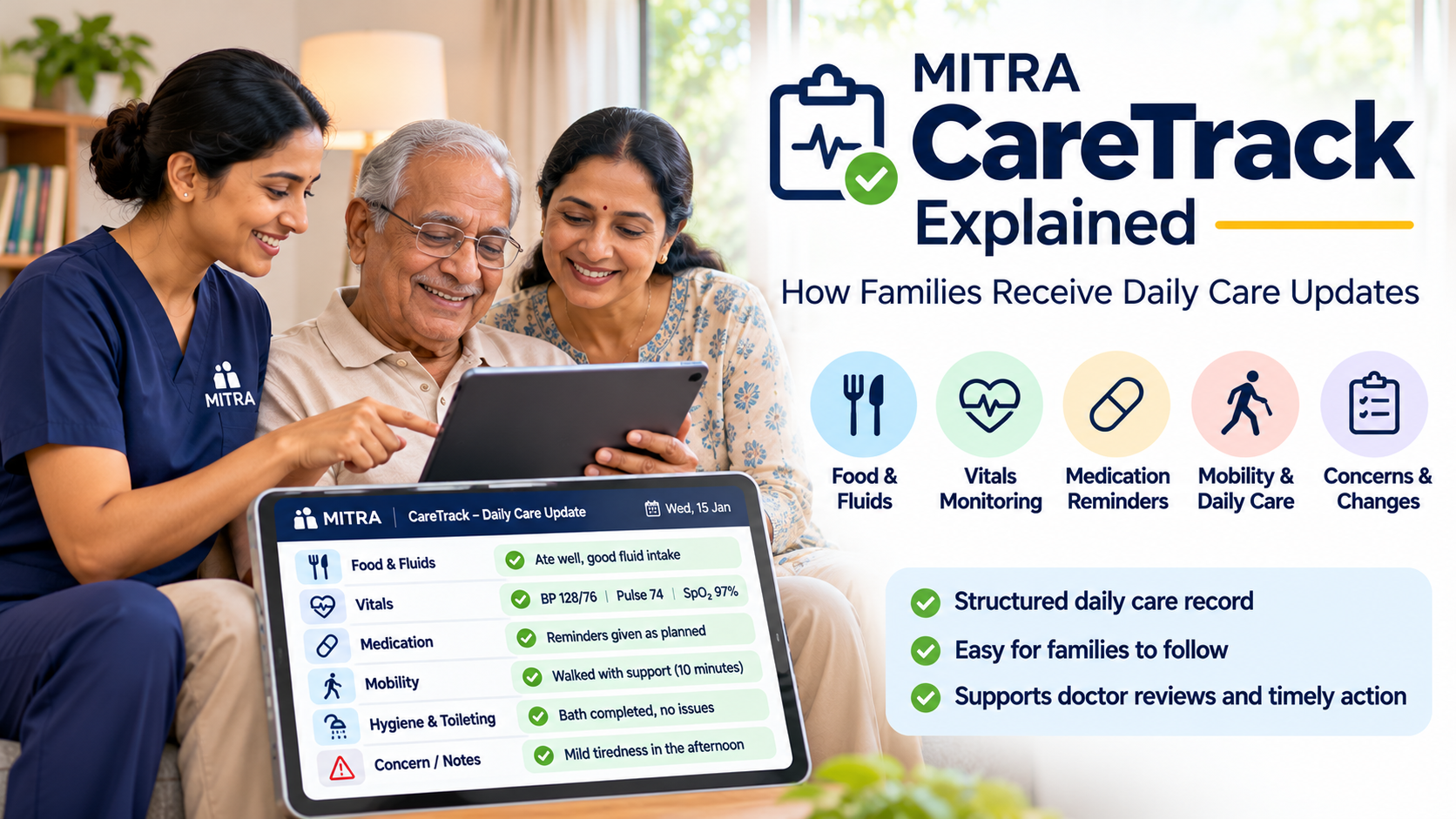
MITRA CareTrack Explained: How Families Receive Daily Care Updates
CareTrack is MITRA's structured daily care record for home caregiving. See what caregivers document, how families can follow day-to-day care, how vitals and concerns are tracked, and how CareTrack supports doctor reviews, escalation and continuity when caregivers change.
Wed, 4 Nov 2026